







Key Takeaways
- HyperAutomation extends traditional automation by integrating AI, ML, and NLP—enabling systems to process unstructured data, make dynamic decisions, and adapt intelligently to evolving business needs.
- While traditional automation is ideal for structured, repetitive tasks, HyperAutomation is suited for end-to-end process orchestration, especially where multiple systems, exceptions, and human decisions are involved.
- Architecture is critical in automation, scalability, reliability, and adaptability. HyperAutomation’s cloud-native, API-driven, and event-based design outperforms traditional UI-based RPA bots.
- Intelligence and analytics give HyperAutomation a strategic edge. Real-time monitoring, process mining, and predictive insights replace static logs and manual troubleshooting in legacy systems.
- Businesses should adopt a phased approach, starting with RPA and gradually evolving into HyperAutomation to handle complexity, reduce manual interventions, and prepare for future growth.
Automation has helped businesses speed up processes and cut costs in the last decade. But as expectations rise and technology moves faster, many companies ask the same question: Is traditional automation enough anymore?
Enter HyperAutomation—a term that sounds futuristic, and honestly, it is. But it’s also genuine and already changing how businesses work. If you’ve heard these terms tossed around—traditional automation, RPA, HyperAutomation, AI bots—but weren’t sure how they all fit together technically, this blog is for you.
We’ll examine both approaches and how their technical setups differ, helping you understand why businesses are shifting toward more intelligent, flexible systems.
Let’s keep it simple and human all the way through.
First, What Are We Comparing?
Before getting technical, we need to be clear about these two things.
Traditional Automation (a.k.a. RPA)
This is where it all started for many companies. Traditional automation usually involves setting up bots or scripts that follow set instructions. These bots are good at handling repetitive, rule-based tasks. Think of them like highly obedient interns—they do exactly what you tell them but don’t think for themselves.
You might use traditional automation to:
- Move data from one system to another
- Generate reports every week.
- Fill out the online forms.
- Copy-paste information from emails into spreadsheets
It’s effective, but very limited.
HyperAutomation
HyperAutomation takes that basic automation idea and levels it up by adding artificial intelligence, machine learning, natural language processing, process mining, and even AI agents. Instead of just doing what they’re told, these systems can analyze, decide, and improve their work over time.
With HyperAutomation, you can:
- Understand and process unstructured data like scanned documents or emails
- Make real-time decisions using data patterns.
- Let multiple bots and AI models collaborate on a task.
- Handle complex processes from start to finish with minimal human help
Why Architecture Matters?
Architecture might sound like a boring technical term, but it’s crucial. The way a system is built determines
- How flexible it is
- How much can it handle?
- Whether it breaks down when things change
- How quickly can you scale it up
Let’s compare how traditional automation and HyperAutomation are built behind the scenes.
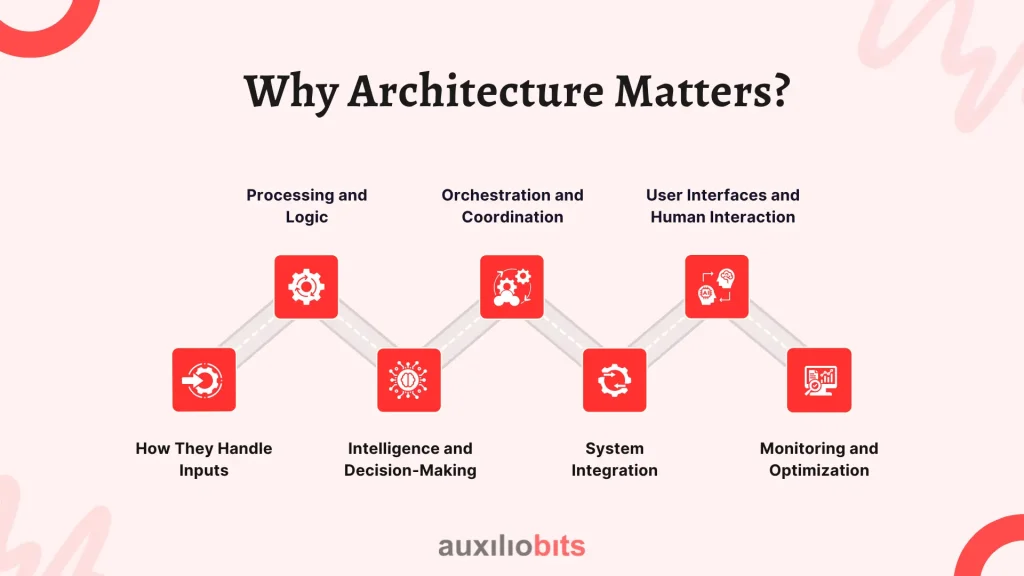
1. How They Handle Inputs
Traditional Automation: Traditional bots need neat things. They like clean spreadsheets, fixed-form templates, or well-structured database entries. They usually choke if you give them a PDF or a poorly written email.
HyperAutomation: These systems are much better at handling real-world mess. You can throw in emails, scanned invoices, audio messages, or even chat transcripts—and they can often figure out what to do. Thanks to tools like OCR (optical character recognition), NLP (natural language processing), and even generative AI, HyperAutomation is built for chaos.
Real example: Imagine you get 500 invoices every month in different formats.
- Traditional bots: You need to build templates for each one.
- HyperAutomation: The system learns patterns and adjusts as it goes.
2. Processing and Logic
Traditional Automation: These systems rely on strict rules. If you’ve ever used an “if this, then that” setup, you’ve seen how rigid this can be. Bots follow a sequence and don’t adapt unless you go back and reprogram them.
HyperAutomation: HyperAutomation tools can decide based on conditions, historical patterns, or real-time data. Instead of sticking to a script, they can “think” and adjust on the fly.
Real example: A customer emails support with a refund request.
- Traditional bot: Checks for keywords and forwards the request.
- HyperAutomation: It understands the customer’s intent, checks their purchase history, calculates refund eligibility, and processes it, or asks a human if unsure.
3. Intelligence and Decision-Making
Traditional Automation: There’s no real intelligence here. Bots just follow rules. They won’t catch unusual patterns, and they definitely won’t warn you if something feels off.
HyperAutomation: Now we’re talking. These systems bring in machine learning models and even predictive analytics. They can learn from past data, detect anomalies, and improve outcomes.
Real example: Detecting fraudulent insurance claims
- Traditional bot: Looks for a few red flags based on rules.
- HyperAutomation: Analyzes previous fraud patterns, predicts risk level, and flags questionable cases for review
4. Orchestration and Coordination
Traditional Automation: Usually, bots run in isolation. You need an orchestrator to assign them tasks, and even then, the process is often rigid and pre-scheduled. If one bot fails, the system might just stop.
HyperAutomation: In this setup, there’s often a central brain—an intelligent orchestrator coordinating tasks between bots, humans, and AI agents. It can dynamically assign tasks, pause when human input is needed, and even reroute tasks when something fails.
Real example: Approving a business loan
- Traditional: One bot pulls credit, another checks documents, and another creates reports—but the sequence is fixed.
- HyperAutomation: An AI agent checks eligibility, assigns tasks to different bots, asks a human for review, and completes the application all in one flow.
5. System Integration
Traditional Automation: These bots usually interact through user interfaces (UI), like humans clicking buttons or filling out forms. This makes them fragile—the bot breaks if a button moves or changes. They can also use APIs, but it’s not always easy.
HyperAutomation: HyperAutomation platforms rely on deeper integrations using APIs, webhooks, data streams, and microservices. They can instantly pull data from anywhere—cloud platforms, ERP systems, CRMs—and act on it.
Real example: When a sale is made
- Traditional: A bot logs into three systems to update sales records
- HyperAutomation: An event-driven workflow updates all systems through APIs instantly
6. User Interfaces and Human Interaction
Traditional Automation: Most bots run in the background, and users rarely interact with them directly. If you need a manual trigger or input, it usually comes from a dashboard or control room.
HyperAutomation: The user experience is much richer here. HyperAutomation platforms include chatbots, AI assistants, voice-enabled tools, and “human-in-the-loop” controls where humans can jump in when needed.
Real example: A customer asks about their delivery status
- Traditional: Sends a canned message.
- HyperAutomation: AI chatbot checks shipping data and delivery history, and responds with an accurate status and expected delivery time
7. Monitoring and Optimization
Traditional Automation: Monitoring is often limited to logs, alerts, and reports. You know if something breaks, but you don’t get much insight into how well the system performs or what can be improved.
HyperAutomation: These systems provide real-time dashboards, track process KPIs, and suggest new automation opportunities. They use process mining to map out how work gets done and task mining to see how employees interact with systems.
Real example: Your expense approval process is slowing down
- Traditional: You see delays but don’t know why
- HyperAutomation: It identifies the bottleneck (e.g., one approver taking too long) and suggests a fix
Side-by-Side Summary Table
| Area | Traditional Automation | HyperAutomation |
| Input Handling | Needs clean, structured data | Handles messy, unstructured data |
Logic and Rules | Static, pre-defined flows | Dynamic, AI-based decisions |
Intelligence | Rule-based only | Learns from data, predicts outcomes |
| Orchestration | Sequential, limited collaboration | Intelligent, real-time coordination |
| Integration | UI and basic API | Full API, event-based, cloud-native |
| Human Interaction | Basic dashboards | AI chatbots, voice, human-in-loop |
| Monitoring & Feedback | Logs and alerts | Analytics, process mining, optimization |
When to Use What?
You don’t always need HyperAutomation. Sometimes, traditional automation is just right.
Use Traditional Automation when:
- The task is simple and repeatable
- You have structured data.
- Speed of setup is more critical than scalability.
- You’re just getting started with automation.
Use HyperAutomation when:
- Your processes involve multiple systems and decision points
- You need to work with messy, real-world data.
- Your goal is complete digital transformation, not just task automation.
- You want to future-proof your automation investments
Final Thoughts
The truth is, most businesses don’t jump straight into HyperAutomation. They start with traditional RPA, see some wins, and then slowly build out smarter, more integrated systems. That’s the natural evolution.
But as your processes become more complex and customer expectations rise, sticking with old-school automation may not cut it. HyperAutomation brings the flexibility, intelligence, and scale you’ll need to thrive in the long run.
It’s not just about doing things faster—it’s about doing things smarter.