







Key Takeaways
- Chat agents are now critical infrastructure in BFSI, handling surges, maintaining compliance, and lowering per-interaction costs while meeting the expectations of a digitally native customer base.
- Layered deployment is essential—from instant data retrieval (Tier 0) to guided processes (Tier 1) and pre-triage before human escalation (Tier 2), ensuring efficiency without sacrificing quality.
- BFSI enjoys structural advantages—structured data, rigid processes, and a customer preference for formal accuracy—making chat agents more reliable here than in sectors like retail or travel.
- Technology orchestration is the differentiator—without secure integrations, a domain-tuned NLP, and a decision-routing layer, chat agents become “polite FAQ widgets” instead of operational assets.
- Success is measured beyond containment rates—real impact comes from higher first-contact resolution, shorter resolution times, compliance accuracy, and reduced customer effort.
Walk into any bank branch on a Monday morning and you’ll see it: the queue that refuses to move, the customer trying to dispute a charge with a stack of printed statements, and the frustrated teller doing three jobs at once. Now translate that scene into the digital realm—thousands of customers hitting online banking or mobile apps at the same time, each with a different urgency level.
This is the day-to-day battlefield for BFSI customer support. And while the industry has been layering on self-service portals for years, chat agents—human-assisted or AI-driven—have quietly become the workhorses that take the edge off the chaos.
Not as PR-friendly as a shiny new app launch, but far more impactful in the trenches.
Also read: AI Agents for Regulatory Compliance Monitoring in Banking
Why Banks and Insurers Are Betting on Chat Agents
Officially, the story is about “improving the customer experience.” Unofficially, the drivers are sharper and more pragmatic:
- Handling unpredictable surges—Tax filing season, market volatility, and even a bad headline about a competitor can spike inquiries in hours. You can’t triple your call center overnight, but you can scale AI-driven chat.
- Keeping compliance in check – A human under pressure might promise something that bends the rules; a programmed agent won’t.
- Lowering per-contact costs – A voice call can cost multiple dollars. An automated exchange, even with advanced NLP, is a fraction of that.
- Meeting new communication norms – A growing chunk of customers—especially under 35—would rather type than talk.
Interestingly, compliance teams often turn from skeptics to advocates once they see how clean, timestamped, and retrievable every AI chat exchange is.
Where Chat Agents Fit in BFSI Operations
The fantasy is a single all-knowing bot. The reality? Chat agents work best when they live inside a layered support model:
1. Instant Data Access (Tier 0)
- Balance checks.
- Loan due dates.
- Insurance coverage limits—pulled directly from live systems.
2. Step-by-Step Guidance (Tier 1)
- Walking a user through digital KYC submission.
- Guiding a claim form upload without missing mandatory fields.
3. Pre-Triage for Humans (Tier 2)
- Collects account history, transaction IDs, and complaint details—before a human joins the chat.
- Flags potential fraud or high-risk cases for priority routing.
This setup does more than reduce call volumes; it keeps skilled agents from drowning in repetitive, low-value interactions.
Why BFSI Gets More Mileage Out of Chat Agents Than Retail or Travel
There’s a structural advantage here:
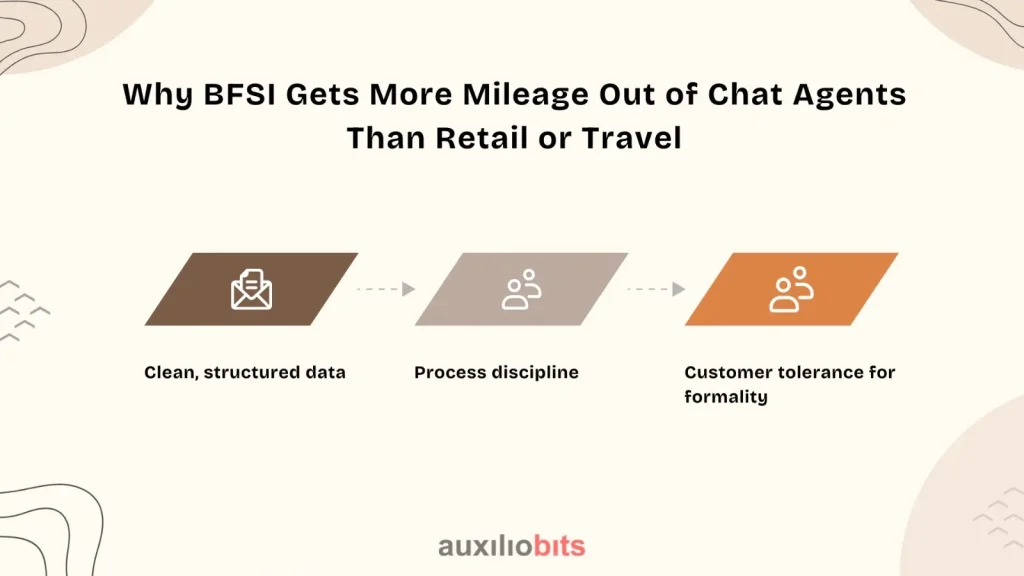
- Clean, structured data – Account records, transactions, and policies follow strict formats, making automation more reliable.
- Process discipline—Banking and insurance workflows leave less room for improvisation, which suits rule-driven bots.
- Customer tolerance for formality—No one expects a credit union chatbot to make jokes; they expect it to be accurate and secure.
The trade-off? Zero room for fuzzy answers. A bot that “thinks” your policy is active but isn’t will cost more in goodwill than any operational savings.
The Technology Stack That Works
The most resilient deployments aren’t a single chatbot widget—they’re multi-layered systems:
- Domain-tuned NLP/NLU – Off-the-shelf large language models are often narrowed with BFSI-specific vocabulary.
- An orchestration brain—routes queries between different APIs, CRMs, and compliance systems while logging every decision for audits.
- Secure integration gateways—direct hooks into core banking or policy platforms.
- Fallback rules—Immediate escalation to a human if the bot hits a dead-end or detects a sensitive scenario.
Strip out the orchestration layer, and you end up with a bot that can talk but can’t act. That’s a common—and expensive—mistake.
Concrete BFSI Use Cases
The most valuable deployments tend to be unglamorous:
- Card fraud checks – A simple yes/no confirmation in chat can block a stolen card before it’s used again.
- Policy claim intake—Customers upload documents and get a claim ID without ever waiting in a call queue.
- Regulatory confirmations—Bots ensure that mandatory disclosures are read and acknowledged before a product is issued.
- Debt restructuring navigation—Customers in financial distress can explore repayment options without an intimidating human conversation.
Each replaces what used to be a chain of phone calls, paper forms, or in-branch appointments.
Why They Don’t Replace Humans—And Shouldn’t
Inside well-run BFSI operations, bots free people from low-value work but don’t replace them. Human teams remain vital for:
- Negotiating sensitive terms.
- Handling distressed customers.
- Spotting and acting on subtle cross-sell opportunities.
Think of it as bandwidth redistribution—routine tickets are compressed so skilled agents can focus where judgment matters.
The Common Failure Modes
When these systems go wrong, the root cause is often upstream:
- Overhyping capabilities—selling a glorified FAQ bot as “your financial concierge.”
- Integration gaps—The bot understands you but can’t take action, forcing you back to phone or email.
- Ignoring regional compliance—a script built for US banking can violate GDPR or PSD2 rules in Europe.
These missteps are preventable—but they require legal, IT, and CX teams to align from day one.
Measuring Real Impact
Containment rate is an easy vanity metric. But the BFSI leaders who get value track:
- First Contact Resolution (FCR)—Including cases closed in a bot-human combo.
- Resolution time—how quickly cases are completed, not just acknowledged.
- Compliance accuracy—percentage of bot-handled interactions without policy breaches.
- Customer Effort Score (CES)—Often a stronger loyalty predictor than NPS in support contexts.
Without this, you risk a bot that “looks busy” but isn’t moving the needle.
Strategic Decisions That Make or Break a Rollout
- Staff buy-in – If agents feel bots are stealing cases, they’ll find ways to sideline them.
- Model governance—Language models can drift over time; in finance, that’s not just bad—it’s risky.
- Channel balance—Bots shouldn’t try to win against human support. They should win at the right kind of work.
- Downtime planning—If your fraud-report bot crashes, what’s the fallback?
The deployments that succeed treat bots as a core service delivery layer, not a bolt-on widget.
Quick Case Example
A regional bank in Southeast Asia added an AI chat module to its mobile app for loan application status, card blocking, and remittance tracking.
Six months later:
- 82% of targeted queries resolved without human intervention.
- Human handle time dropped 31%.
- Complaints about wait times fell nearly in half.
Oddly, the compliance team celebrated more than CX—they could now produce complete interaction logs in minutes during audits.
The Competitive Edge That Doesn’t Show Up in Ads
Every BFSI player can copy a feature. Copying an integrated, operationally embedded chat agent ecosystem is harder. When done right, these agents take over the daily grind while preserving human effort for the moments that shape trust.
It’s not about replacing branches or call centers. It’s about letting each channel play to its strengths—while chat handles the sheer volume of everyday “need-it-now” requests with a memory, a paper trail, and no bad days.