







Key Takeaways
- Moving from live chat to AI chat is not just a tech upgrade—it’s a shift in philosophy that must begin with a clear purpose.
- Early chatbot failures stemmed from rigid, keyword-driven flows that collapsed when customers went off-script.
- Modern AI chat thrives by retaining context, interpreting natural language, and integrating real-time business data.
- Accuracy, tone, and seamless human escalation determine whether AI chat enhances or harms the customer experience.
- The winning model is a hybrid—AI handles predictable tasks while humans resolve complex, emotional, or multi-system cases.
Somewhere between the first “Click here to chat with us” pop-ups of the late 2000s and the AI-powered assistants of today, customer service quietly reinvented itself—several times. Not always for the better. We’ve seen deployments that were hailed as the “future of support” get switched off within six months because they made the customer experience worse, not better.
The shift from live chat to AI chat isn’t just a technology upgrade. It’s a philosophical one. It asks a blunt question: Why are we automating this conversation in the first place? If the honest answer is “because it’s cheaper,” you already know how that story ends—frustrated customers, confused staff, and a support function that becomes a punchline on social media.
Also read: What Are AI Agents? A Business Leader’s Guide to Intelligent Workflows
When Live Chat Ruled
For a while, live chat was the sweet spot between slow email and interruptive phone calls.
- Customers liked it because they could multitask while getting answers.
- Businesses liked it because one agent could juggle multiple chats at once.
For example, agents averaged four concurrent chats without missing SLAs. They handled everything from “What’s your cancellation policy?” to rebooking entire family itineraries mid-flight delay.
But live chat also had its cracks:
- Hidden queues—The cheerful “You are next in line!” message meant a 12-minute wait.
- Agent fatigue—managing five conversations, updating the CRM, and hunting down answers in a knowledge base simultaneously.
- Script syndrome—Customers eventually spotted the canned replies (“I understand your concern…” repeated for the fifth time).
It worked—until volumes spiked, or until someone ran the cost-per-contact numbers and started looking for automation.
The First Bot Experiments
By the mid-2010s, “chatbot” became the buzzword. Most of these early bots were glorified decision trees. They worked fine for highly predictable queries but fell apart the moment a customer went off-script.
One retail client of mine plugged in a basic keyword-matching bot to handle order status checks. The first week, resolution rates looked promising. By week four, half the conversations ended with “Can I just speak to a human?”—because any deviation (“Where’s my package? It’s two days late.”) sent the bot into a loop.
Lesson learned: speed means nothing if it’s at the expense of relevance.
The AI Conversation Shift
Modern AI chat isn’t just an upgrade—it’s a different species. Instead of chasing keywords, it processes meaning. It can handle a follow-up question without losing track of the first one. It can integrate live data—inventory counts, policy updates, shipment tracking—into the answer on the fly.
The difference shows up in three areas
- Context memory—AI can pick up on a reference from three turns back.
- Language fluidity—Customers don’t have to guess the “magic words”; the bot understands.
- Data integration—The AI can pull a customer’s order history or contract terms into the conversation instantly.
Of course, it’s not magic. Feed it stale data or wrap it in clumsy workflows, and you’ve just created a faster way to give wrong answers.
Purpose First, Platform Second
Too many AI chat rollouts start with the tech stack and work backwards to the business goal. That’s how you end up with a system that’s impressive in demos but infuriating in real life.
The companies that get it right start with a sharper question: What problem are we trying to solve in the customer journey?
I’ve seen three “purpose anchors” work especially well:
- Extending coverage—An airline using AI to manage common rebooking requests during overnight hours, keeping humans free for complex reroutes.
- Reducing ticket volume—A SaaS firm using AI to not only fix the issue but explain how to prevent it in the future.
- Personalizing the experience— An insurer using AI to surface customer-specific policy clauses instead of sending everyone to the generic FAQ.
If your only KPI is “reduce cost per contact,” don’t be surprised when customers revolt.
Field Example: Electronics Brand, Global Scale
A consumer electronics company I advised had 120 live chat agents handling support in three languages. The same dozen queries—battery issues, warranty checks, reset instructions—accounted for most chats.
They didn’t replace the agents. Instead, they layered AI in front for those repeat questions:
- Model-specific answers—pulled directly from the product knowledge graph.
- Mid-chat escalation—AI could hand off to a human without losing the conversation thread.
Within six months, first-contact resolution on those common issues jumped from 45% to 78%. The human agents? They were redeployed to outbound campaigns for loyalty customers. The net effect wasn’t job loss—it was a better use of skills.
The Details That Make or Break It
From watching AI chat in the wild, a few truths stand out:
- People will test the bot—expect random, off-topic, and even sarcastic inputs.
- Data accuracy is critical—an AI giving last year’s refund policy is worse than no AI at all.
- Tone takes tuning—”Sure thing!” might work for a retail order, but sounds glib in a medical insurance claim.
- Escalation should feel natural—no “Please call this number instead” dead ends.
Where AI Still Stumbles
Even the best deployments have limits:
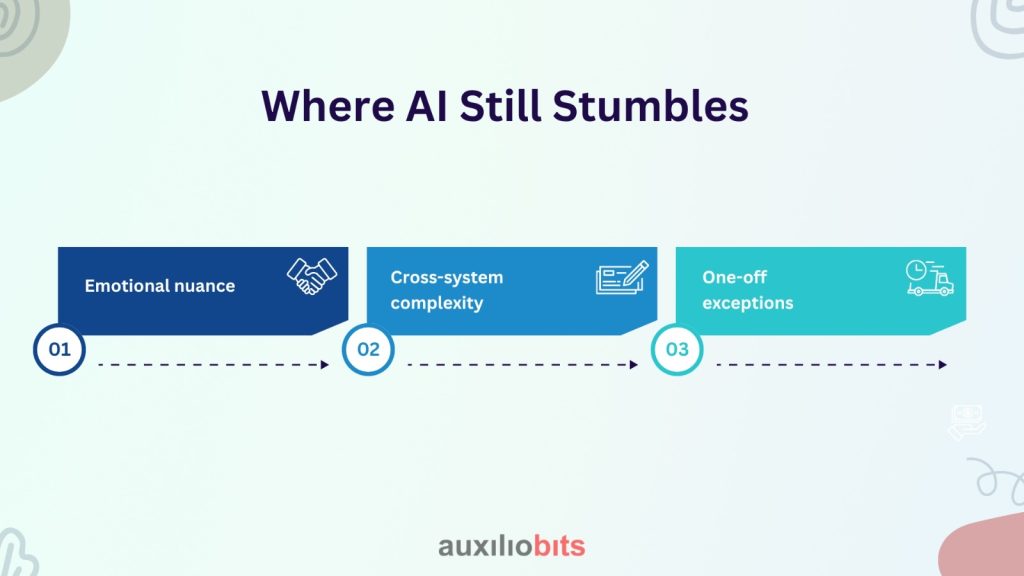
- Emotional nuance—AI can mimic empathy but not truly navigate grief, anger, or sensitive personal situations.
- Cross-system complexity—troubleshooting that spans ERP, CRM, and legacy apps is still a human forte.
- One-off exceptions—Rare but critical cases require judgment that AI can’t reliably fake.
These aren’t flaws—they’re reminders that AI should complement, not replace, skilled support staff.
Practical Build Advice
For those steering a move from live to AI chat, hard-won lessons include:
- Start small—prove it on one clear use case.
- Mine chat logs—find the repeatable patterns.
- Connect to live systems—avoid generic, knowledge-base-only responses.
- Preserve context when escalating—make the human handoff invisible to the customer.
- Define success in CX terms, not just cost terms.
And yes—train your human agents to work with AI, not around it.
The Likely Future
The “AI will replace humans” line misses the point. The most efficient models today are hybrid:
- AI handles the 80% that’s repetitive and predictable.
- Humans tackle the 20% that’s ambiguous, emotional, or cross-functional.
The line between them isn’t fixed; as AI learns from human interventions, its range grows. But the partnership remains.
Customers don’t care whether they’re talking to a bot or a person. They care that:
- They get the right answer.
- They get it quickly.
- They don’t have to repeat themselves.
If automation helps you hit all three, they’ll come back. If not, they’ll find someone else.
Conclusion
The journey from live chat to AI chat is more than a story of tools evolving—it’s a shift in how businesses view customer conversations. Where early experiments often chased efficiency at the cost of experience, today’s best deployments recognize that speed, relevance, and empathy must coexist. AI brings context memory, data integration, and scalable coverage, but it doesn’t replace the human touch needed for complex, emotional, or high-stakes interactions.
The companies that succeed are those that treat AI chat as a strategic partner—augmenting human talent rather than replacing it. They start with a clear purpose, integrate AI thoughtfully into their workflows, and ensure that escalation to a human feels seamless. Customers may not care whether they’re speaking to a bot or a person, but they will remember whether they felt heard, understood, and helped. And in the end, that’s the only metric that truly matters.