








Key Takeaways
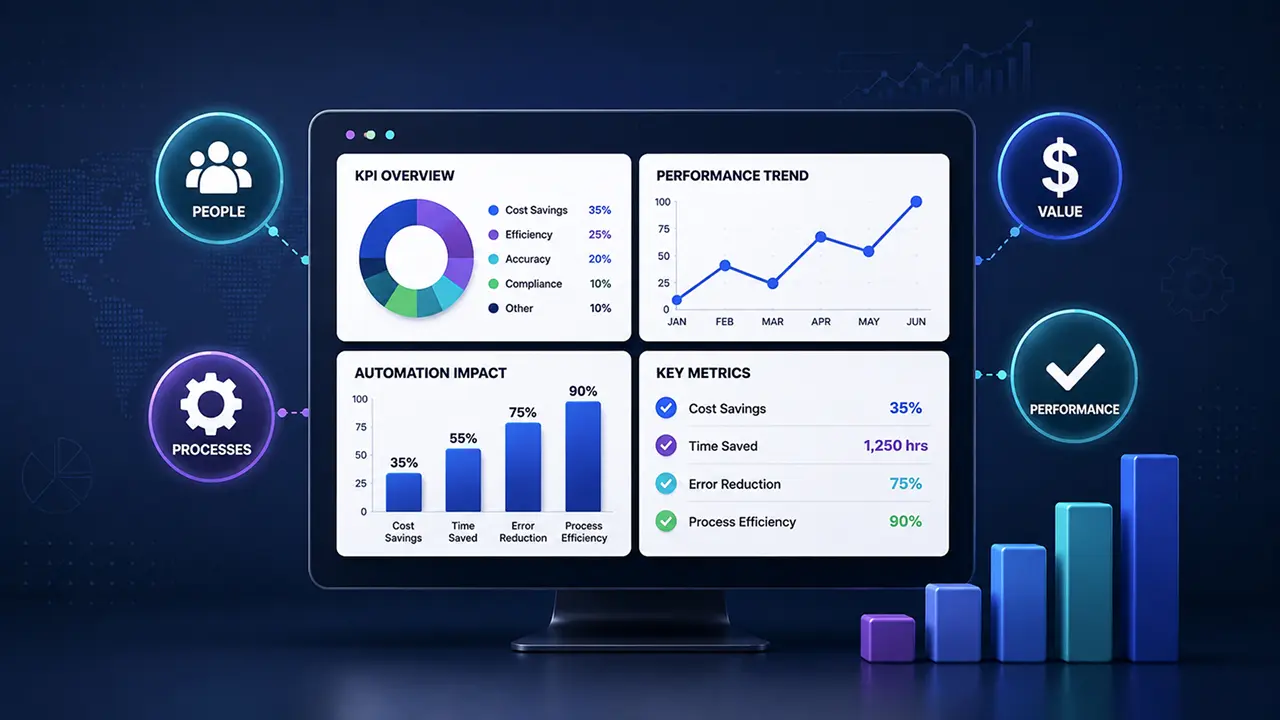
- Measure business impact, not automation volume: The number of automated transactions alone does not demonstrate meaningful ROI.
- Track efficiency and accuracy together: Cycle time, cost per transaction, STP rate, exception rate, and error rate provide a more complete view of performance.
- Use KPIs to measure automation maturity: Increasing straight-through processing and reconciliation automation can reveal how effectively finance processes are becoming autonomous.
- Connect automation to financial outcomes: ROI should account for labour savings, reduced errors, faster close cycles, improved working capital, and increased finance capacity.
- Measure the strategic value of automation: The strongest finance automation programmes free employees from repetitive work so they can focus on forecasting, analysis, risk management, and strategic decision-making.
Finance automation is no longer measured simply by how many manual tasks a finance team can eliminate. As organisations automate accounts payable, accounts receivable, reconciliation, reporting, expense management, and financial close, finance leaders need a clearer way to measure whether automation is actually improving business performance.
That is where finance KPIs automation becomes important.
The right KPIs help organisations evaluate whether automation is reducing processing costs, improving accuracy, accelerating financial cycles, strengthening compliance, and giving finance teams more time for strategic work.
However, not every metric deserves equal attention. Tracking the number of invoices processed or hours saved may demonstrate activity, but it does not necessarily prove business value.
The most useful finance automation KPIs connect operational improvements to measurable financial outcomes.
What Are Finance Automation KPIs?
Finance automation KPIs are measurable indicators used to evaluate how effectively automation improves finance processes and business outcomes.
They can measure several dimensions of performance, including:
- Speed: How quickly finance processes are completed
- Cost: How much it costs to execute financial processes
- Accuracy: How often transactions and records are processed correctly
- Productivity: How much work finance teams can complete with available resources
- Compliance: Whether processes consistently follow financial controls and policies
- Visibility: How quickly finance leaders can access reliable financial information
- Business impact: Whether automation contributes to measurable financial value
For example, measuring invoice processing time tells you whether AP automation is accelerating operations. Measuring cost per invoice tells you whether that efficiency is translating into financial savings. The strongest measurement frameworks track both.
Why Finance Automation KPIs Matter
Automation creates large volumes of operational data. Without the right KPIs, finance leaders may struggle to distinguish between automation activity and actual transformation.
A process processing 20,000 invoices automatically may sound successful. But if exception rates remain high, approvals are still delayed, and employees spend significant time correcting errors, the automation may not be delivering its expected value.
Finance automation KPIs create a baseline for comparison.
Before implementation, organisations can measure current performance. After implementation, the same KPIs can demonstrate changes in efficiency, accuracy, cost, and cycle times.
This allows finance leaders to answer questions such as:
- Has automation reduced the cost of processing transactions?
- Are invoices and payments moving faster?
- Has manual intervention decreased?
- Are reconciliation errors declining?
- Is the finance team spending less time on repetitive work?
- Has the financial close become faster?
- Is automation improving compliance?
- Is the investment generating measurable ROI?
The goal is not to track more metrics. It is to identify the metrics that reveal whether finance automation is producing meaningful business outcomes.
10 Finance Automation KPIs That Matter
1. Cost per Transaction
Cost per transaction is one of the most useful metrics for measuring automation efficiency. It measures the average cost of completing a finance transaction, such as processing an invoice, reconciling an account, handling an expense claim, or collecting a payment.
A simplified calculation is: Cost per transaction = Total process cost ÷ Number of transactions
Automation should reduce the labour and operational costs of repetitive transactions.
For example, if AP automation reduces the average cost of processing an invoice, finance leaders have a clear financial metric to compare before and after implementation. This KPI becomes particularly valuable when transaction volumes increase. If the business processes significantly more transactions without a proportional increase in finance headcount, automation is improving scalability.
2. Processing Cycle Time
Cycle time measures how long it takes to complete a finance process from beginning to end.
Common examples include:
- Invoice receipt to approval
- Payment request to payment execution
- Reconciliation start to completion
- Expense submission to reimbursement
- Period close start to completion
Reducing cycle time is one of the clearest indicators that automation is removing bottlenecks.
However, finance teams should measure the entire process, rather than focusing only on the automated step. An invoice may be automatically captured in seconds, but if approval takes five days, the overall process has not become truly efficient.
3. Straight-Through Processing Rate
Straight-through processing (STP) measures the percentage of transactions completed without manual intervention.
STP rate = Transactions completed automatically ÷ Total transactions × 100
This is particularly useful for AP, AR, reconciliation, and expense processes.
A higher STP rate generally indicates that automation is handling a greater proportion of routine transactions successfully.
For example, if 85% of invoices are processed from capture through approval without human intervention, finance teams can focus their attention on exceptions rather than routine transactions. This makes STP one of the most important finance KPIs automation metrics for evaluating automation maturity.
4. Exception Rate
Automation does not eliminate every exception. The more important question is how many transactions require human intervention and why.
Exception rate measures the percentage of transactions that fall outside predefined automation rules or workflows.
Common exceptions include:
- Missing information
- Duplicate invoices
- Incorrect purchase orders
- Pricing mismatches
- Unusual transactions
- Failed reconciliations
- Policy violations
A declining exception rate indicates that automation is becoming more effective.
Finance leaders should also track the reason for exceptions. This can reveal opportunities to improve upstream processes, data quality, business rules, or AI models
5. Error Rate
Accuracy is essential in finance. Faster processing is not valuable if automation creates additional errors. Error rate measures the percentage of transactions requiring correction because of inaccurate processing.
Examples include:
- Incorrect invoice coding
- Duplicate payments
- Incorrect account matching
- Reporting errors
- Incorrect payment details
- Reconciliation mismatches
A well-designed automation programme should reduce error rates and increase processing speed.
This KPI is particularly important because manual finance processes often create hidden costs. An error may require investigation, correction, additional approvals, and potentially customer or supplier communication.
6. Days to Close
The financial close is one of the most important processes to measure because it affects the speed at which leadership receives reliable financial information.
Days to close measures the number of days required to complete the month-end or year-end close.
Automation can accelerate activities such as:
- Account reconciliation
- Journal preparation
- Intercompany matching
- Data collection
- Variance analysis
- Reporting
- Approval workflows
A shorter close cycle gives finance leaders faster visibility into business performance. More importantly, it allows finance teams to move from simply reporting what happened to analysing why it happened and what should happen next.
7. Reconciliation Automation Rate
Reconciliation is a high-volume activity that can consume significant finance resources. This KPI measures the percentage of reconciliation activity completed automatically.
A high reconciliation automation rate indicates that systems can match transactions, identify discrepancies, and route exceptions without requiring finance professionals to manually compare records.
Finance leaders should track both automation rate and reconciliation accuracy. The objective is not simply to automate more reconciliations. It is to automate them reliably.
8. Finance Productivity
Finance productivity measures how much work a finance team can complete with its available resources.
Possible measures include:
- Invoices processed per FTE
- Accounts reconciled per FTE
- Transactions processed per employee
- Reports completed per FTE
- Revenue supported per finance employee
Automation should increase capacity without requiring proportional increases in headcount.
This does not necessarily mean reducing finance staff. Instead, organisations can redirect employees from repetitive transaction processing to forecasting, analysis, controls, and strategic decision-making.
9. Automation ROI
Automation ROI connects operational improvement to financial value.
A simplified formula is: Automation ROI = (Financial benefits − Automation investment) ÷ Automation investment × 100
Benefits can include:
- Labour savings
- Reduced error costs
- Lower processing costs
- Faster close
- Reduced late-payment costs
- Improved working capital
- Reduced compliance risk
- Increased finance capacity
ROI should be measured over time rather than immediately after deployment. Finance leaders can establish a baseline before implementation and compare it against results at 3, 6, and 12 months.
10. Time Reallocated to Strategic Work
One of the most overlooked finance automation KPIs is how much employee time is released from repetitive work.
Suppose automation reduces manual reconciliation, invoice entry, report preparation, and data validation. The value is not only the hours saved. The bigger question is what finance professionals do with that capacity.
Teams can redirect time towards:
- Financial planning and analysis
- Forecasting
- Scenario modelling
- Business partnering
- Risk management
- Cash-flow optimisation
- Strategic decision support
This KPI helps organisations demonstrate that automation is transforming the finance function, rather than simply reducing manual workload.
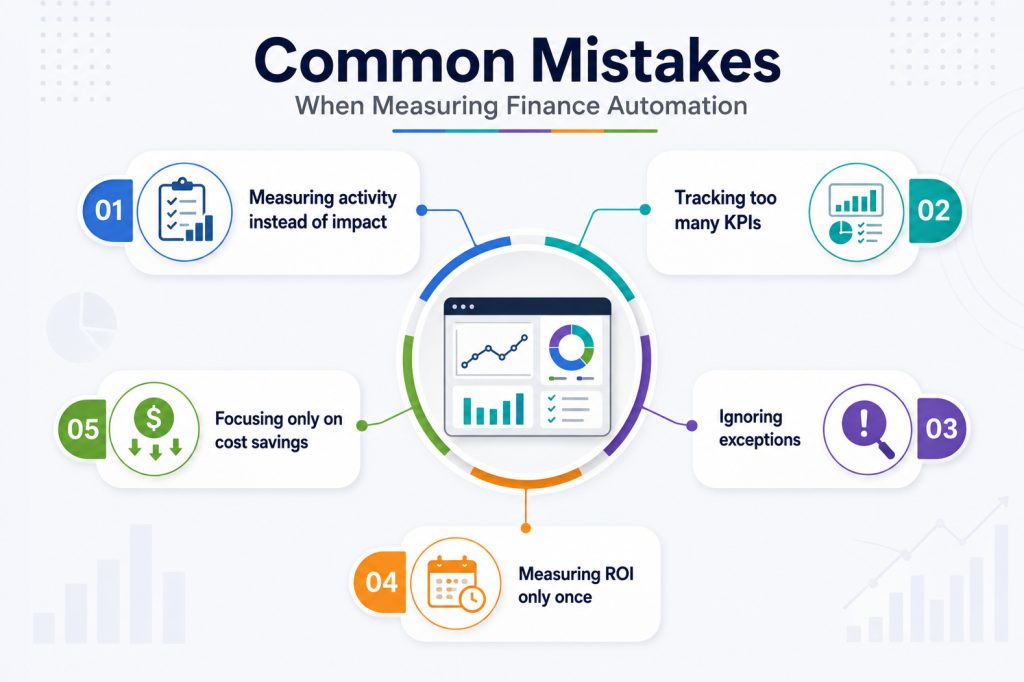
Common Mistakes When Measuring Finance Automation
1. Measuring activity instead of impact
Counting automated transactions is useful, but it does not prove value. Focus on outcomes such as cost reduction, speed, accuracy, and capacity.
2. Tracking too many KPIs
A dashboard with dozens of metrics can make decision-making harder. Choose a focused set that aligns with strategic objectives.
3. Ignoring exceptions
An automation system can appear highly successful based on volume while employees spend significant time handling exceptions. Always measure both automation rate and exception rate.
4. Measuring ROI only once
Automation benefits evolve as adoption increases and processes mature. Review ROI periodically to understand whether value is increasing, stable, or declining.
5. Focusing only on cost savings
Finance automation is not simply a cost-cutting strategy. Faster close cycles, stronger controls, improved accuracy, better visibility, and greater analytical capacity can create significant strategic value.
Conclusion
Finance automation should not be evaluated solely on the basis of automation volume. The most valuable finance KPIs automation framework connects process performance with measurable business outcomes.
Metrics such as cost per transaction, cycle time, straight-through processing rate, exception rate, error rate, days to close, reconciliation automation, productivity, ROI, and strategic time released provide a balanced view of automation performance.
The objective is ultimately bigger than reducing manual work.
Successful finance automation enables organisations to build a finance function that is faster, more accurate, more scalable, and more strategic.
By establishing clear baselines, setting measurable targets, monitoring trends, and connecting operational KPIs to financial outcomes, finance leaders can turn automation from a technology initiative into a measurable driver of finance transformation.