







Key Takeaways
- Ethical frameworks must guide autonomous AI agents to prevent biased, unfair, or unsafe decisions that can negatively impact both financial consumers and institutions.
- Black-box AI systems damage trust. Transparent AI, capable of explaining its decisions clearly, ensures user confidence and supports compliance with regulations and customer rights.
- AI systems trained on biased data can amplify societal inequalities. Ethical guardrails like fairness audits and representative data ensure inclusive and nondiscriminatory decision-making.
- AI systems must secure personal financial data from threats. Robust cybersecurity, compliance with laws like GDPR, and data privacy controls are non-negotiable in finance.
- Even the most advanced AI requires a human-in-the-loop. Human accountability ensures interventions are possible and builds trust in decisions made by AI agents.
Regardless of the industry, technology is rapidly redefining services. This is also applicable to the financial sector. However, one of the most notable breakthroughs is the increasing popularity of autonomous AI agents, which are known to operate independently. From improving strategies in the financial sector to helping make swift decisions, etc, autonomous AI agents are gaining immense popularity with time. Financial firms have utilized these agents to serve various purposes, including loan processing and investment management, among others.
Nevertheless, autonomous AI agents can create unwanted challenges if they are not utilized fairly and equitably. Every financial institution should implement ethical rules and regulations because they empower machines to make consequential judgments. These moral norms are regulations, structures, and design concepts developed to ensure that AI systems operate in a way that is open, equitable, responsible, and secure.
Also read: Building Autonomous AI Agents for Manufacturing Control Systems
Understanding Autonomous AI Agents
Autonomous AI agents are innovative software systems designed to operate independently of human intervention. One of the best advantages of these agents is that they are capable of making quick decisions, unlike humans. Apart from this, they grow with time as they continue to learn from past mistakes. Hence, no financial firm can encounter significant challenges if AI agents are used fairly.
That said, these agents have helped financial settings improve their operations. Are you curious to learn more about it? Keep reading as we have mentioned some of the benefits below.
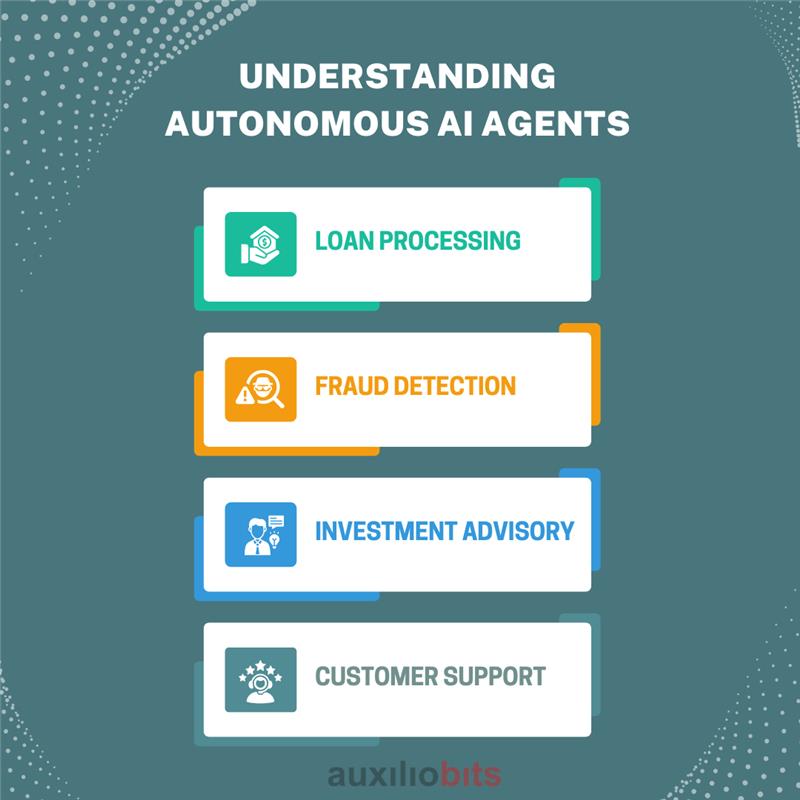
1. Loan Processing
AI agents can assess creditworthiness by analyzing vast datasets, including credit history, income levels, and spending patterns, to automatically approve or reject loan applications. This drastically speeds up approval times and eliminates human biases, provided adequate training is provided.
2. Fraud Detection
These agents can monitor transactions in real-time, spotting anomalies and suspicious behavior that may indicate fraud. By using machine learning, they become increasingly accurate in identifying threats and providing faster responses than traditional systems.
3. Investment Advisory
AI agents can act as robo-advisors, analyzing market trends, customer risk profiles, and financial goals to provide personalized investment recommendations. They offer 24/7 availability and can handle large portfolios with efficiency and consistency.
4. Customer Support
Through natural language processing and understanding, AI agents can handle customer queries, provide information, and resolve common issues across chat, email, or voice. This reduces the burden on human support teams and enhances customer satisfaction.
While the benefits of autonomous AI agents are significant—speed, scalability, cost savings, and improved decision-making—they also introduce potential risks. Without proper oversight, these agents might make unethical or incorrect decisions, especially if they are trained on biased or incomplete data. Lack of transparency, accountability, and human control can lead to trust issues and regulatory concerns.
Therefore, as financial institutions embrace these powerful tools, it becomes essential to implement strong governance, transparency, and ethical guidelines to ensure that AI agents work fairly, reliably, and in the best interest of all stakeholders.
Why Do We Need Ethical Guardrails?
As artificial intelligence (AI) becomes deeply embedded in the financial services industry, it brings the promise of speed, accuracy, and efficiency. However, AI systems, particularly autonomous agents, operate based on data patterns and statistical probabilities, not human values. They lack emotions, empathy, or an inherent understanding of right and wrong. This makes them powerful but also potentially dangerous if left unchecked.
In finance, decisions made by AI can significantly affect people’s lives, livelihoods, and financial futures. Whether it’s approving a home loan, recommending investments, or flagging fraud, each decision carries real-world consequences. A single error or biased judgment by an AI agent could deny someone a loan they deserve, misidentify fraud, or lead to poor financial advice. Without ethical guardrails in place, the risks of harm grow substantially.
Risks Without Ethical Guardrails
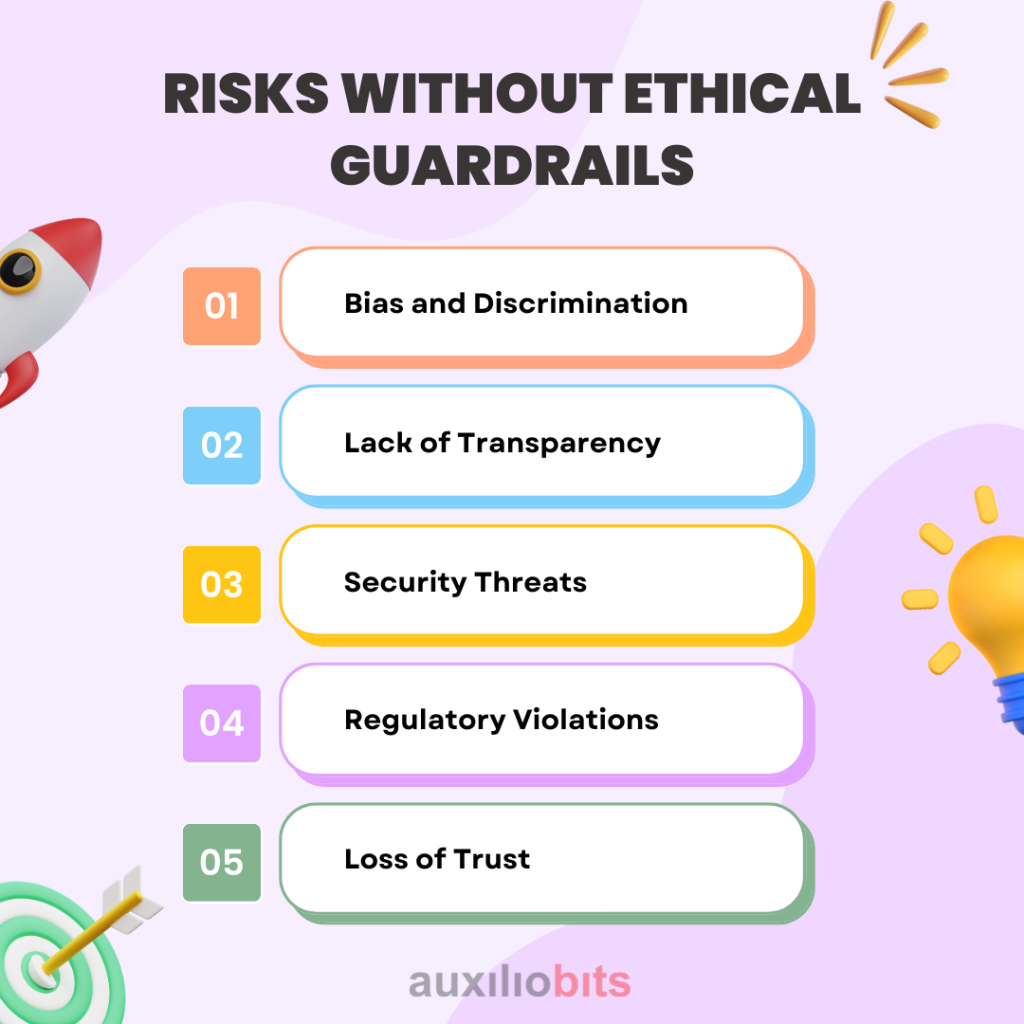
1. Bias and Discrimination
AI systems learn from historical data. If that data contains biases—based on race, gender, age, or geography—the AI may replicate and even amplify those biases in its decisions. For example, if past loan approvals were unfairly biased against specific communities, an AI trained on that data might continue the trend, unfairly rejecting deserving applicants. This creates not only ethical concerns but also legal risks related to discrimination.
2. Lack of Transparency
AI decisions can be incredibly complex and difficult for humans to interpret. This “black box” nature of AI means users often don’t understand how or why a particular decision was made. In finance, this lack of transparency undermines trust and makes it difficult to challenge or appeal unfair outcomes. Customers and regulators need clear explanations, especially when decisions impact people’s finances.
3. Security Threats
AI systems can be vulnerable to hacking, data poisoning, or adversarial attacks. Malicious actors may manipulate AI behavior to commit fraud, evade detection, or gain unauthorized access to sensitive data. Without proper security protocols, AI could become a new attack surface for financial institutions.
4. Regulatory Violations
The financial industry is one of the most regulated sectors globally. Laws related to data privacy (like GDPR), consumer rights, anti-money laundering (AML), and fair lending must be strictly followed. AI that doesn’t comply—either by design or by oversight—could expose institutions to fines, sanctions, and reputational damage.
5. Loss of Trust
Trust is foundational in financial services. If customers feel that AI systems are unfair, biased, or unpredictable, they will resist adoption. Loss of trust can lead to customer attrition, negative publicity, and a damaged brand image.
Key Principles for Ethical AI in Finance
As AI becomes more integrated into financial services, designing it responsibly is essential. Ethical guardrails ensure that AI operates not only efficiently but also fairly and safely. The following key principles should guide the design and deployment of ethical AI systems in the financial industry:
1. Fairness
AI must treat every individual equally, regardless of gender, race, age, income level, or geographic location. Since AI systems learn from data, there’s a risk they may absorb historical biases embedded in that data. For example, if previous loan approvals favored one demographic group over another, an AI system trained on that data might perpetuate the same bias. To prevent this, it’s vital to use diverse and representative datasets, implement bias detection tools, and regularly audit outcomes to ensure fairness in decision-making.
2. Transparency
Financial decisions can profoundly impact individuals’ lives, and customers have a right to know how those decisions are made. AI systems should be explainable—their logic and reasoning must be understandable to humans, including customers, regulators, and internal auditors. Whether it’s a loan denial or a flagged transaction, the AI should provide clear, interpretable explanations that justify its actions. This builds trust and enables accountability.
3. Accountability
Even the most advanced AI systems must not operate without human oversight. There should always be a designated human-in-the-loop who takes responsibility for AI outcomes. This ensures that if something goes wrong, such as a false fraud alert or an unfair loan rejection, Complex and evolving regulations govern financial services—someone is accountable and able to intervene, correct, and learn from the incident.
4. Privacy
In finance, AI often processes sensitive personal and financial data. Protecting that data is not just an ethical duty but a legal requirement. Strong data privacy practices must be enforced, including encryption, access controls, and data minimization. AI systems should also comply with data protection laws like GDPR and CCPA, ensuring user consent and data transparency.
5. Security
AI systems can be targets for cyber threats, including data breaches, adversarial attacks, and model manipulation. Securing AI involves implementing robust authentication, following secure coding practices, and conducting frequent audits and penetration tests. Security ensures the integrity and reliability of AI systems.
6. Compliance
Complex and evolving regulations govern financial services. AI must be designed to operate within these legal boundaries. This means regularly monitoring systems for regulatory compliance, updating models as laws change, and ensuring traceability of every AI decision to support audits and investigations.
By embedding these principles, financial institutions can develop AI that is not only powerful and efficient but also responsible, ethical, and aligned with societal values.
Conclusion
Autonomous AI agents can transform financial services. They can make things faster, wiser, and more efficient. But we must guide them with strong ethical guardrails to ensure they are fair, safe, and trustworthy.
The financial industry thrives on trust. If people don’t trust the systems, they won’t use them. By building ethical guardrails, we protect users, follow the law, and unlock the full potential of AI — the right way.