






Key Takeaways
- Oracle, SAP, and Workday are the primary pillars of enterprise solutions, each handling specific business domains, such as finance, HR, operations, and workforce management.
- Cross-platform automation is necessary to integrate the functionality of individual components into a single, unified system.
- Integration techniques, such as API-based connections, RPA, iPaaS, and Message Queues/Event Buses, help achieve global functionality and enable data exchange among these individual components.
- Challenges in integration include maintenance, data compatibility, security compliance (such as SOX and GDPR), and scalability issues, among others. To perform cross-automation, solutions to these challenges must be identified.
- Setting up automation correctly is critical. It demands a clear roadmap, the right tools, robust security, and thorough end-to-end testing.
- Best practices involve using stable APIs (such as V2), implementing robust error handling, utilizing secure tokens, and validating with both positive and negative test scenarios.
In today’s tech-driven era, businesses mainly rely on Oracle, SAP, and Workday, which have become the essential pillars of the enterprise world.
Oracle facilitates businesses in database management, financial management, payroll management, and employee details, and serves as a backend for numerous applications.
SAP enables companies to integrate different functions and processes into a unified system, improving efficiency, data management, and decision-making. It supports areas such as Enterprise Resource Planning (ERP), Customer Relationship Management (CRM), Supply Chain Management (SCM), and Human Capital Management (HCM).
Workday helps organizations manage all aspects of their workforce, including benefits, employee learning, payroll, performance management, talent acquisition, and time tracking.
Cross-platform automation refers to the integration of Oracle, SAP, and Workday, enabling them to communicate with each other and perform various functions. In this blog, I will primarily focus on the benefits, challenges, and multiple applications of integrating all three platforms.
Integration Techniques
Integration techniques refer to the methods through which we can connect these platforms and integrate them to perform as a single system. These techniques involve the use of Robotic Process Automation, Application Programming Interface, and various other approaches.
1. API-Based: Oracle, SAP, and Workday support API-based integration. REST API can be used to communicate with each other using a standard approach.
Use Case: Suppose a company hires a new joinee. The HR team creates an account in Workday for him, and then a job is scheduled by a trigger that sends the new joiner’s data to Oracle. Then, Oracle sets up the payroll for the new employee and triggers SAP, which assigns the employee to the appropriate cost center and grants them the required access.
2. RPA: Robotic Process Automation can also be used to reliably and accurately connect all three platforms. RPA utilizes UI automation and data scraping technology, which can be leveraged for data exchange.
Use Case: Suppose a company hires a new joinee. A bot is triggered, which extracts details of the new joiner from the Workday portal and enters the data into the Oracle database. Then, the bot logs into the SAP Graphical User Interface and assigns the user the appropriate permission, department, and cost center.
3. Integration Platform as a Service (iPaaS): Various cloud-based integration solutions provide services to multiple companies, facilitating the connection of disparate systems, automating data exchange processes, and orchestrating business processes.
Some of the leading iPaaS providers are MuleSoft, Boomi, Workato, Jitterbit, and SnapLogic.
These service providers use pre-built connectors to exchange data and communicate with other components.
4. Message Queues and Event Buses: Message Queues and Event Buses enable time-independent and flexible communication between systems by passing messages or events between applications in real-time.
A few companies that use Message Queues and Event Buses are Apache Kafka, Azure Service Bus, and AWS EventBridge.
Challenges in Integration
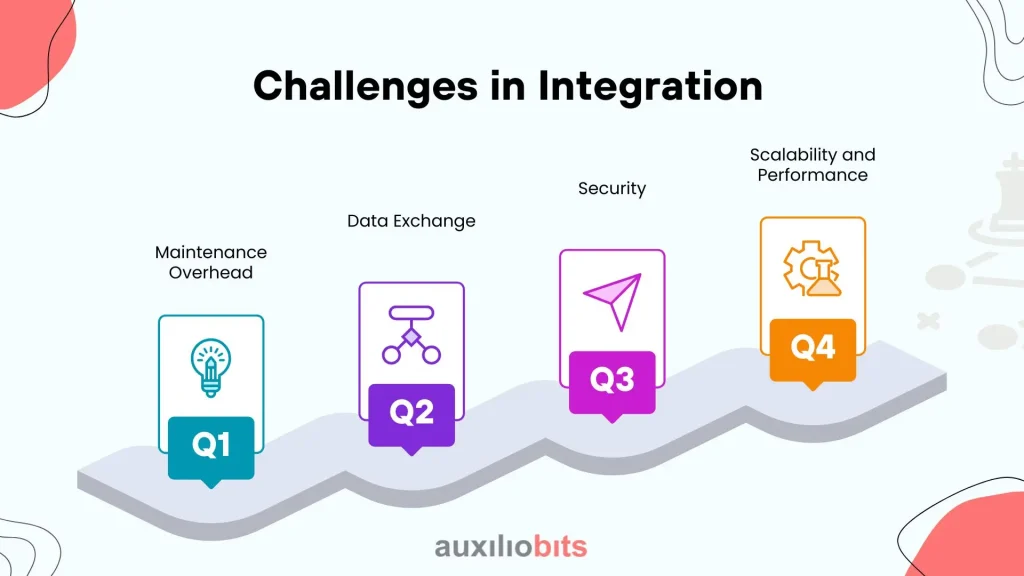
1. Maintenance Overhead: Promptly installing updates and maintaining each platform are essential to ensure smooth functioning.
2. Data Exchange: For the exchange of data, the information must be aligned across all three platforms. Data should contain a standard part that can be used to refer to the same data on other platforms, such as Employee ID or Account Name.
3. Security: The data exchange should be performed reliably and in compliance with various regulations, such as SOX and GDPR.
4. Scalability and Performance: A large volume of data and data types can strain integration solutions.
How to Set Up Automation the Right Way?
Setting up automation in the right way is highly important because the setup’s functioning depends on the configuration approach to a great extent. One must follow best practices when setting up automation, which involves adhering to the planned roadmap, utilizing the appropriate tools in the setup, implementing security measures, and conducting proper end-to-end testing.
1. Define a Clear Roadmap:
For smooth automation, the integration process should be predefined with a thorough understanding of the functioning and limitations of each component, ensuring it doesn’t impact the integration.
2. API:
The V2 API should be preferred because it is highly stable and reliable. It can be used for a smooth automation process. V2 APIs are easy to use, scalable, and require minimal maintenance.
3. Error Handling and Monitoring:
Implement error-handling mechanisms and proper retry mechanisms using try-catch blocks to handle edge cases. Process monitoring ensures no transaction is hampered.
4. Secure Integrations:
All integrations should be implemented in a highly secure environment, ensuring data encryption and decryption, role-based authentication, and OAuth using access tokens, bearer tokens, and other secure protocols.
5. Testing:
To ensure successful integration with scalability, accuracy, and performance, proper testing must be conducted, and all positive and negative cases should be thoroughly tested before deployment.
Finance Workflows That Benefit Most from Cross-Platform ERP Automation
Cross-platform ERP automation becomes especially valuable when finance teams operate across multiple entities, systems, and business units. Instead of manually moving data between SAP, Oracle, Workday, and other applications, automation can connect these systems and create a more consistent flow of financial information. The existing article highlights APIs, RPA, iPaaS, and event-driven integration as methods for connecting enterprise platforms, making these approaches relevant to finance workflows as well.
1. AP Automation Across ERP Systems
Accounts payable is one of the clearest areas for cross-platform automation. In a multi-ERP environment, invoices may arrive from different suppliers and need to be processed against purchase orders, receipts, and vendor records stored in separate systems. Automation can capture invoice data, validate key fields, perform two- or three-way matching, and route invoices to the appropriate approvers regardless of which ERP contains the underlying data. Businesses can use AP automation services to reduce manual data entry while maintaining consistent approval and exception-handling processes across finance systems.
2. Reconciliation Across Entities and ERP Platforms
Reconciliation becomes more complicated when different legal entities use different ERP platforms. Automated workflows can collect bank transactions, ledger data, and intercompany balances from SAP, Oracle, or other financial systems and compare them against predefined rules. This supports automated bank matching, exception identification, and intercompany reconciliation without requiring finance teams to manually consolidate spreadsheets from each entity. A structured reconciliation automation approach can also provide better visibility into unmatched transactions and outstanding exceptions.
3. Financial Close Automation
The month-end close process often requires finance teams to consolidate information from multiple systems before reporting can be finalized. Cross-platform automation can coordinate activities such as journal preparation, account reconciliation, material ledger close, intercompany eliminations, and consolidated reporting. Instead of waiting for teams to extract and reconcile information manually, automated workflows can move validated data between systems and trigger downstream activities based on predefined conditions. This makes month-end close automation particularly useful for organizations managing complex, multi-entity finance operations.
4. Vendor Master Data Synchronization
Vendor master data is another area where inconsistencies can create downstream finance problems. A supplier may be created or updated in one system while the corresponding record remains outdated in another. Cross-platform automation can synchronize key fields such as vendor name, address, tax information, payment terms, banking details, and supplier status across SAP, Oracle, and Workday, with validation rules applied before updates are propagated. ERP integration services can help establish these connections while accounting for differences in data structures, identifiers, APIs, and security requirements.
Real Example: Accelerating a Multi-Entity Financial Close
Consider a finance team supporting several legal entities, with some entities running SAP and others using Oracle. Before automation, the team may need to extract trial balances, bank data, intercompany balances, and supporting files from each system, standardize them in spreadsheets, identify discrepancies, and manually coordinate corrections. A cross-platform automation layer can instead collect data from both ERPs, apply validation and matching rules, identify exceptions, and route unresolved items to the appropriate finance team. Once exceptions are resolved, the workflow can support consolidated reporting and downstream close activities. The result is a more standardized close process with fewer manual handoffs and greater visibility into outstanding work. This approach builds on the same integration principles discussed earlier in the article, where APIs, RPA, and integration platforms connect otherwise separate enterprise systems.
Ready to Streamline Your Finance Operations?
Explore how cross-platform ERP automation can streamline your finance operations. Book a free discovery call.
Conclusion
Despite some limitations and challenges in integration, various real-time applications require the integration of SAP, Workday, and Oracle. Growing enterprises demand a formulated approach to achieve complex tasks by connecting multiple tools that perform different functions independently. Companies need to build ecosystems that connect various autonomous systems. These custom connectors help in solving significant, complex problems by breaking them down into smaller, manageable tasks.
By employing a structured approach and efficiently utilizing existing resources, along with implementing proper safety measures, a robust ecosystem can be created that is capable of achieving tasks that may initially seem impossible.