








Choosing between a captive Global Business Services (GBS) model and outsourced Business Process Outsourcing (BPO) is not simply a decision about cost or headcount. It determines who owns operational knowledge, how quickly processes can change, where accountability sits, and how much control an organization retains as its needs evolve.
The discussion around captive vs outsourced shared services has also become more nuanced. Organizations can retain strategic capabilities internally, outsource selected processes, and combine both approaches within a single operating model. Understanding these options requires looking beyond traditional comparisons of ownership and cost to examine how each model behaves in practice.
What Are Captive GBS and Outsourced BPO?
A captive GBS model consolidates business services within an organization that retains ownership of its people, processes, governance, and operational decisions. Depending on its maturity, it may support finance, procurement, HR, IT, and other corporate functions through standardized, integrated services.
Outsourced BPO transfers responsibility for defined business processes to an external service provider under agreed contractual terms, performance measures, and governance arrangements. The provider typically supplies the delivery workforce and operational infrastructure, while the client retains responsibility for business objectives and appropriate oversight.
The important distinction is that GBS describes a broader service-delivery and governance model, while BPO describes an outsourcing arrangement. They are not always mutually exclusive. A GBS organization can manage captive teams and external providers within the same enterprise-wide framework.
Captive GBS vs Outsourced BPO: Key Differences
The differences become clearer when organizations evaluate how work is governed, how expertise develops, and how operational changes are implemented.
| Dimension | Captive GBS | Outsourced BPO |
| Ownership | The organization owns the delivery operation | An external provider delivers contracted services |
| Process knowledge | Accumulates within the organization | Shared between client and provider, depending on the contract |
| Governance | Internal leadership and enterprise-wide controls | Contractual governance, service levels, and joint oversight |
| Talent management | Direct control over recruitment, development, and career paths | Provider manages its workforce within agreed requirements |
| Technology decisions | Greater freedom to select and integrate internal platforms | Depends on contract scope, provider capabilities, and integration arrangements |
| Capacity changes | Requires internal hiring, restructuring, or automation | May offer access to an existing delivery workforce and flexible capacity |
| Transformation | Can be embedded directly into internal operating priorities | Depends on contractual scope, incentives, and provider capabilities |
| Financial structure | More direct responsibility for operating costs and investment | Contracted fees, transition costs, and potential change charges |
| Knowledge continuity | Institutional knowledge can remain inside the business | Continuity depends on documentation, retention, and transition arrangements |
| Accountability | Internal leaders own delivery and improvement | Responsibilities are divided between client and provider |
Neither model automatically produces better outcomes. A well-governed BPO arrangement can outperform an immature captive center, while a mature captive operation can provide stronger institutional knowledge and process ownership. The decision depends on the capabilities an organization needs to retain and the work it can manage effectively through external partners.
The Hidden Trade-Off: Control Versus Organizational Capability
A common mistake in captive vs outsourced shared services decisions is treating control as an advantage that automatically translates into better performance.
Captive ownership gives an organization greater authority over staffing, process design, technology, and priorities. However, it also means the organization must build and maintain the management capabilities needed to use that authority. Recruiting experienced process leaders, establishing governance, managing attrition, and funding continuous improvement all require sustained attention.
Outsourcing changes where those capabilities reside. A provider may already have trained personnel, established procedures, specialist technology, and experience managing transaction volumes. But access to those capabilities does not necessarily mean the client develops them internally.
This creates an important distinction between owning a process and having the capability to improve it.
For example, a company may operate its accounts payable process through a captive center but still depend on an ERP vendor for integration expertise. Another company may outsource invoice processing while retaining internal ownership of process standards, exception policies, and automation priorities.
The second organization has outsourced execution without necessarily surrendering strategic control. This is why operating-model decisions should distinguish between delivery responsibility, decision rights, and ownership of business outcomes.
Why the Cost Comparison Is More Complicated Than It Looks
The financial case for captive vs outsourced shared services often begins with a comparison of salaries against vendor fees. That comparison can be misleading because the two models distribute costs differently.
A captive operation requires investment in recruitment, leadership, infrastructure, technology, training, compliance, and ongoing management. Some costs remain relatively fixed even when transaction volumes decline. If demand grows, the organization may need to expand its workforce or invest in automation to maintain service levels.
An outsourced arrangement may reduce the need for direct investment in delivery infrastructure. However, the contract can introduce transition charges, minimum-volume commitments, change requests, indexation clauses, and fees for work outside the agreed scope.
Three less-visible factors deserve particular attention:
- Demand variability: Determine who absorbs the cost when transaction volumes fluctuate significantly. A fixed-capacity contract and a per-transaction arrangement can behave very differently.
- Process complexity: Exceptions, regulatory differences, and nonstandard workflows can create costs that are not obvious in the initial proposal.
- Exit and transition costs: Moving work between providers or bringing it back in-house requires documentation, knowledge transfer, systems access, and operational continuity planning.
A useful evaluation compares the total cost of delivering the required outcomes over time, rather than comparing headline labor rates. It should also distinguish costs that genuinely disappear from those that simply move to another budget.
The Knowledge Retention Problem Most Comparisons Miss
One of the most consequential differences in captive vs outsourced shared services is what happens to operational knowledge when people leave, processes change, or responsibilities move between teams.
Operational knowledge exists at several levels. Documented knowledge includes procedures, business rules, and work instructions. Practical knowledge includes how employees resolve unusual cases, interpret incomplete information, and recognize when a transaction requires escalation. Strategic knowledge includes why a policy exists, which exceptions are commercially acceptable, and how a process affects customers or financial decisions.
The last two categories are harder to transfer through standard operating procedures alone.
In an outsourced environment, a provider may know how to process a transaction without fully understanding the commercial reasoning behind a particular decision. Conversely, a captive team may retain historical knowledge but lack the specialist expertise to modernize the process.
Organizations can reduce these risks by maintaining:
- Process ownership: A clearly accountable internal owner who understands the end-to-end workflow.
- Decision documentation: Recorded business rules, exception rationales, and escalation criteria.
- Knowledge portability: Documentation and system access that allow another qualified team to take over.
- Continuous learning: Regular reviews that turn recurring exceptions and errors into process improvements.
The goal is not to prevent outsourcing or eliminate staff turnover. It is to ensure that critical knowledge remains accessible and that operational performance does not depend on a few individuals or a single provider.
How to Decide Which Model Fits Your Organization
A practical captive vs outsourced shared services assessment should begin with the nature of the work, not with a preferred delivery structure.
Ask five questions before making the decision:
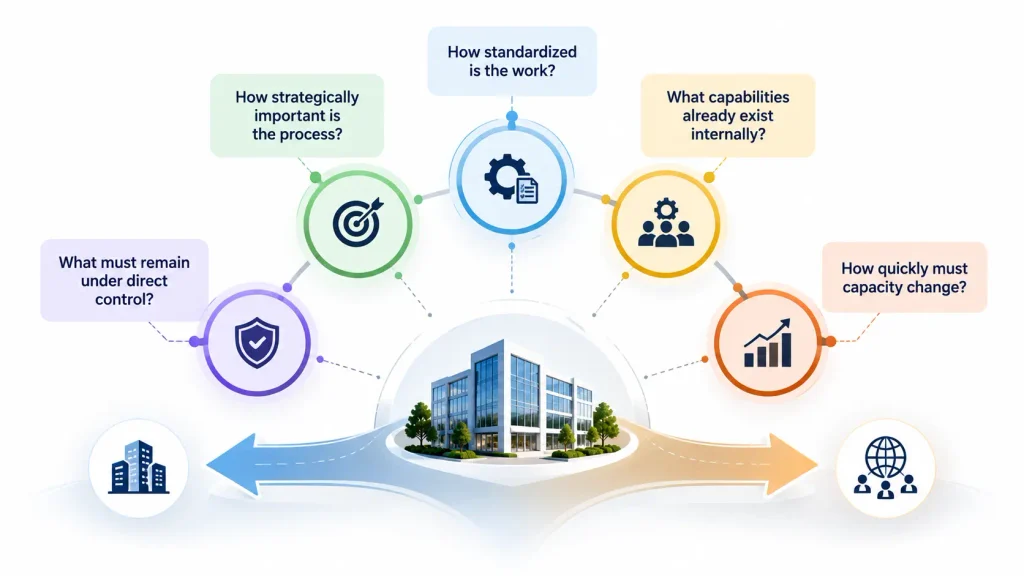
- How strategically important is the process? Processes involving sensitive decisions, proprietary knowledge, or direct business judgment may benefit from stronger internal ownership.
- How standardized is the work? Stable, repeatable activities are often easier to transfer to an external provider than processes with frequent policy changes and complex exceptions.
- What capabilities already exist internally? A captive model requires operational leadership, technology expertise, workforce management, and continuous improvement capabilities.
- How quickly must capacity change? External providers may offer access to established delivery teams, while internal expansion can provide greater organizational integration over time.
- What must remain under direct control? Data access, regulatory obligations, approval authority, automation governance, and audit requirements should influence the boundaries of each arrangement.
For captive vs outsourced shared services, the answers should be evaluated together. A process may be suitable for outsourced execution but still require internal ownership of controls and business decisions.
Organizations should also assess their ability to manage the selected model. Choosing a captive center without sufficient leadership or technical capability can create an expensive operation that struggles to improve. Outsourcing without strong internal governance can produce similar problems through dependency on the provider.
Measuring Success Beyond Cost Savings
The right operating model should deliver more than lower operating expenses. It should improve the reliability, responsiveness, and adaptability of business services.
Useful measures include:
- Service quality: Accuracy, error rates, and compliance with established controls.
- Process efficiency: End-to-end cycle time, manual touchpoints, and exception rates.
- Business responsiveness: Time required to implement policy changes or accommodate new business requirements.
- Knowledge resilience: Ability to maintain service during staff turnover, provider changes, or system migrations.
- Automation effectiveness: Percentage of transactions completed without manual intervention and the effort required to resolve exceptions.
- Business outcomes: Impact on working capital, reporting timeliness, customer experience, and decision-making.
These indicators help organizations understand whether their operating model is improving the business or merely moving costs between departments.
A mature approach to captive vs outsourced shared services also evaluates performance across the entire process rather than allowing individual teams to optimize their own metrics at the expense of the overall workflow.
For example, faster invoice processing offers limited value if approval delays remain unchanged. Similarly, reducing the cost per transaction may not represent a genuine improvement if error rates and rework increase.
Conclusion
The choice between captive GBS and outsourced BPO is best understood as a spectrum of operating-model options rather than a simple choice between internal control and external efficiency.
Captive operations offer direct ownership and the opportunity to build long-term organizational capabilities. Outsourcing provides access to external expertise, established delivery infrastructure, and potentially more flexible capacity. Hybrid models allow organizations to distribute responsibilities according to the nature of the work, provided governance remains clear.
Ultimately, captive vs outsourced shared services should be evaluated through the lens of long-term capability, process performance, knowledge retention, and adaptability. The strongest operating model is the one that places each responsibility where it can be managed effectively while preserving accountability for business outcomes.