








Key Takeaways
- Automation ROI starts with a reliable baseline. Measure the real cost of manual finance processes, including labour, rework, errors, delayed closes, penalties, and missed discounts.
- ROI isn’t automatic. The outcome depends on choosing the right workflows, defining measurable KPIs, controlling implementation scope, and selecting automation that can handle exceptions effectively.
- Finance automation ROI goes beyond labour savings. A strong business case should account for error reduction, faster invoice processing, working-capital improvements, and quicker access to decision-ready financial data.
- Vendor comparison should go beyond licence price. Evaluate exception rates, total cost of ownership, time to value, security, contract flexibility, and access to comparable customer references.
- The strongest ROI case is built on your own numbers. A scoped pilot, clear success metrics, and a measurable baseline give CFOs evidence they can validate and defend before making a larger automation commitment.
You’ve researched finance automation. You’ve seen the demos and compared platforms, and your finance team already agrees that manual processes are slowing down the close.
Now comes the question that matters to the person signing the cheque:
Does the ROI actually hold up and can you prove it before you commit?
This isn’t another explainer on what finance automation is. It’s a practical framework for calculating automation return on investment finance teams can defend, backed by independent research, realistic benchmarks, and the questions you should ask every vendor before signing a contract.
The Real Cost of Staying Manual
Before any automation ROI calculation means anything, you need an honest baseline. Finance teams often underestimate the cost of manual work because it is distributed across salaries, rework, delayed closes, errors, and missed opportunities rather than appearing as a single expense. Establishing this baseline is essential for determining potential automation cost savings and building a business case that reflects the true cost of current operations. A spend analytics approach can also help finance teams identify where manual processes and inefficient spending are creating unnecessary costs.
A typical mid-market finance team may spend:
- 40–60 hours/month on manual invoice matching and approval routing
- 15–25 hours/month correcting reconciliation errors
- 3–5 additional days on month-end close because of manual data collection
- 1 FTE or more keeping repetitive AP, AR, and reconciliation workflows moving
At a fully loaded finance analyst cost of $75,000–$95,000 annually, this can represent roughly $35,000–$55,000 in annual labour capacity tied up in repetitive work, before accounting for error remediation, late-payment penalties, missed discounts, cost per invoice, or delayed decision-making. These costs establish the baseline against which automation cost savings should be measured.
That’s the baseline your automation investment has to beat.
What Independent Research Actually Shows
Vendor case studies can demonstrate what is possible, but skeptical buyers are right to question whether those results represent typical outcomes. Independent research on RPA ROI consistently shows 200-600% first-year returns for well-scoped automation projects, with payback periods of 3-9 months.
Deloitte’s Finance Trends 2026 research indicates that AI-driven automation adoption is widespread, but only a minority of finance organizations report clear, measurable ROI. The gap highlights an important point: measurement discipline matters as much as the technology itself.
Forrester Total Economic Impact studies of enterprise automation platforms have documented substantial three-year returns, with outcomes varying according to deployment scope, implementation strategy, and change management.
Broader research into intelligent automation has also reported ROI ranging widely across industries and processes. That variation is important. There is no universal automation ROI percentage that every finance department should expect.
The honest takeaway is that automation benefits are real, but they aren’t automatic. Results depend on choosing the right workflows, establishing a measurable baseline, controlling implementation scope, and selecting technology that genuinely handles exceptions rather than simply moving manual work into a digital interface. This also determines the RPA ROI an organization can realistically achieve.
That’s the standard to apply to every vendor’s claims, including ours.
How to Calculate Finance Automation ROI
A defensible business case starts with a simple formula. To calculate automation ROI, use:
ROI = (Annual Savings + Annual Revenue Impact − Annual Automation Cost) / Annual Automation Cost × 100
Break the calculation into three core areas.
1. Direct Labour Savings
Calculate: Hours reclaimed × fully loaded hourly cost
To calculate automation ROI, don’t assume every hour disappears. The more credible calculation identifies how much time automation actually removes from repetitive work and how much is redirected toward higher-value activities such as FP&A, analysis, forecasting, and strategic planning, while also accounting for FTE savings.
2. Error and Compliance Cost Avoidance
Manual data entry and reconciliation introduce opportunities for errors, duplicate payments, incorrect coding, and compliance issues.
Measure your current cost of:
- Error investigation
- Reconciliation rework
- Duplicate or incorrect transactions
- Audit preparation
- Late-payment penalties
- Missed early-payment discounts
Automation with validation and audit trails can reduce this cost substantially—but your own baseline should determine the estimate.
3. Speed-to-Cash and Working Capital
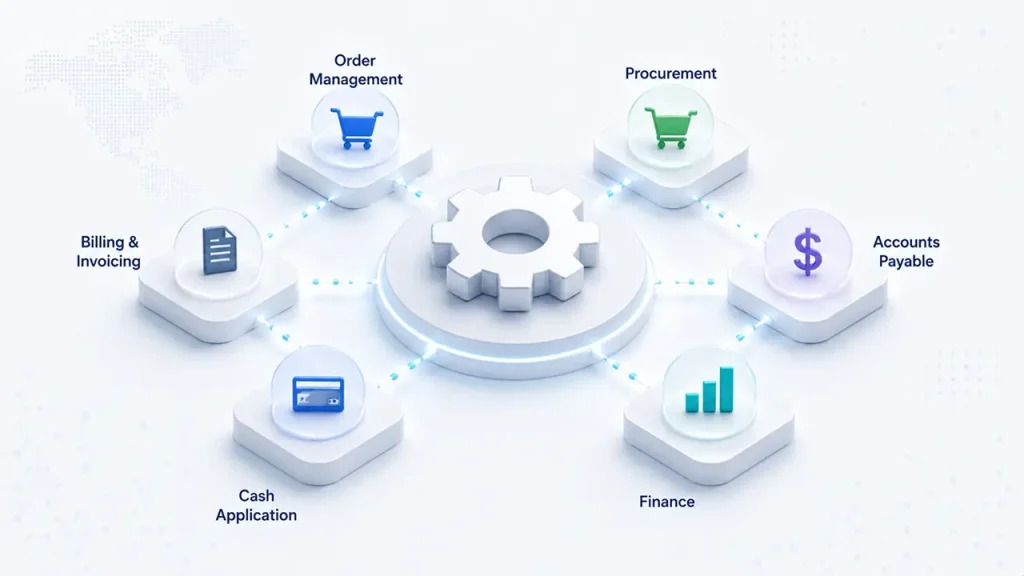
That makes finance automation ROI broader than headcount reduction alone. To calculate automation ROI accurately, finance teams should account for labour savings, cost per invoice, working-capital improvements, and the additional business value created by faster, more accurate financial operations.
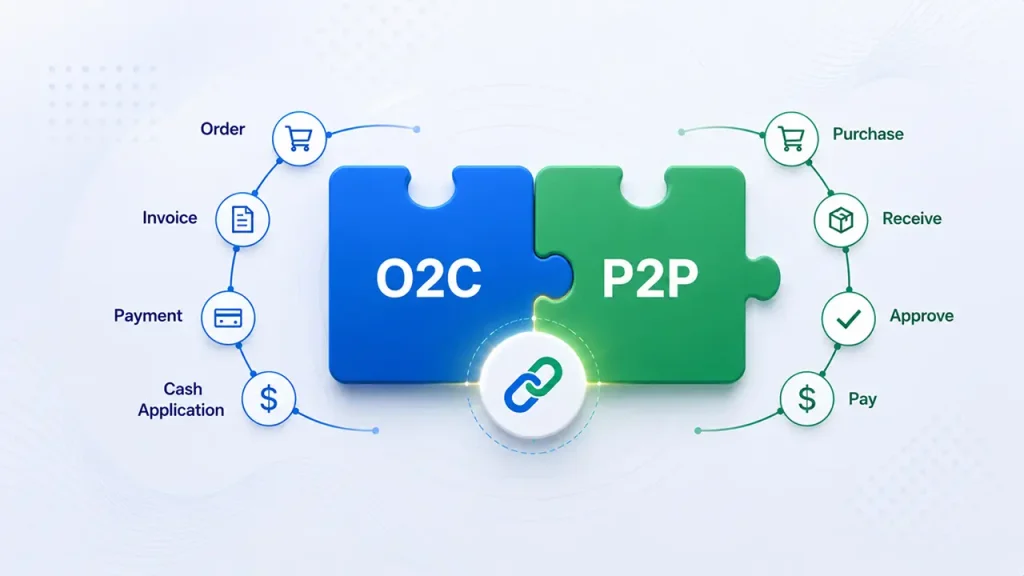
That makes finance automation ROI broader than headcount reduction alone. To calculate automation ROI accurately, finance teams should account for labour savings, cost per invoice, working-capital improvements, and the additional business value created by faster, more accurate financial operations. This broader view is especially relevant when evaluating P2P automation, where improvements can span purchasing, invoice processing, approvals, and payments.
An Illustrative Finance Automation ROI Model
To demonstrate how the framework works, consider a modeled—not customer-specific—scenario.
Company profile: 220-person SaaS business with a four-person finance team, three subsidiaries, and two ERP systems.
| Metric | Before Automation | After Automation (Modelled) |
| Month-end close | 11 days | 3–4 days |
| Reconciliation errors | Recurring | Substantially reduced |
| Analyst time on manual matching | ~50% of two FTEs | Reallocated to FP&A |
| Estimated payback | — | 6–9 months |
This is an illustrative model, not a promised result. For actual proof, ask your vendor for a customer reference in your industry and company-size range. A direct conversation with a current customer can reveal implementation challenges, exception rates, adoption issues, cost per invoice, and realised savings that a polished case study may not.
Industry Benchmarks for Automation ROI
| Metric | Manual process | After automation | Improvement |
| Cost per invoice | $8-15 | $1-3 | 70-80% reduction |
| Touchless rate | 10-20% | 60-80% | 3-4x improvement |
| Invoice cycle time | 10-15 days | 2-3 days | 75% faster |
| First-year ROI | — | 200-600% | Typical for well-scoped projects |
| Payback period | — | 3-9 months | Most implementations |
| FTE hours per 1,000 invoices | 40-60 hours | 5-10 hours | 80-85% reduction |
| Error rate | 5-10% | <1% | 90%+ reduction |
Real Automation ROI: Auxiliobits Client Results
At Auxiliobits, finance automation engagements are measured against defined operational and financial outcomes rather than generic efficiency claims. Across automated finance processes, clients have achieved 40–60% reductions in manual finance work, 2–3x faster processing, and $200K+ in annual savings for mid-size shared services teams. These results provide a practical benchmark for organizations evaluating the potential economics of finance automation.
One documented engagement for processing vendor invoices recovered 9,700+ hours annually and delivered $200K+ in annual savings for a large marketing network. The automation addressed invoice intake, data extraction, ERP entry, and exception handling, demonstrating how labour savings can translate directly into measurable financial value rather than simply reducing task time.
The impact can extend beyond AP processing. For clients that extend automation into financial close and reconciliation, Auxiliobits reports a 73% reduction in close time. In another enterprise engagement, automation across 70+ agencies recovered 9,700 hours annually and delivered $218K in cost savings, showing how the ROI opportunity can expand when automation is applied across connected finance workflows.
Implementation speed also matters when calculating payback. Auxiliobits reports a typical 6–8 week engagement timeline for moving from assessment to a working automation solution. For finance teams building an investment case, these results show why ROI should be evaluated against actual transaction volumes, labour costs, cycle times, and exception rates, not just software pricing. For a deeper framework for building the business case, see the AP automation guide.
How to Compare Finance Automation Vendors
Don’t compare platforms based solely on licence price or headline ROI.
Take this framework into every vendor conversation:
| Evaluation Dimension | Question to Ask |
| True exception rate | What percentage still requires manual review after go-live? |
| Total cost of ownership | What are the implementation, transaction, integration, and administration costs? |
| Time to value | How quickly can we complete our first automated workflow or close cycle? |
| Security & compliance | What certifications, audit trails, and data-residency options are available? |
| Contract flexibility | What are the exit terms, data portability provisions, and pricing escalators? |
| Customer references | Will you provide an unscripted reference from a comparable organisation? |
The most important question may be the first one. A process that is technically “automated” but still sends 20–30% of transactions to human reviewers may deliver far less ROI than the original business case suggests.
Look for straight-through processing, intelligent exceptions, and AI automation services that can handle variability without constantly escalating work back to human reviewers.
What the Payback Period Actually Looks Like
A realistic implementation should be measured in stages rather than treated as an overnight transformation.
Month 1–2: Implementation, integrations, and workflow configuration
Month 2–3: First automated workflows and measurable time savings
Month 4–6: Exception patterns become clearer and validation rules mature
Month 6–12: Benefits compound across labour, error reduction, speed, and working capital
Most automation projects show a first-year ROI of 200-600% with an automation payback period of 3-9 months. The fastest payback comes from automating high-volume, repetitive processes first.
How to De-Risk the Automation Decision
For a CFO or finance committee, the biggest risk isn’t necessarily the software investment. It’s committing to a multi-year contract without first proving the economics against your own data and establishing clear cost justification.
Two requests can materially reduce that risk:
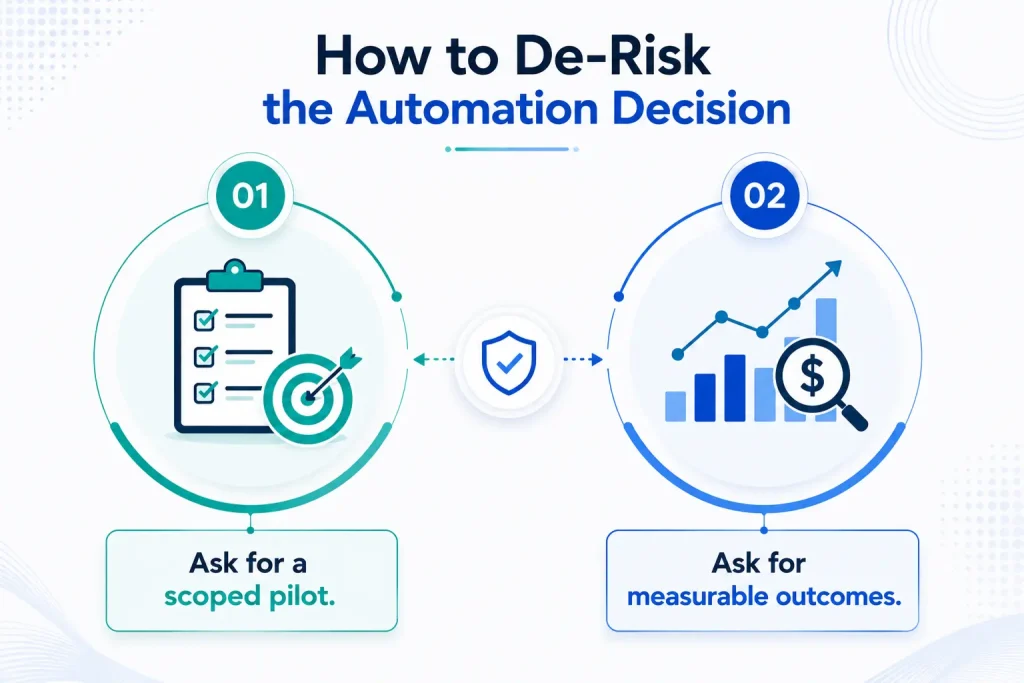
1. Ask for a scoped pilot.
Start with one workflow or entity, for example, reconciliation or invoice processing, and define success metrics before the pilot begins. Business automation consulting can help assess the workflow, identify the right pilot scope, and establish measurable outcomes before committing to a larger automation investment.
2. Ask for measurable outcomes.
Agree on the KPIs that matter: processing time, exception rate, error reduction, close duration, hours reclaimed, or cost per transaction.
3. Cost Justification
A well-structured pilot provides the cost justification your buying committee needs before approving a full automation investment.
If a vendor won’t discuss measurable outcomes or provide customer references, that’s valuable information when evaluating the investment.
Building the Business Case for Your CFO
A strong finance automation business case doesn’t need inflated projections. It needs numbers your CFO can challenge and still trust.
Bring three things to the discussion:
- Your actual cost of manual work: labour, rework, errors, and opportunity cost measured over at least 30 days.
- Your complete automation cost: licence fees, implementation, integration, maintenance, and internal administration.
- Evidence that the model is achievable: a pilot result, measurable benchmark, or customer reference from a comparable organisation.
Then calculate the payback period using conservative assumptions. That transforms the conversation from “Should we automate?” into “How quickly can this investment pay for itself?”
Calculate Your Own Automation ROI
Every finance organisation has its own starting point. Transaction volume, ERP complexity, team structure, error rates, and existing automation all influence the outcome. That’s why the strongest business case isn’t based on an industry average. It’s based on your numbers.
If you’re evaluating finance automation, start by measuring your current process costs, then test the vendor’s assumptions against your baseline.
Explore Auxiliobits Agentic Process Automation and see how AI-driven agents can help automate finance workflows with greater autonomy and exception handling.
You can also explore Intelligent Enterprise Automation to understand how automation can extend beyond individual finance processes.
The right automation investment isn’t the one promising the biggest ROI percentage. It’s the one whose ROI you can measure, validate, and defend.