







Key takeways
- A medical referral is when a primary care physician directs or refers a patient to a specialist. It is a complex process with several interlinked processes that work in tandem.
- Different elements of the referral system include home health referrals, prior authorizations, coordinating approvals, sign-offs, record updates, orders, communication between different EMRs, and more.
- Each of these processes requires an extensive data exchange which involves extensive documentation.
- EMRs have helped store data digitally. An EMR serves as a central repository where all patient data is stored. This data can easily be accessed by different stakeholders including the patients.
- Automation technologies such as RPA and ML enable the staff to edit the members on the referral distribution list, reassign referrals if required, exclude members from receiving referrals for specific periods, and more.
The healthcare domain has several workflows that interact with each other for different outcomes. Automation has made inroads in the healthcare sector and has made a huge impact in enhancing productivity and reducing costs.
Automating different administrative and nonadministrative tasks has minimized errors, and saved time and costs. Several processes such as billing, claims management, appointment scheduling, etc. can be automated with the help of Robotic Process Automation (RPA). Automation of different processes enhances the overall efficacy of healthcare systems.
One of the processes in healthcare that is a perfect candidate for automation is referral management.
Medical referral in simple terms is when a primary care physician directs or refers a patient to a specialist. On the face of it, it looks like a simple straightforward process. However, it is a complex process that has several interlinked processes that need to work in tandem.
Here’s how a referral process works:
- A primary care doctor issues a written order to the patient to consult a physician for a specific condition.
- Before scheduling an appointment with the specialist, the hospital staff checks if the patient has valid insurance coverage. The details of the insurance coverage must be available in the medical records of the patient.
- The hospital authorities check if the insurance coverage includes specialist consultations or not. Some insurance policies provide coverage to consult only certain contracted healthcare providers.
- If authorization is not required, the medical records are directly sent to the specialist’s office. In case authorization is required, the hospital authorities send the required documents for approval to the insurers.
- The insurance company processes the documents and sends their approval/denial to the hospital.
- In case of approval, the documentation is forwarded to the specialist. The specialist’s office assesses the documents for clinical appropriateness. They also ascertain that they contract with the particular insurance company.
- Once all checks are carried out, the office of the specialist connects with the patient to schedule an appointment.
- A patient is required to carry all the test reports, details of previous treatment, X-rays, any other test reports, etc. The specialist may require more tests to be conducted.
Each of the steps in the above process requires an extensive exchange of data. In legacy systems, this was done manually through paper reports. With the coming of the internet, the process moved to a digital domain. EMR or Electronic Medical Records, which contained all patient data came as a game-changer. EMRs serve as a central repository where all patient data is stored. Different entities such as medical practitioners, insurance companies, labs, pharmacies, and patients themselves could access information through EMRs.
EMRs help clinicians in:
- Tracking patient data over time.
- Identifying patients who are due for preventive checkups.
- Assessing the response to specific parameters like blood pressure, blood sugar, etc.
- Monitoring the impact of treatment on patients
- Enhancing the quality of patient care
However, patient records are just the tip of the iceberg in the complex referral system. Different elements such as home health referrals, prior authorizations, coordinating approvals, sign-offs, record updates, orders, communication between different EMRs and more need to be streamlined.
One of the shortcomings of EMRs is ineffective communication between different networks. For instance, the EMR created at the primary care provider’s end may not be capable of communicating with the network of the specialist. Another limitation of EMRs is referral leakage which can lead to a loss in revenue and poor patient experience. It is also difficult to track referrals and close referral loops.
Many of these limitations are addressed by Electronic Health Records (EHR) that focus on the total health of the patient. They include a broader view of patient care that goes beyond the standard clinical data gathered. EHRs can easily communicate between networks and carry all the information from the clinician’s office to that of the specialist. The data stored in EHRs moves with the patient. So, it can be easily shared with specialists, hospitals, nursing homes, and even across the country.
EHRs serve as an excellent format to integrate automation in referral management.
Role of Automation in Referral Management
Automation keeps the referrals moving seamlessly without the need for legacy manual systems. Automation enables the staff to edit the members on the referral distribution list, reassign referrals if required, and exclude members from receiving referrals for certain periods.
The following are the Enhancements Offered by Automation:
- Enables the staff to manage the turnaround time more efficiently,
- Provides insights into the low and high volume periods.
- Assess the efficiency of referral reviewing by the staff and more.
The Robotic Process Automation (RPA) is deployed to automate the different rule-based processes. Machine Learning is leveraged for intelligent automation. Machine Learning algorithms create a model to predict whether a referral is clean or rejected, approved or denied, etc. However, a manual review is recommended to cross-check the ML classification. ML also helps identify the areas that offer the best ROIs.
Features of Referral Automation Solutions:
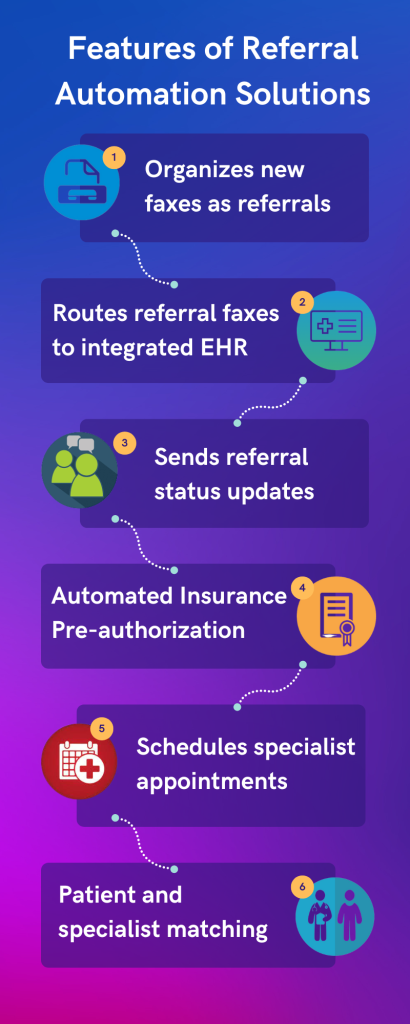
- The software identifies and organizes new faxes as referrals or documents related to existing patients.
- The automation software routes referral faxes to the referrals queue or an integrated EHR.
- Bots notify staff if any referral needs attention.
- Automated referral status updates are sent to the referring doctor.
- The insurance pre-authorization is automated with the help of automation bots.
- Facilitates tracking the patient referrals throughout the referral cycle.
- The software schedules specialist appointments once all checks are complete. Some automation solutions also include a feature that helps patients schedule appointments directly through the interface.
- Automation software may also include a feature that enables primary care providers to invite specialists for a secure online discussion to review a specific patient case.
- Bots accurately match the patient with the specialist based on factors such as insurance, provider affiliation, average wait time, distance from the patient, and other relevant metrics.
- The software provides insights in real-time such as referral source dashboard, patient referral volume, referral trends, referral leakage rate, and more. This information helps healthcare providers enhance the quality of care.
How to Choose the Best Referral Automation?
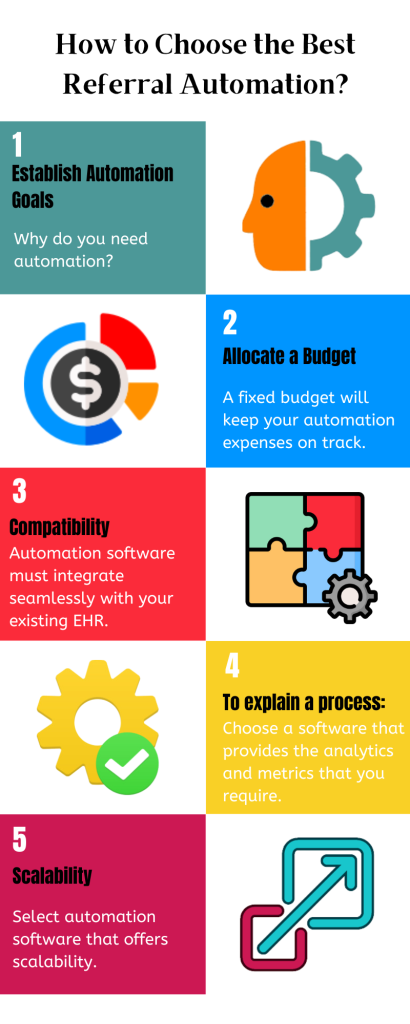
Establish Automation Goals:
To choose the right automation software, you will need to establish what you expect to achieve through automation.
Allocate a Budget:
Automation software can be extremely expensive. And, it is very easy to drift towards an expensive solution. Having a fixed budget helps you stay on track as far as the expenses are considered.
Compatibility with Existing System:
Choose an automation software that integrates seamlessly with your existing EHR.
Insights:
Check if the software provides the required analytics and insights as per your specific needs.
Scalability:
When investing in a referral automation solution, it is a good idea to think about your long-term goals and check if it is capable of meeting those goals. One of these aspects is ascertaining if the software will support the growth and expansion of your healthcare facility. Therefore, make sure you choose software that can scale with the growing needs of your services.
These are some of the factors that will help you select the best software for your healthcare facility. However, with several players in the field of healthcare automation software, it is easy to get confused and you may find it difficult to find the best fit for your services.
This is where Auxiliobits can help you!
Our professionals have an in-depth knowledge of automation technology. They also understand how different workflows in healthcare function. Our team studies the existing systems on the client’s side. Based on the specific needs of the clients, we suggest the best software solutions to streamline your referral management system. We suggest customized solutions that are cost-effective and enhance the efficacy of the system.
Based on your existing set-up, our experts may recommend enterprise-level automation systems that help in automating different workflows. Enterprise-level automation helps different workflows connect on a single platform. It facilitates seamless data transfer and speeds up different processes and enhances productivity. However, the recommendations adhere to the allocated budget.
We have several years of experience in providing automation solutions to clients in the healthcare sector.
Connect with our team Now to find the best automation solutions!
Keep yourself updated with the latest in the field of automation with more blogs on the subject posted HERE!





