







Human resources has evolved from an administrative function into a strategic business partner responsible for workforce planning, employee experience, compliance, and organizational performance. Yet many HR teams still operate through fragmented processes, disconnected systems, and inconsistent service delivery across business units and geographies. An HR shared services model addresses these challenges by centralizing selected HR activities while preserving local capabilities for responsibilities that require proximity, contextual understanding, or direct business engagement.
The objective is not to move every HR activity into a central department. It is to determine which processes benefit from standardization and scale, which require local decision-making, and how both can operate within a unified service delivery framework.
For HR leaders, designing this structure requires more than organizational restructuring. It involves process segmentation, service catalog design, governance, technology integration, data ownership, and performance measurement. Understanding what belongs in the center and what should remain local is the foundation of a sustainable HR operating model.
What Is an HR Shared Services Model?
An HR shared services model is an operating structure that consolidates common HR processes, expertise, and technology into a centralized service organization supporting multiple business units, locations, or employee populations.
Instead of every department maintaining separate teams for routine HR activities, the organization establishes a common delivery function responsible for executing standardized processes. These typically include employee data management, payroll administration, benefits administration, onboarding coordination, HR inquiries, and employment documentation.
The centralized function operates alongside other HR capabilities, including HR business partners (HRBPs), specialist Centers of Excellence (CoEs), and local HR teams.
A typical HR operating model contains four interconnected layers:
- HR shared services: Executes repeatable transactions, manages employee inquiries, maintains records, and delivers standardized services.
- HR business partners: Translate business priorities into workforce strategies and advise business leaders on organizational effectiveness.
- Centers of Excellence: Develop specialist policies, frameworks, and solutions for talent acquisition, compensation, learning, performance management, and organizational development.
- Local HR and site support: Handle location-specific requirements, employee relations matters, local compliance, and situations requiring direct employee or management engagement.
These layers must operate through clearly defined responsibilities, escalation routes, and decision rights. Otherwise, centralization can create additional handoffs instead of reducing operational complexity.
A well-designed HR shared services model therefore combines centralized execution with distributed expertise and accountable business-facing support.
What HR Activities Should Move Into the Center?
The strongest candidates for centralization are activities with high transaction volumes, repeatable workflows, common data requirements, and relatively predictable outcomes. These processes benefit from consistent execution, automation, shared expertise, and consolidated reporting.
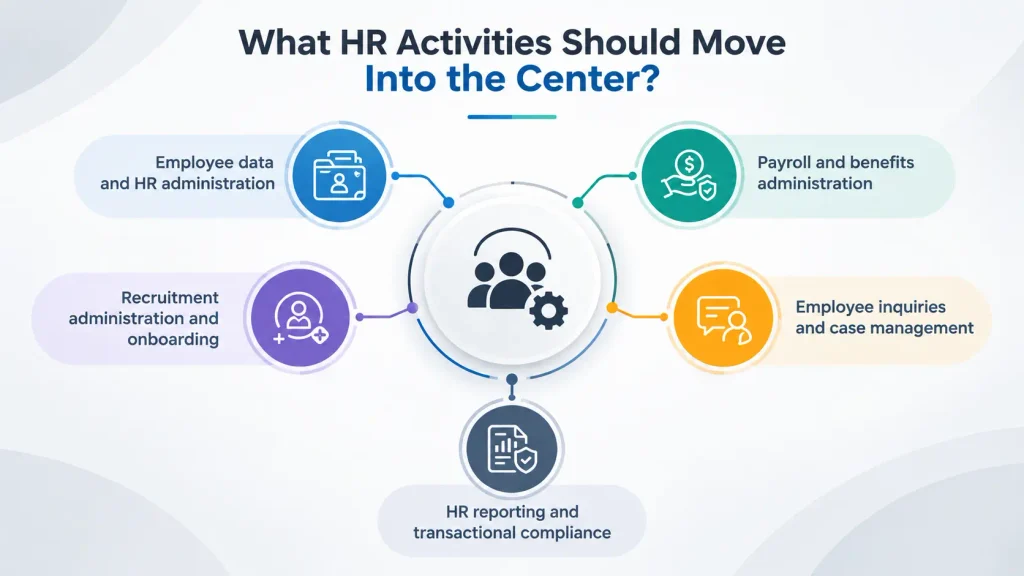
1. Employee data and HR administration
Employee lifecycle administration is one of the most suitable areas for centralization. Activities include employee record creation, job and organizational data updates, employment documentation, employee status changes, and maintenance of HR information systems.
A centralized team can enforce common data definitions, mandatory fields, validation rules, and approval workflows. This improves data completeness and reduces discrepancies between payroll, HR systems, finance, and workforce reporting.
For multinational organizations, however, standardized data structures must accommodate country-specific employment attributes and statutory reporting requirements.
2. Payroll and benefits administration
Payroll-related administration involves collecting employee changes, validating payroll inputs, managing exception queues, coordinating approvals, and reconciling payroll outputs. These activities can be consolidated into a common service function, but centralization does not eliminate local statutory obligations or the need for country-specific payroll expertise.
A robust design separates payroll data preparation, authorization, payment execution, and reconciliation according to the organization’s control framework. Access restrictions, segregation of duties, audit trails, and exception monitoring are particularly important.
Benefits administration can follow a similar structure, with centralized enrollment support and standardized employee communications supported by local benefit rules and provider arrangements.
3. Recruitment administration and onboarding
Recruitment administration often contains repeatable activities such as interview scheduling, candidate communications, background-check coordination, offer documentation, and onboarding task management.
Centralizing these activities can improve recruiter capacity, reduce administrative delays, and create a consistent candidate experience.
Strategic workforce planning, hiring decisions, and relationship management with business leaders should remain with the appropriate HR or business stakeholders. The shared service team executes the approved process rather than independently determining workforce priorities.
4. Employee inquiries and case management
A centralized HR service desk can provide a common entry point for questions about policies, leave, payroll, benefits, employment documents, and HR systems. Requests should be categorized using a standardized taxonomy and routed through defined workflows. Frequently asked questions can be resolved through knowledge articles and employee self-service, while complex cases move to specialist teams.
The service desk should track first-contact resolution, case aging, reopening rates, escalation volumes, and employee satisfaction rather than relying solely on the number of tickets closed.
5. HR reporting and transactional compliance
Routine workforce reports, data extracts, document retention, audit evidence collection, and recurring compliance checks can also be centralized.
Common definitions and controlled reporting logic help ensure that business units interpret workforce metrics consistently. Nevertheless, report ownership, data access permissions, retention schedules, and regulatory obligations must be explicitly assigned.
What Should Stay Local?
Centralization works best when routine execution is separated from activities that depend on local context, sensitive judgment, or immediate interaction with employees and managers.
The purpose of local HR support is not to recreate every centralized administrative function. The purpose of local HR support is to preserve capabilities that standardized workflows alone cannot deliver effectively.
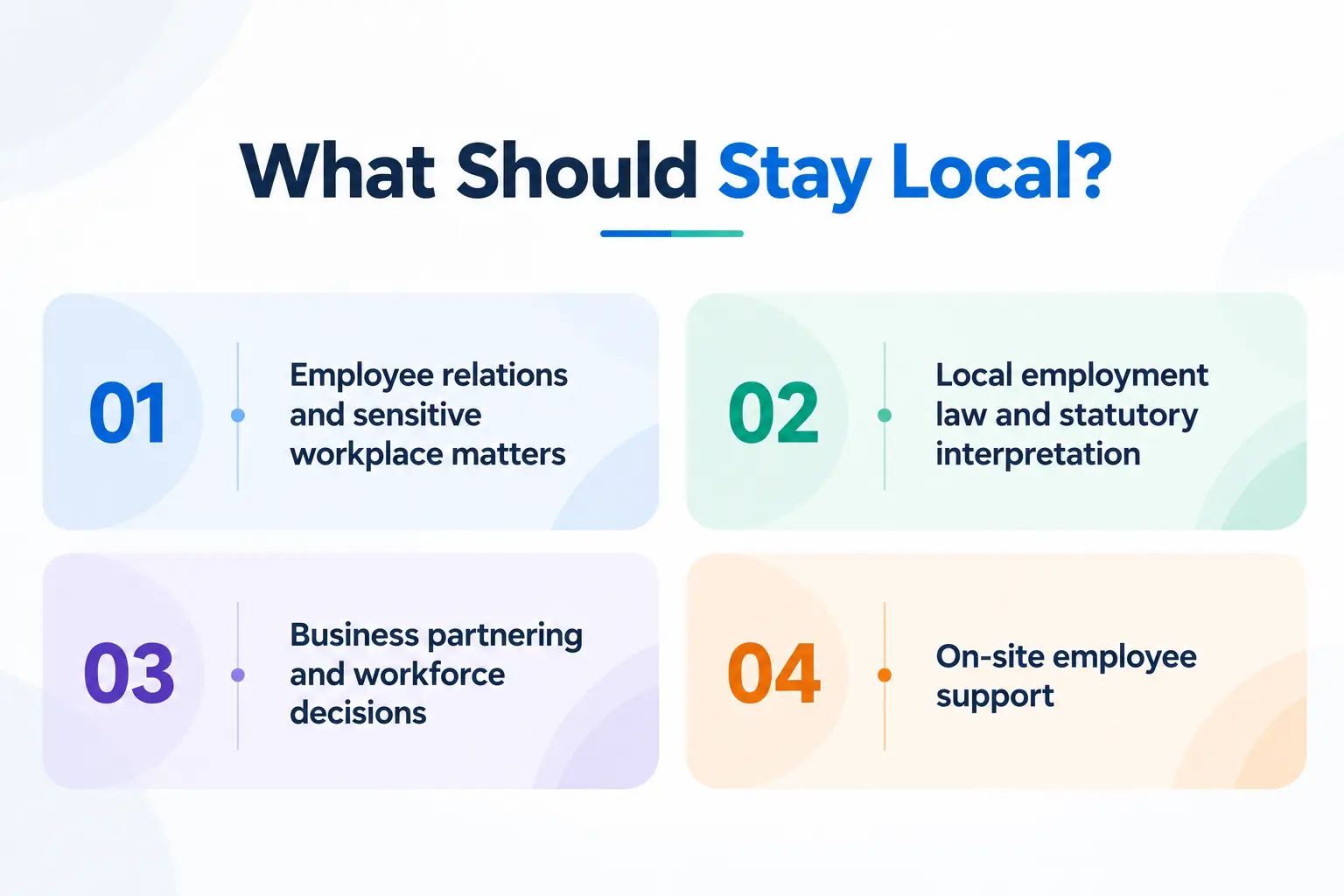
1. Employee relations and sensitive workplace matters
Grievances, workplace investigations, disciplinary cases, conflict resolution, and sensitive employee concerns frequently require direct engagement.
Local HR professionals can assess workplace dynamics, understand cultural context, coordinate with managers, and respond to urgent situations. Complex cases may also require specialist employee relations, legal, or compliance support.
Central teams can support these activities through case tracking, document management, policy guidance, and reporting. However, sensitive decisions sh
2. Local employment law and statutory interpretation
Employment regulations differ across countries and sometimes across states or jurisdictions. Requirements may affect working hours, leave entitlements, termination procedures, employee documentation, benefits, and consultation obligations.
A centralized organization can maintain common policy frameworks and compliance controls, but local experts must validate their application against applicable laws.
This requires a clear distinction between global policy ownership, local legal interpretation, and operational execution. Organizations should also establish a process for monitoring regulatory changes and updating workflows before new requirements take effect.
3. Business partnering and workforce decisions
Business leaders need HR professionals who understand operational priorities, workforce risks, organizational design, and talent requirements.
HRBPs should therefore remain closely connected to business units. Their responsibilities include advising leaders on workforce planning, organizational change, succession risks, leadership effectiveness, and employee engagement.
Routine reporting preparation may be centralized, but interpreting workforce trends and translating them into business decisions requires strategic partnership.
4. On-site employee support
Certain environments require immediate, in-person assistance. Manufacturing facilities, healthcare organizations, distribution centers, and geographically dispersed operations may need local HR presence to support shift-based employees, workplace incidents, urgent employee concerns, or location-specific activities.
The level of local support should reflect employee population, operational risk, geographic dispersion, and service demand rather than follow a uniform headcount ratio.
How to Decide What Moves Into the Center
The decision should be based on process characteristics, risk, and business requirements—not simply on whether a task appears administrative.
A practical assessment evaluates each activity across six dimensions:
| Assessment criterion | Centralization indicator |
| Process standardization | Common rules and workflows apply across units |
| Transaction volume | High and recurring demand supports economies of scale |
| Exception rate | Most cases follow predictable decision paths |
| Regulatory complexity | Requirements can be controlled through defined local variations |
| Employee proximity | Direct local interaction is not essential |
| Technology readiness | Systems support shared workflows, data access, and auditability |
Each process can be scored against these dimensions and classified as centrally delivered, locally delivered, or jointly managed.
For example, employee address changes may be fully centralized through employee self-service with automated validation. A complex workplace investigation, by contrast, requires case-specific judgment and appropriate local or specialist involvement.
The HR shared services model should also distinguish process ownership from task execution. A centralized team may execute a process without owning the underlying policy, approving exceptions, or making consequential employment decisions.
This distinction prevents accountability gaps and helps organizations avoid moving sensitive decisions into teams designed primarily for high-volume service delivery.
Designing the Service Delivery and Governance Structure
Once scope is established, the next challenge is defining how work moves between centralized services, local HR, HRBPs, and specialist teams.
A service catalog should document each service, its eligibility criteria, required inputs, accountable owner, expected turnaround time, escalation path, and applicable controls. Standard service definitions reduce ambiguity and create a measurable basis for performance management.
A tiered support structure is often effective:
- Tier 0 — Self-service: Employees and managers access knowledge articles, forms, policy information, and guided workflows.
- Tier 1 — General HR support: Service agents resolve routine inquiries and straightforward administrative requests.
- Tier 2 — Specialist resolution: Experienced teams handle complex payroll, benefits, systems, policy, or employee lifecycle cases.
- Tier 3 — Expert or decision authority: Appropriate HR leaders, legal specialists, CoEs, or authorized business stakeholders resolve high-risk matters and approve exceptions.
Not every issue must follow all four tiers. Routing rules should direct cases to the correct destination based on complexity, risk, and required decision authority.
The governance structure should define service ownership, policy ownership, data stewardship, approval rights, and escalation accountability. Service-level agreements (SLAs) should establish expected response and resolution times, while operational-level agreements (OLAs) should clarify dependencies between internal teams.
A mature HR shared services model also requires regular governance reviews to examine recurring failures, unresolved ownership questions, policy exceptions, and service performance trends.
Common Implementation Mistakes to Avoid
Several design errors can undermine shared services transformations even when the organizational structure appears sound.
- Centralizing before standardizing: Moving inconsistent processes into a central team consolidates complexity rather than eliminating it. Map workflows, remove unnecessary variations, and establish common controls before migration.
- Removing local expertise too aggressively: Eliminating local capacity without assessing regulatory requirements, employee needs, and operational risks can increase escalation delays and compliance exposure.
- Automating fragmented processes: Automation magnifies existing process design. Resolve unclear ownership, duplicate approvals, and poor data quality before implementing advanced workflows.
- Creating ambiguous accountability: If policy owners, process owners, and service delivery teams have overlapping responsibilities, issues may circulate between teams without resolution.
- Measuring volume instead of value: High case-closure rates do not necessarily indicate quality. Pair productivity measures with accuracy, employee satisfaction, resolution effectiveness, and risk indicators.
- Underestimating change management: Employees and managers need clear communication, training, accessible support, and confidence in the new service channels. Transition planning should include knowledge transfer, testing, cutover controls, and post-launch stabilization.
- Avoiding these mistakes requires treating the transformation as an operating model redesign rather than a simple departmental consolidation.
Conclusion
An effective HR shared services strategy establishes a deliberate boundary between standardized enterprise services and responsibilities that require local judgment, specialist expertise, or direct business engagement.
Centralizing repeatable administration creates opportunities for scale, consistency, and automation. Retaining the right local capabilities protects employee experience, regulatory responsiveness, and the quality of business decisions.
Ultimately, the HR shared services model succeeds when its processes, technology, governance, and performance measures operate as one integrated system. Organizations that establish clear ownership, standardize before automating, and continuously evaluate service outcomes can build a more scalable HR function without sacrificing the human judgment that effective people management requires.