








Building a shared services function from scratch is more than consolidating teams or moving administrative work into one location. It is an opportunity to redesign how an organization delivers internal services, manages costs, maintains controls, and scales operations as the business grows. Understanding how to start a shared services center begins with identifying which activities should be centralized, what business problems centralization should solve, and how success will be measured.
For organizations dealing with fragmented processes, duplicated effort, inconsistent reporting, or rising operational costs, a well-designed shared services function can create a more consistent operating foundation. However, the business case must go beyond projected savings. It should demonstrate improvements in service quality, accountability, flexibility, and long-term organizational capability.
What Is a Shared Services Function, and Why Build One From Scratch?
A shared services function brings selected business activities from different departments, business units, or locations into a coordinated service-delivery model.
For example, instead of five business units independently processing supplier invoices, a company can consolidate invoice processing into one shared services team using common procedures, technology, and performance standards.
Common functions suitable for shared services include:
- Finance: Accounts payable, accounts receivable, reconciliations, and financial reporting.
- Human resources: Payroll administration, employee records, and routine employee support.
- Procurement: Purchase order administration, supplier onboarding, and purchasing support.
- IT: Service desk operations, access requests, and routine technical support.
- Customer operations: Standardized back-office support and transaction processing.
Starting from scratch allows an organization to design its operating model around current business requirements instead of inheriting outdated structures and inefficient workflows.
The potential benefits include:
- Lower operating costs: Reduce duplicated work and improve resource utilization.
- Standardized processes: Establish consistent procedures, approval rules, and service expectations.
- Stronger controls: Improve audit trails and clarify responsibilities.
- Better performance visibility: Use common metrics to identify bottlenecks and recurring errors.
- Scalable operations: Support additional transactions without automatically replicating every role.
These benefits are not automatic. Centralizing an inefficient process without redesigning it can simply reproduce the same problems at a larger scale.
How to Build a Business Case for Shared Services
Before deciding how to start a shared services center, establish a clear picture of the current operating environment. Leadership needs evidence of existing problems, the cost of maintaining the current model, and the improvements the proposed center is expected to deliver.
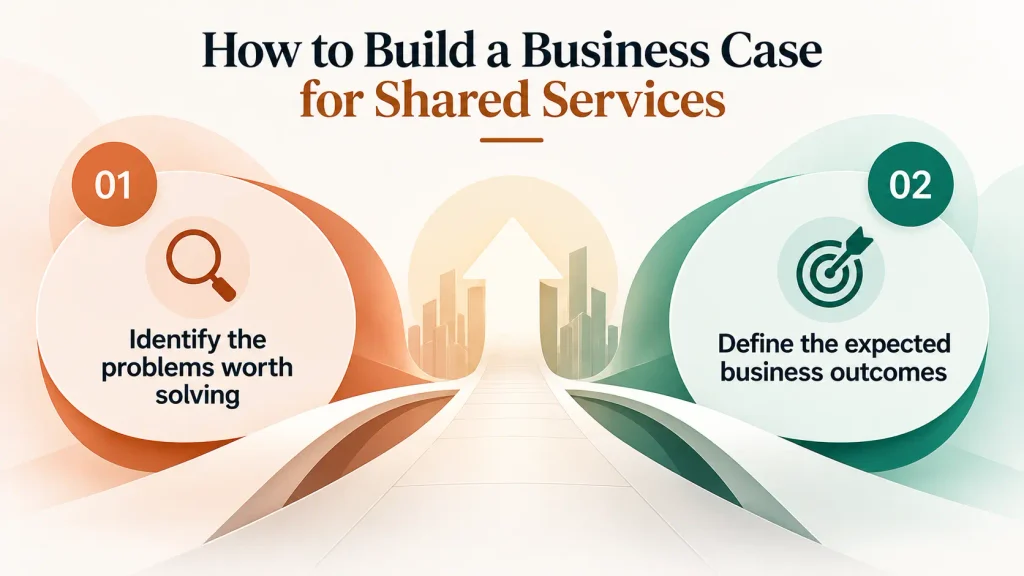
1. Identify the problems worth solving
Review existing processes across departments and business units. Focus on inefficiencies that centralization or standardization could realistically address.
- Duplicated effort: Multiple teams independently perform the same administrative activities.
- Inconsistent procedures: Departments follow different approval rules or documentation standards.
- High exception rates: Employees repeatedly correct errors, chase missing information, or resolve avoidable discrepancies.
- Limited visibility: Management cannot easily compare performance across business units.
- Growing operating costs: Transaction volumes increase faster than productivity.
One frequently overlooked factor is the cost of exceptions. Two departments may process identical invoice volumes but require different amounts of manual work because their supplier data and approval procedures differ.
A reliable business case captures these differences instead of assuming every department will achieve identical savings.
2. Define the expected business outcomes
Connect each identified problem to a measurable result.
| Current problem | Expected improvement | Suggested KPI |
| Duplicated administrative work | Better resource utilization | Cost per transaction |
| Inconsistent invoice processing | More standardized workflows | First-time-right rate |
| Frequent approval delays | Faster processing | Invoice cycle time |
| Poor operational visibility | Consistent performance reporting | SLA attainment |
| Repeated manual corrections | Less rework | Exception rate |
This makes the proposal easier to evaluate because leadership can see what the investment should change and how the results will be assessed.
Which Processes Should You Centralize First?
Not every activity belongs in a shared services center. Some processes are repetitive and governed by consistent rules, while others depend on local knowledge, specialist judgment, or regulatory requirements.
When evaluating how to start a shared services center, assess each candidate process against four criteria:
- Repeatability: Does the process follow similar steps across departments?
- Volume: Is there enough recurring work to justify a dedicated delivery structure?
- Risk: Can centralization preserve the necessary controls?
- Readiness: Are the data, systems, and documentation reliable enough to support the transition?
| Process characteristics | Examples | Recommended approach |
| High volume and standardized | Invoice data entry, routine reconciliations | Strong candidates for early consolidation |
| Repeatable but location-specific | Payroll administration, tax-related processing | Centralize with documented local requirements |
| High volume but inconsistent | Supplier onboarding across departments | Standardize before consolidating |
| Judgment-heavy and business-specific | Complex commercial disputes, strategic approvals | Retain specialist decision-making |
Accounts payable can be a suitable starting point because invoice intake, validation, and approval routing often involve repeatable activities. An organization can standardize these workflows before expanding into complex supplier disputes.
Avoid selecting a process solely because it appears expensive. A costly process with fragmented data and numerous exceptions may require substantial redesign before consolidation becomes practical.
Calculate the Full Cost of Establishing the Center
A credible business case compares the total cost of the proposed model with the cost of delivering the same services today. Comparing employee salaries alone will underestimate the investment required.
1. Costs to include
One-time implementation costs
- Process assessment and redesign.
- Recruitment, onboarding, and training.
- Technology configuration and integration.
- Data cleansing and migration.
- Transition support and change management.
2. Ongoing operating costs
- Employee compensation and management.
- Technology licenses and infrastructure.
- Quality assurance and compliance.
- Reporting, workforce planning, and continuous improvement.
- Support retained within local business units.
3. Benefits to quantify
- Reduced duplication and avoidable manual effort.
- Lower rework and exception-handling costs.
- Better utilization of existing technology.
- Avoided recruitment as transaction volumes grow.
- Improved service quality and control consistency.
When evaluating how to start a shared services center, distinguish between direct financial savings and productivity gains. If automation frees employees to perform higher-value work, that capacity is valuable, but it does not automatically reduce payroll expenditure.
The financial model should also test less favorable scenarios. Consider what happens if implementation takes longer, transaction volumes fall short of expectations, or only part of the projected efficiency improvement materializes.
A strong business case explains both the expected return and the assumptions behind it.
Design the Operating Model Before Moving Work
A shared services center needs clear ownership, decision-making authority, and service expectations. Without these foundations, centralization can introduce additional approval layers rather than improve efficiency.
Define three essential elements:
- Process ownership: Assign an accountable owner for end-to-end performance, standards, and continuous improvement.
- Decision rights: Specify which decisions the center can make independently and which require approval from functional or local management.
- Service governance: Establish service-level agreements (SLAs), escalation procedures, reporting requirements, and regular performance reviews.
For example, an accounts payable team may validate invoices and route approvals, while a business unit retains responsibility for resolving commercial disputes. Documenting this distinction prevents transactions from becoming stuck between teams.
Organizations should also decide which activities must remain local. The goal is to centralize repeatable execution while preserving the specialist judgment and business relationships that require local involvement.
Build Technology Around Standardized Processes
Technology can improve shared services performance, but implementing software before understanding the workflow can automate existing inefficiencies.
Start by mapping the process, identifying repetitive tasks, and documenting business rules. Then determine whether existing ERP capabilities, workflow tools, or automation platforms can address the identified problems.
For example, an invoice-processing workflow could combine:
- Intelligent document processing: Extract invoice data and reduce manual entry.
- Workflow automation: Route invoices according to approval rules.
- Reconciliation automation: Match transactions and flag discrepancies.
- AI-assisted exception handling: Help investigate unusual cases, with appropriate controls and human oversight.
Before investing in new tools, assess data quality, integration requirements, access controls, and auditability. The technology roadmap should prioritize verified bottlenecks and allow the center to accommodate additional business units without repeatedly rebuilding its systems.
Plan the Transition Without Disrupting Operations
Even a well-designed operating model can fail if work moves too quickly or if the organization loses critical knowledge. A phased implementation gives the organization an opportunity to test the new process before expanding it.
Use this transition checklist:
- Document existing processes and baseline performance.
- Assign process owners and define responsibilities.
- Standardize workflows and resolve critical data issues.
- Configure systems and test business rules.
- Train employees and establish escalation procedures.
- Pilot the process with a limited scope.
- Validate service quality before expanding to other business units.
A pilot may reveal issues that planning alone cannot identify. For instance, an invoice workflow may work well for one business unit but fail for another because approval limits or supplier data differ.
When planning how to start a shared services center, treat knowledge transfer as a critical deliverable. Employees must understand unusual scenarios and escalation rules, not merely routine processing instructions.
Measure Success Beyond Cost Savings
A shared services function needs a balanced performance framework. Focusing exclusively on cost per transaction can encourage shortcuts that increase errors or delay resolution.
| KPI | What it measures | Why it matters |
| Cost per transaction | Average processing cost | Tracks operational efficiency |
| Cycle time | Time required to complete a process | Identifies delays |
| First-time-right rate | Transactions completed without correction | Measures process quality |
| SLA attainment | Performance against agreed targets | Tracks service reliability |
| Exception rate | Transactions requiring intervention | Reveals process complexity |
| Control compliance | Adherence to defined requirements | Supports risk management |
Capture baseline performance before transitioning work. Review the results regularly and investigate the reasons behind changes rather than assuming every improvement comes from centralization.
For example, lower processing costs accompanied by rising exception rates may indicate that the team is moving transactions faster but creating more rework.
Build a Roadmap for Continuous Improvement
A shared services center should evolve as the organization grows. Its initial focus may be routine transaction processing, but it can gradually develop stronger analytics, automation, and process improvement capabilities.
A practical maturity roadmap has three stages:
- Establish: Consolidate selected activities, document procedures, and introduce consistent reporting.
- Optimize: Reduce exceptions, improve data quality, standardize workflows, and automate suitable tasks.
- Scale: Expand into additional processes, strengthen analytics, and establish continuous improvement capabilities.
Each stage should have clear performance targets and readiness criteria. Leadership can then review actual results, address gaps, and approve expansion based on evidence rather than assumptions.
Conclusion
The business case for starting a shared services function from scratch should demonstrate how the organization can improve service delivery, strengthen controls, reduce avoidable effort, and build capacity for future growth.
Success depends on more than consolidating employees. It requires a realistic financial model, carefully selected processes, clear accountability, suitable technology, structured transition planning, and sustained investment in people.
Understanding how to start a shared services center means recognizing that the center is not the end goal. It is an operating capability designed to make the business more consistent, efficient, and adaptable. Start with a clearly defined problem, validate improvements through a manageable scope, and expand when the evidence supports doing so.