





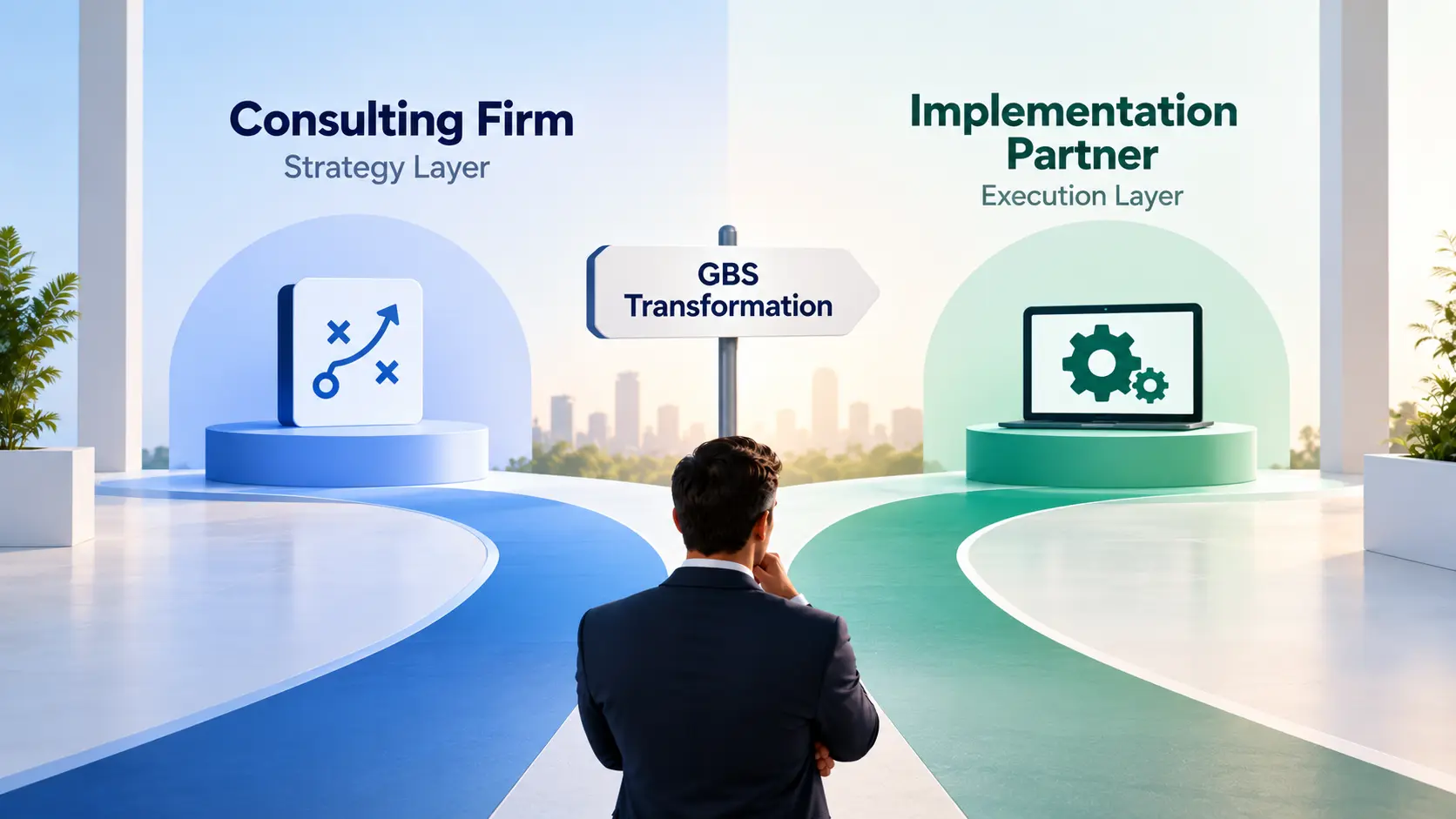


When planning a Global Business Services (GBS) transformation, one of the first decisions leaders face is implementation partner vs consulting firm. The two can look similar from the outside, but they typically solve different problems. A consulting firm can help define the operating model, identify transformation priorities, build a roadmap, and structure governance. An implementation partner turns those priorities into working technology, automated workflows, ERP integrations, and measurable operational results.
This distinction matters because GBS transformation does not end when the strategy document is complete. A roadmap only creates value when someone actually implements it.
For finance shared services leaders, understanding implementation partner vs consulting firm can help determine whether the organization needs strategy, technical execution, or both. This guide explains what each provider typically does, when to hire one, when to use both, and how to move from a GBS strategy to working automation.
The Two Layers of GBS Transformation
GBS transformation can be viewed as two connected layers: strategy and implementation.
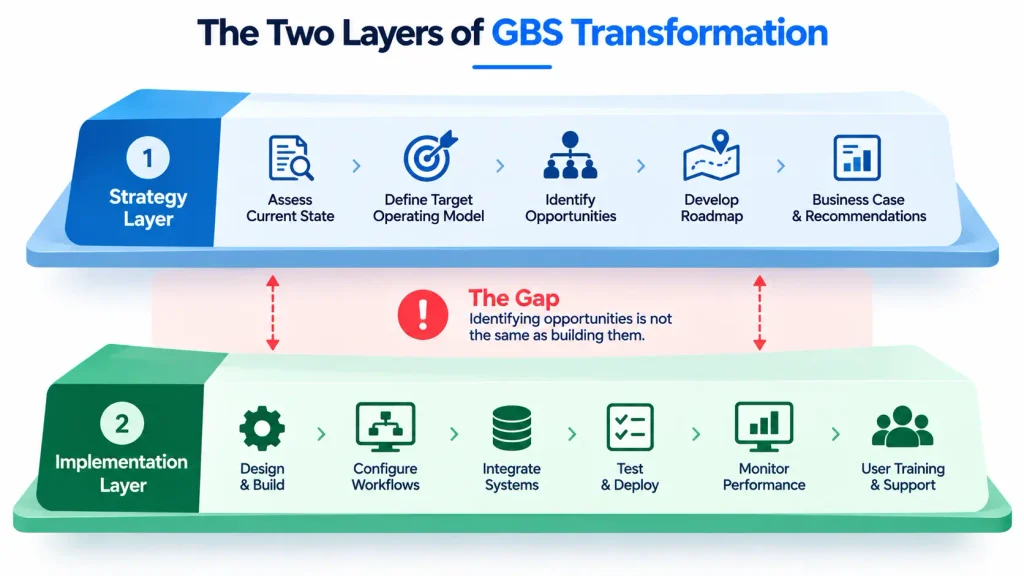
Layer 1: Strategy
The strategy layer defines where the organization wants to go. A consulting firm may help design the target operating model, assess process maturity, define organizational structures, establish governance, identify opportunities, and develop a transformation roadmap.
Typical deliverables include:
- Target operating model
- Process maturity assessment
- Organizational structure
- Governance model
- Transformation roadmap
- Business case
- Technology recommendations
- Vendor-selection strategy
- Change-management plan
The output is usually a strategic blueprint describing what the organization should change and why.
Layer 2: Implementation
The implementation layer turns that blueprint into something operational. Someone needs to build the automation, configure workflows, integrate systems, test the solution, deploy it into production, monitor performance, and measure the results.
Typical deliverables include:
- Working RPA bots
- Automated workflows
- ERP integrations
- Exception-handling logic
- Production deployments
- Monitoring
- Technical documentation
- User training
- Ongoing support
- ROI reporting
This is where GBS transformation implementation happens. The gap between these two layers is where many transformation programs can encounter challenges. A roadmap may identify AP, reconciliation, close, reporting, or other processes as automation opportunities, but identifying the opportunity is not the same as building it.
That is the space an implementation partner is designed to address.
Auxiliobits describes this distinction as the GBS transformation implementation layer—the practical layer where strategy is translated into technology-enabled operations.
What a Consulting Firm Does and Doesn’t Do
Large consulting firms such as KPMG, Deloitte, EY, Bain, and Hackett Group typically operate at the strategy and transformation-advisory layer.
That does not mean consulting firms can never implement technology. Many large firms have technology implementation practices and can deliver substantial implementation programs. However, their role in a GBS transformation is often broader than simply building individual finance automations.
What consulting firms typically do well
1. Target operating model design
Consultants can evaluate how finance, procurement, HR, IT, and other shared services should be organized.
They may determine:
- Which processes should be centralized
- Which activities should remain local
- Which functions should move into GBS
- How service delivery should be structured
- Which governance model should be used
- How responsibilities should be divided
2. Organizational structure and governance
GBS transformation often involves changes to roles, reporting structures, service ownership, governance, and decision-making. A consulting engagement can help define who owns each process and how performance should be managed.
3. Process maturity assessment
Consultants can benchmark current processes and identify gaps. For example, an organization may discover that its AP process is highly manual, reconciliation depends heavily on spreadsheets, and financial close activities involve multiple disconnected systems.
4. Vendor selection and RFP management
Consultants can help create requirements, evaluate vendors, manage RFPs, and compare technology options. This process can be particularly useful when an organization knows it needs transformation but has not yet decided which technology or provider to use.
5. Change-management strategy
GBS transformation affects people as well as technology. Consulting firms can help organizations plan communications, training, organizational changes, and adoption strategies.
What a strategy engagement may not deliver
Depending on the provider and scope, a strategy-focused engagement may not include:
- Production RPA bot development
- Detailed automation workflow development
- ERP-specific automation configuration
- Production deployment
- Automation monitoring
- Ongoing bot maintenance
- Process-level technical support
These activities can instead be handled by an implementation team.
Cost and timeline
A large transformation strategy engagement can cost 100,000–500,000 or more, depending on organizational complexity, geography, scope, and consulting firm.
A strategy engagement may also run for approximately 3–6 months. The key question is what you receive at the end. If the engagement is primarily strategic, the primary deliverables may be a roadmap, operating model, business case, and transformation plan rather than a production automation. That does not make the engagement unsuccessful. If the organization genuinely needs strategy, these deliverables can be valuable.
The issue occurs when an organization expects a strategy engagement to automatically produce working automation. This is the central distinction in shared services consulting vs implementation.
Organizations that need broader strategic guidance can also explore automation consulting to define priorities, requirements, and transformation direction before moving into execution.
Consulting answers: “What should we change, why should we change it, and how should the organization operate?”
Implementation answers: “How do we build and deploy the solution that makes that change happen?”
What an Implementation Partner Does
An implementation partner operates much closer to the technology and process-execution layer. Providers such as Auxiliobits, Auxis, Chetu, and Relevance Lab may help organizations turn defined requirements into working automation. The exact scope varies by provider, but implementation work commonly includes:
Build RPA bots and automation workflows for specific finance processes
An implementation team takes a specific process and converts its business rules into an automated workflow.
For finance, this could include:
- Invoice processing
- AP validation
- Three-way matching
- Reconciliation
- Expense auditing
- Journal processing
- Reporting
- Financial close
- Purchase-to-pay
- Order-to-cash
Integrate automation with your ERP (SAP, Oracle, NetSuite, Sage)
Finance automation usually needs to work with existing systems. An implementation partner may integrate automation with platforms such as:
- SAP
- Oracle
- NetSuite
- Sage
- Microsoft Dynamics
The objective is not simply to build an isolated bot. The automation needs to interact correctly with the systems where financial transactions, master data, approvals, and reporting reside. This makes GBS technology implementation a critical part of execution.
This makes GBS technology implementation a critical part of execution. For organizations looking to connect multiple automation use cases across finance and shared services, intelligent enterprise automation can provide a broader framework for execution.
Deploy and monitor production automation
A POC is useful, but the real value comes when the automation reaches production. Implementation teams typically manage development, testing, user acceptance, deployment, stabilization, and handover.
Provide ongoing support and optimization
Once automation is live, someone needs to monitor it. A production automation may encounter:
- ERP changes
- Application updates
- Unexpected data
- Failed transactions
- New business rules
- Integration errors
- Process exceptions
An implementation partner can provide ongoing support and optimization.
Measure and report on ROI
Implementation should also be tied to measurable outcome and automation ROI. Useful metrics include:
- Processing time
- Manual hours
- Error rate
- Transaction cost
- Exception rate
- Automation rate
- Capacity recovered
- Annual savings
For example, an Auxiliobits AP automation case study reports more than $200,000 in annual savings and approximately 9,700 hours of annual capacity recovered, alongside a reduction in invoice reconciliation time from 4.2 days to less than 18 hours.
Another finance automation case study shows how intelligent document processing and RPA can be applied to broader finance operations.
Cost and timeline
A focused implementation may cost approximately 15,000–150,000 per process, depending on complexity. A relatively contained process may be implemented in approximately 4–8 weeks, although multi-entity environments, complex ERP integrations, extensive testing, and significant process redesign can increase the timeline.
The primary deliverable is different from a strategy engagement: The deliverable is a working automation in production, supported by measurable operational results.
Side-by-Side Comparison
The difference between an implementation partner vs consulting firm becomes much clearer when you compare their role, deliverables, timelines, and responsibilities side by side. While there can be some overlap between the two, their core purpose is different: a consulting firm primarily helps define the transformation strategy, while an implementation partner focuses on building and deploying the automation.
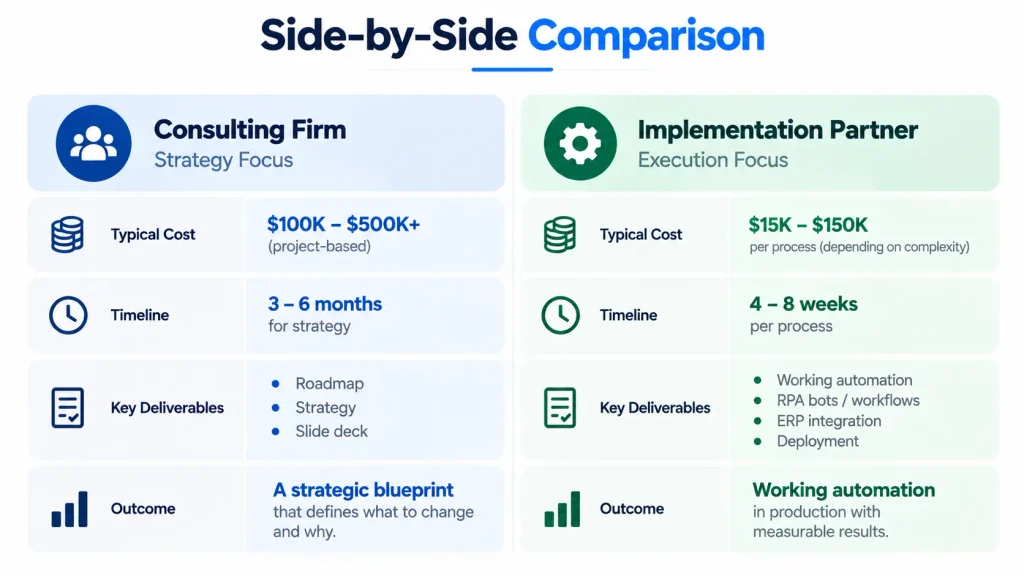
| Dimension | Consulting Firm | Implementation Partner |
| What they deliver | Roadmap, strategy, slide deck | Working automation in production |
| Typical cost | 100K–500K+ | 15K–150K per process |
| Timeline | 3–6 months for strategy | 4–8 weeks per process |
| ERP integration | Advises on it | Actually does it |
| RPA bot development | Doesn’t typically do it in a strategy engagement | Builds and deploys it |
| Core competency | Strategy, operating model, and transformation planning | Automation development and technical execution |
| Measurable ROI | Projects ROI in a model | Delivers and measures ROI in production |
| Ongoing support | Change management coaching | Technical monitoring and maintenance |
| Best for | Organizations that need a strategy | Organizations that need automation built |
| After engagement | You may still need an implementation partner | You have working automation |
The most significant difference is the type of outcome each engagement is designed to produce. A consulting firm may spend several months assessing processes, designing the target operating model, and developing a transformation roadmap. The result can give leadership a clear direction for the GBS program, but it does not necessarily mean the recommended automation is already running.
An implementation partner starts further down the execution path. Once the process and requirements are defined, the partner can build the RPA bots, configure workflows, integrate them with the ERP, test the solution, and deploy it into production.
The cost and timeline can also be significantly different. A strategy engagement may cost 100K–500K+ and take 3–6 months, while a focused implementation may cost approximately 15K–150K per process and take 4–8 weeks.
This is why shared services consulting vs implementation should not be treated as an either-or decision. If you need to determine what your GBS organization should look like, consulting may be appropriate. If you already know what needs to be automated, an implementation partner can take that requirement and turn it into a working solution.
In simple terms: Consulting defines the roadmap. Implementation builds the road.
When You Need a Consulting Firm
A consulting firm can be valuable when your GBS transformation is still at the strategic stage.
You may need consulting if:
- You’re early in the GBS journey
If your organization does not have a target operating model, jumping directly into automation can create disconnected solutions. You first need to understand how the future organization should operate.
- You need organizational design
If the transformation involves restructuring teams, locations, reporting lines, governance, and service ownership, consulting expertise can be useful.
- You need a board-level business case
Senior leadership may require a financial model showing the expected investment, savings, operating-model changes, and potential return before approving the program.
Consultants can help build that business case.
- You need vendor selection
If you do not know whether you need RPA, workflow automation, intelligent document processing, an AP platform, or another technology, consulting support can help define requirements and evaluate vendors.
- You haven’t identified which processes to automate
This is a critical point. If you don’t yet know whether AP, reconciliation, close, reporting, procurement, or another process should be automated first, strategy should come before implementation.
You can explore finance transformation consulting for a broader look at the strategy side of finance transformation. The basic rule is: If the problem is “We don’t know what the future should look like,” start with strategy.
When You Need an Implementation Partner
An implementation partner becomes more relevant when the strategic direction is already clear.
You may need one when:
- You already have a roadmap
Perhaps a consulting firm has completed your GBS strategy, or your internal transformation team has already developed the roadmap.
The next question is, who is going to build it? That’s where implementation comes in.
- You know which processes to automate
If leadership has already identified AP, reconciliation, close, or reporting as priorities, you may not need another strategy exercise. You need technical execution.
- You bought RPA software
Organizations sometimes purchase UiPath or Microsoft Power Automate and then discover that owning the platform does not mean they have the expertise to build finance automations. The implementation partner can design, develop, test, deploy, and support the workflows.
If UiPath is your selected platform, an experienced UiPath implementation partner can help bridge the gap between platform ownership and production deployment.
- Your existing software doesn’t handle your complexity
You may already have AP automation software but still encounter problems involving:
- Multiple ERPs
- Multiple entities
- Complex approval rules
- Non-standard invoice formats
- Reconciliation requirements
- Legacy applications
- Regional variations
In those cases, implementation expertise can help customize or extend the automation environment.
- You need working automation quickly
If the organization already knows what it needs to automate, spending additional months redefining the strategy may delay value. A focused implementation can start with one process and establish measurable results.
For broader GBS requirements, shared services automation implementation can help translate shared-services priorities into actual automated workflows.
The basic rule is: If the problem is “We know what needs to change, but we need someone to build it,” start with implementation.
When You Need Both
Most successful GBS transformations use both a consulting firm and an implementation partner, but in sequence, not in parallel. Each plays a different role in moving the organization from strategy to execution.
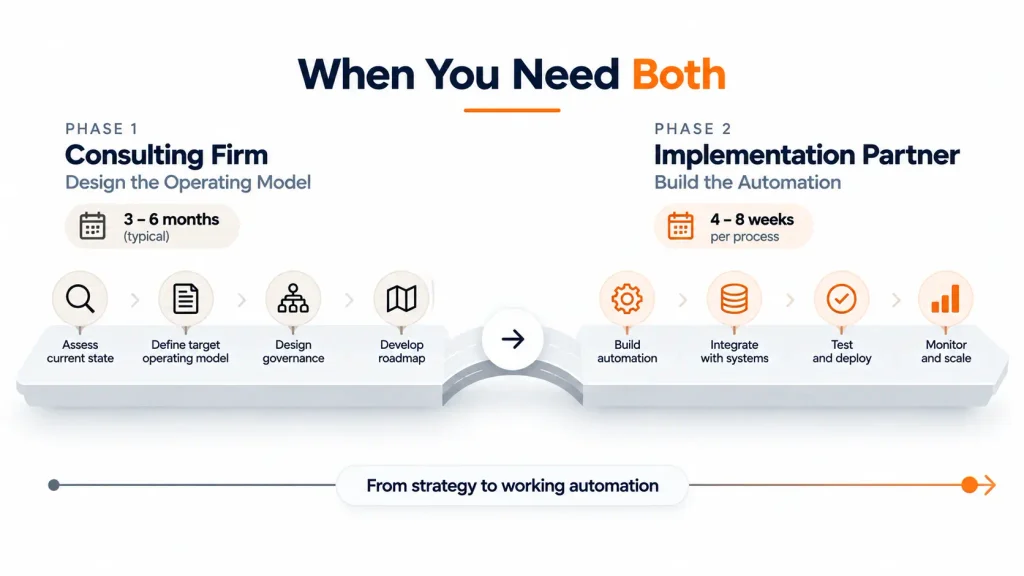
Phase 1: Consulting Firm—Design the Operating Model
The consulting firm first defines the target operating model, transformation roadmap, governance structure, and priorities. This phase typically takes 3–6 months and establishes what needs to change, which processes should be prioritized, and how the GBS organization should operate.
Phase 2: Implementation Partner—Build the Automation
Once the roadmap is ready, the implementation partner turns the strategy into working technology. This includes building automation, integrating ERP and finance systems, deploying workflows, and putting processes into production. Implementation typically takes 4–8 weeks per process, depending on complexity.
One common mistake is hiring a consulting firm and expecting them to also build the automation. Some consulting firms may subcontract the technical work or recommend an implementation partner. If the roadmap already exists, going directly to an implementation partner can provide a more direct path to execution.
The other mistake is hiring an implementation partner before having a clear roadmap. If you do not know what to automate, where to start, or which processes should be prioritized, consulting should come first.
The ideal approach is simple: consulting defines the direction, and implementation turns that direction into working automation.
The Hidden Cost of Using a Consulting Firm for Implementation
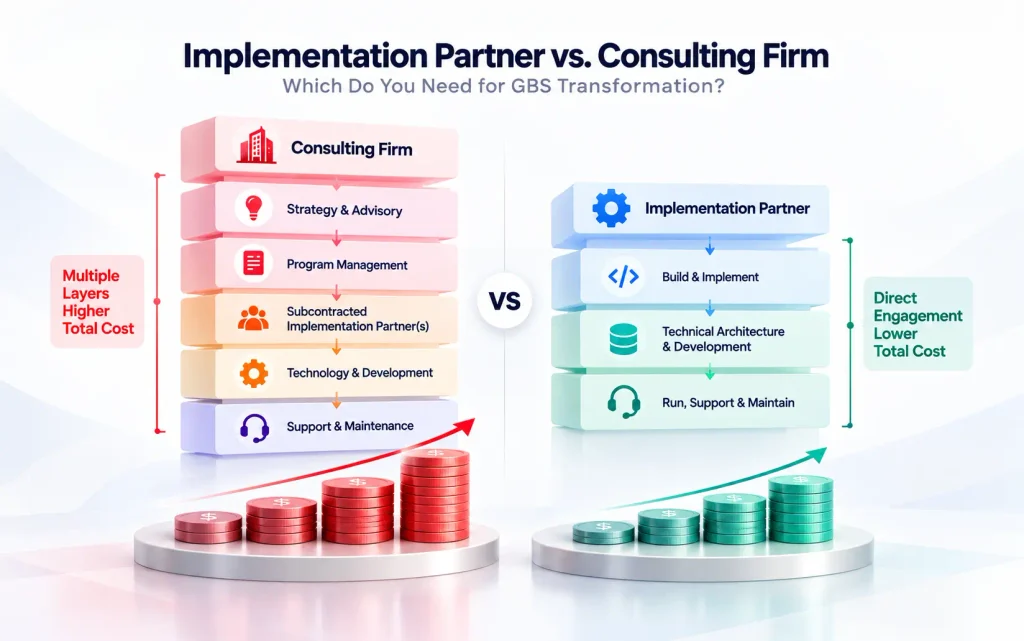
The cost discussion around implementation partner vs consulting firm needs to go beyond the initial proposal.
A strategy engagement and an implementation engagement should not be compared only on price because they produce different outcomes.
However, organizations should understand how implementation is actually delivered.
Some large consulting firms have their own technology implementation practices. Others may work with specialist implementation partners, subcontract portions of development, or recommend technology providers depending on the engagement.
If a third party is involved, ask:
- Who actually writes the automation?
- Who owns the technical architecture?
- Who manages the production environment?
- Who provides support after go-live?
- Who is accountable for integration failures?
- What percentage of the fee goes to implementation?
- Who will be on the delivery team?
- Are the people selling the project the same people delivering it?
There is also a risk of paying for multiple layers of management when a specialist implementation partner could execute a clearly defined process directly.
However, it would be misleading to claim that direct implementation is always 50–70% cheaper. Actual savings depend on the scope, provider, geography, complexity, technology, and commercial structure.
The better approach is to compare proposals on total cost to production, not just consulting fees.
For example: Strategy cost + implementation cost + software + support + change management
versus
Direct implementation cost + software + support
The more important question is, how much will we spend before a working automation is actually in production?
A $200,000 strategy engagement that produces an excellent roadmap may be justified if strategy is the organization’s primary need. But if the organization already knows what to automate, spending heavily on another strategy phase before building anything may delay measurable value.
How to Transition From Consulting to Implementation
If you have already completed a GBS strategy project, the next step should be converting the roadmap into an executable implementation plan.
- Ask your consulting firm for their process prioritization and technical requirements: Get a clear list of the processes they recommend prioritizing, along with the technical requirements, system dependencies, and implementation considerations needed to move forward.
- Take the roadmap to an implementation partner for a POC on the highest-priority process: Share the consulting roadmap with an implementation partner and use a proof of concept (POC) to validate the automation approach, technical feasibility, and expected results before scaling.
- Start with one process (usually AP—highest ROI, clearest metrics): Begin with accounts payable (AP), where transaction volumes, processing times, error rates, and potential savings can be measured clearly. This creates a measurable starting point for the transformation.
- Scale from there: reconciliation, close, reporting, O2C: Once the first automation is successfully implemented, extend the same approach to other finance processes, including reconciliation, financial close, reporting, and order-to-cash (O2C).
- Auxiliobits offers a discovery call to map your roadmap to an implementation plan: If you already have a GBS transformation roadmap but need help turning it into execution, Auxiliobits can review your priorities and map them to a practical implementation plan. Book a free discovery call.
Ready to Move From Strategy to Execution?
GBS transformation creates the most value when strategy and execution are connected.
If you are still deciding how your organization should operate, a strategy engagement can help establish the target operating model, GBS transformation roadmap, governance, and priorities. But if you already have the roadmap, the next question is different: Who is going to build it?
That is where an implementation partner can help. The practical approach is to start with one high-value process, such as reconciliation automation, establish a baseline, build a proof of concept, deploy the automation, measure the results, and then scale to additional GBS processes.
If you already have a GBS roadmap but need help turning it into working automation, book a free discovery call to map your transformation plan to an implementation timeline.
The goal is not to choose consulting or implementation simply because one sounds better. Choose strategy when you need to decide what to build. Choose implementation when you know what needs to be built. Use both when your transformation requires both answers, including the adoption of agentic process automation.