








Finance shared services organizations are under increasing pressure to reduce costs, process transactions faster, improve accuracy, and deliver more value without continuously adding headcount. For many leaders, automation has become the practical answer to that challenge. But automation alone is not enough. The biggest gains come when organizations combine process standardization, technology, governance, and a clear operating model.
The evolution from traditional shared services centers to Global Business Services (GBS) is accelerating this shift. Finance organizations are moving beyond transactional centralization toward integrated, technology-enabled operations powered by automation, AI, and intelligent orchestration.
This guide explains what finance shared services are, how they are evolving into GBS organizations, why automation matters now, which KPIs leaders should track, and how to build a practical automation roadmap.
What are finance shared services?
Finance shared services is a centralized operating model in which a dedicated team performs finance and accounting processes for multiple business units, entities, regions, or functions. Instead of every business unit maintaining its own finance operations, common activities are consolidated into a shared services organization.
Typical finance shared services processes include:
- Accounts payable (AP)
- Accounts receivable (AR)
- General ledger (GL) activities
- Bank and account reconciliation
- Financial reporting
- Vendor management
- Expense management
- Transaction processing
- Month-end close support
The original business case for shared services was straightforward: consolidate repetitive work, standardize processes, and achieve economies of scale. Centralization can reduce duplicated roles, create consistent processes, improve management visibility, and lower the cost of finance operations.
However, centralization by itself does not guarantee efficiency. A shared services center can still depend heavily on spreadsheets, email approvals, manual data entry, repetitive ERP transactions, and employees moving information between disconnected systems.
That is where automation becomes important.
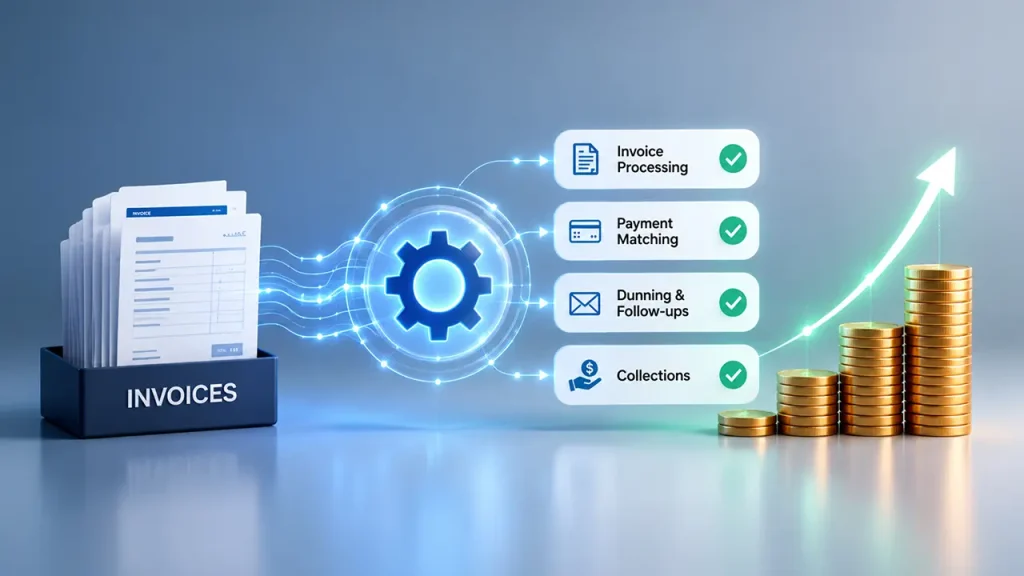
Back office automation can remove repetitive activities from processes such as invoice processing, reconciliation, reporting, and data validation. Organizations can redesign the process and automate tasks that do not require human judgment, rather than just transferring manual work from individual business units to a centralized team.
The result is a shared services model that is not only centralized but also standardized, measurable, scalable, and increasingly technology-driven.
The evolution from shared services to GBS
The traditional shared services center was primarily designed to centralize transactional finance activities. Today, many organizations are moving toward a broader global business services model.
The evolution can be viewed in three stages.
1. SSC: Shared Services Center: The traditional SSC centralizes repetitive finance operations into a dedicated team, often in one location or a small number of delivery centers.
The focus is primarily transactional:

- Process invoices
- Reconcile accounts
- Maintain financial records
- Produce reports
- Handle vendor and employee queries
The primary objective is usually cost reduction through consolidation and standardization.
2. GBS: Global Business Services: GBS expands the model beyond finance. A mature GBS organization can bring together finance, HR, procurement, IT, and other business support functions under a coordinated operating model.
It is also typically more geographically distributed, with processes delivered across multiple locations and service centers.
The focus shifts from simply processing transactions to optimizing the end-to-end service.
That means asking questions such as:
- Can the process be standardized globally?
- Can systems and data be integrated?
- Where are unnecessary handoffs occurring?
- Which activities should be automated?
- How should exceptions be handled?
- How can service quality and business outcomes be measured?
This is where the shared services operating model becomes more important. Technology, governance, process ownership, locations, people, and performance management need to work together rather than operate as separate decisions.
3. AI-native GBS: The next stage is an AI-native GBS organization where automation, intelligent document processing, AI, workflow orchestration, and agentic AI become part of the operating model itself.
Traditional automation follows predefined rules. Agentic systems can increasingly interpret context, reason through defined workflows, take multiple actions, and escalate exceptions within established controls.
For finance shared services, this can mean moving from a model where employees manually coordinate every stage of a process to one where technology coordinates routine work and people focus on exceptions, judgment, and higher-value activities.
This is the broader goal of GBS transformation: not simply creating a larger shared services organization, but creating a more scalable and intelligent way of delivering business services.
GBS therefore becomes less about where work is performed and more about how work is designed, automated, governed, measured, and continuously improved.
Why shared services teams are adopting automation now
Several forces are making automation a higher priority for finance shared services leaders.
1. Labor costs are increasing. Offshore and nearshore delivery models can still provide significant advantages, but wage inflation and competition for skilled finance talent are reducing some of the historical cost advantage. Organizations increasingly need productivity improvements in addition to labor arbitrage.
2. Automation technology has matured. Intelligent document processing, AI-based extraction, machine learning, workflow automation, and agentic AI can now address more than simple data entry. They can support document interpretation, matching, exception management, reconciliation, and process orchestration.
3. ERP integration is improving. Modern finance automation does not have to depend entirely on screen-based RPA. APIs and integration frameworks allow automation to interact with ERP and finance systems more reliably while keeping the existing technology stack in place.
4. Competitive pressure is increasing. When competitors can process invoices faster, close books sooner, and operate with fewer manual touches, maintaining a heavily manual shared services model becomes a competitive disadvantage.
5. Compliance and auditability matter. Well-designed automation can create consistent workflows, approval records, audit trails, and exception histories. This can strengthen controls rather than simply reduce manual work.
The right transformation strategy therefore combines process redesign with technology. Finance leaders evaluating these opportunities can also explore finance transformation consulting to understand how process assessment, automation, implementation, and measurement fit together.
Key shared services KPIs and metrics to track
One of the most important shared services best practices is to establish measurable baselines before implementing automation.
Without a baseline, it is difficult to prove whether an automation initiative has actually improved the operation.
For finance shared services, leaders should track a combination of cost, speed, productivity, quality, and control metrics.
| KPI | What it measures | Benchmark |
| Cost per invoice | Total AP cost / invoices processed | $1–3 automated vs. $8–15 manual |
| Touchless rate | % of invoices processed without human touch | 60–80% automated vs. 10–20% manual |
| Invoice cycle time | Time from receipt to payment | 2–3 days automated vs. 10–15 days manual |
| FTE productivity | Invoices processed per FTE per day | 5–10× improvement with automation |
| Exception rate | % of invoices requiring manual intervention | 20–40%; target under 20% |
| First-pass yield | % of invoices processed correctly the first time | 80–95% automated |
| Discount capture rate | % of eligible early-payment discounts captured | 90%+ automated vs. 40–60% manual |
These figures should be treated as directional benchmarks rather than universal targets. Actual performance varies based on invoice complexity, ERP environment, supplier behavior, approval structures, transaction volume, and process maturity.
The important point is to establish your own baseline and measure improvement against it.
Leaders should also avoid focusing on a single KPI. A lower cost per invoice is not necessarily a success if it comes with more errors or weaker controls. The strongest finance shared services programs balance efficiency with quality, compliance, service levels, and employee productivity.
Shared services automation roadmap
A phased roadmap is usually more effective than attempting to automate every finance process simultaneously.
The objective should be to prove value with one process, stabilize it, and then reuse the technology, governance, and lessons learned across additional workflows.
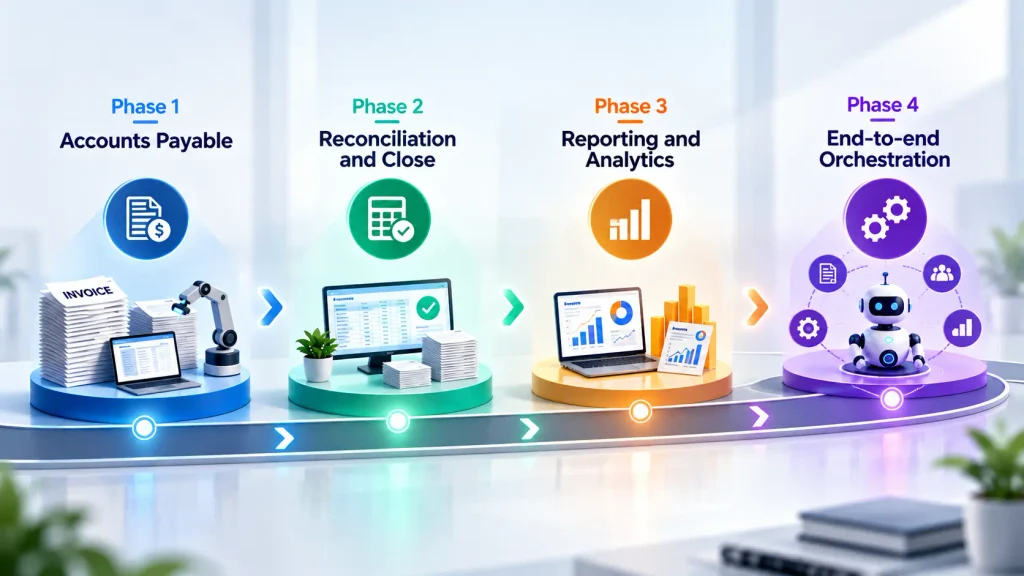
Phase 1—Accounts Payable
Accounts payable is often the best starting point because it combines high transaction volumes, repetitive activities, and measurable outcomes.
The initial automation scope can include:
- Invoice capture
- Data extraction
- Validation
- Purchase-order matching
- Duplicate detection
- Approval routing
- Exception identification
- ERP posting
Organizations can begin with AP automation services and target an initial implementation timeline of approximately 6–8 weeks for a focused engagement.
The key is not simply to automate invoice data entry. Leaders should look at the complete workflow from invoice receipt through validation, matching, approval, exception handling, posting, and payment preparation.
Phase 2—Reconciliation and close
Once AP automation is stable, the next opportunity is often reconciliation and financial close.
Automation can support:
- Bank reconciliation
- Intercompany matching
- Account reconciliation
- Variance identification
- Close checklists
- Supporting documentation
- Exception routing
This phase can typically be approached over 4–6 weeks after Phase 1 is stable.
The benefit is not just faster reconciliation. Finance professionals spend less time comparing information manually and more time investigating the exceptions that actually require judgment.
Phase 3—Reporting and Analytics
The next stage expands automation into reporting and analytics.
Potential use cases include:
- Monthly reporting packages
- Data consolidation
- Management reporting
- Spend analysis
- KPI dashboards
- Automated report distribution
A focused 4–6 week phase can establish automated reporting workflows while creating more timely access to operational information.
Organizations looking to improve visibility can also explore spend analytics to move from manually assembled reports toward more consistent, actionable spend data.
Phase 4—End-to-end orchestration
The final stage is connecting the individual automated processes into a coordinated finance operating environment.
Instead of having separate automation for AP, reconciliation, reporting, and close, organizations can introduce intelligent orchestration across the workflows.
Agentic systems can help coordinate multi-step processes, interpret exceptions, interact with enterprise applications, and escalate work when human judgment is required.
This is where agentic process automation becomes particularly relevant.
A focused orchestration phase may take 8–12 weeks depending on the number of processes, systems, entities, and integrations involved.
The long-term objective is not a collection of disconnected bots. It is an integrated finance shared services operation where automated processes work together as part of a scalable operating model.
Best practices for shared services automation
Successful automation depends as much on execution discipline as on technology.
- The first best practice is to start with the highest-volume, most repetitive process. For many finance shared services organizations, AP provides the clearest starting point because it has measurable transaction volumes and repetitive workflows.
- Second, baseline performance before automation. Record cost per transaction, cycle time, exception rates, touchless rates, FTE effort, and quality metrics before making changes.
- Third, choose technology that integrates with your ERP. A standalone automation tool that creates another disconnected workflow may simply move complexity somewhere else. Automation should fit into the broader finance technology architecture.
- Fourth, build internal capability. Organizations should not depend indefinitely on external teams to identify, build, and maintain every automation. Automation-as-a-Service can help organizations access technical expertise and scale automation without building and maintaining every capability entirely in-house.
- Fifth, plan for change management. Automation changes job responsibilities. Employees who previously processed transactions may increasingly focus on exceptions, analysis, controls, and process improvement. Communicating that shift early is critical.
- Finally, measure continuously. KPIs should be reviewed monthly rather than annually. Automation should be treated as a continuously improving operating capability, not a one-time technology project.
These principles are at the heart of effective shared services automation: standardize first, automate intelligently, measure results, and scale what works.
Real transformation case studies
The value of shared services automation becomes clearer when measured through actual operational outcomes.
Auxiliobits’ published finance transformation examples include a vendor invoice-processing engagement for a large marketing network that recovered more than 9,700 hours annually and generated more than $200,000 in annual savings. Another finance case involving a luxury apparel manufacturer reported a 73% reduction in monthly close processing time.
The broader shared services offering also highlights potential reductions in manual finance work of 40–60%, demonstrating how automation can extend beyond one isolated workflow.
These examples illustrate what shared services automation can look like in practice: measurable reductions in manual effort, faster processes, greater capacity, and the ability to scale finance operations without proportionally increasing headcount.
For organizations evaluating a broader program, explore shared services automation services to understand how a process-first approach can connect AP, reconciliation, reporting, and close.
How to get started
Finance shared services leaders do not need to automate everything to begin transforming the operation.
Step 1: Assess your current state. Document your processes, transaction volumes, systems, manual activities, exceptions, approval flows, and current performance metrics.
Step 2: Identify the highest-impact opportunity. Look for a process with high volume, repetitive work, measurable cost, and clear rules. AP is often a strong candidate.
Step 3: Choose the right implementation partner. Look for finance-specific experience rather than a partner that only provides generic automation technology. The partner should understand finance processes, ERP integration, controls, exceptions, and shared services KPIs.
Step 4: Start with a proof of concept. A focused 6–8 week implementation can demonstrate whether the technology and process design deliver measurable results before expanding the scope.
Step 5: Measure and expand. Compare the automated process against your original baseline. If the results are positive, apply the same architecture and governance to reconciliation, reporting, close, and other processes.
A well-built AP automation business case can help quantify the expected savings, productivity improvements, capacity gains, and potential return on investment before implementation begins.
The goal is not to launch the biggest automation program. It is to create a repeatable model that proves value and can scale.
Ready to transform your finance shared services organization?
Finance shared services can deliver far more than centralized transaction processing. With the right operating model and automation strategy, organizations can reduce manual effort, improve service quality, strengthen controls, and create capacity for higher-value finance work.
Ready to transform your shared services or GBS organization with automation? Book a discovery call to see how you can build a practical automation roadmap, starting with the processes that offer the clearest path to measurable ROI.