








Finance leaders evaluating accounts payable often face a familiar choice: should the organization invest in technology or hand the process to an external provider? Accounts payable outsourcing can reduce the burden on internal teams, while AP automation can reduce the manual work itself. Both approaches can improve efficiency and lower operating costs, but they solve different problems.
Outsourcing transfers AP activities and their management to a third party. Automation uses software, AI, intelligent document processing, and workflow technology to perform repetitive AP activities within the organization’s existing environment.
The right choice depends on more than the lowest initial cost. Finance leaders should consider long-term economics, control, scalability, compliance, ERP integration, implementation requirements, and how much operational ownership they want to retain.
What is AP outsourcing?
AP outsourcing (also called accounts payable outsourcing services) means handing your accounts payable processes over to a third-party BPO (business process outsourcing) provider. Instead of your internal team processing invoices, a dedicated outsourcing partner takes on the day-to-day work and, in most cases, the management of that work too.
Typical AP outsourcing services include invoice processing, data entry, invoice-to-PO matching, vendor communication, and payment execution. Some providers offer end-to-end coverage, from invoice receipt through payment, while others handle only specific pieces of the workflow, like data entry or exception resolution.
Outsourcing providers generally operate under one of three models:
- Offshore—teams based in lower-cost regions such as India or the Philippines
- Nearshore—teams in a neighboring or nearby time zone
- Onshore—domestic teams operating in the same country
Pricing is usually structured one of two ways: per-invoice pricing, typically ranging from $0.50 to $2.00 per invoice, or FTE-based pricing, where you pay for a dedicated headcount regardless of volume fluctuations.
AP outsourcing sits under the broader umbrella of finance BPO (finance and accounting outsourcing), where companies delegate transactional finance work, AP, AR, payroll, reconciliations to external providers so internal teams can focus on higher-value work.
What Is AP Automation?
AP automation uses software and technologies such as robotic process automation (RPA), artificial intelligence (AI), intelligent document processing (IDP), workflow orchestration, and payment automation to reduce manual work across the accounts payable process.
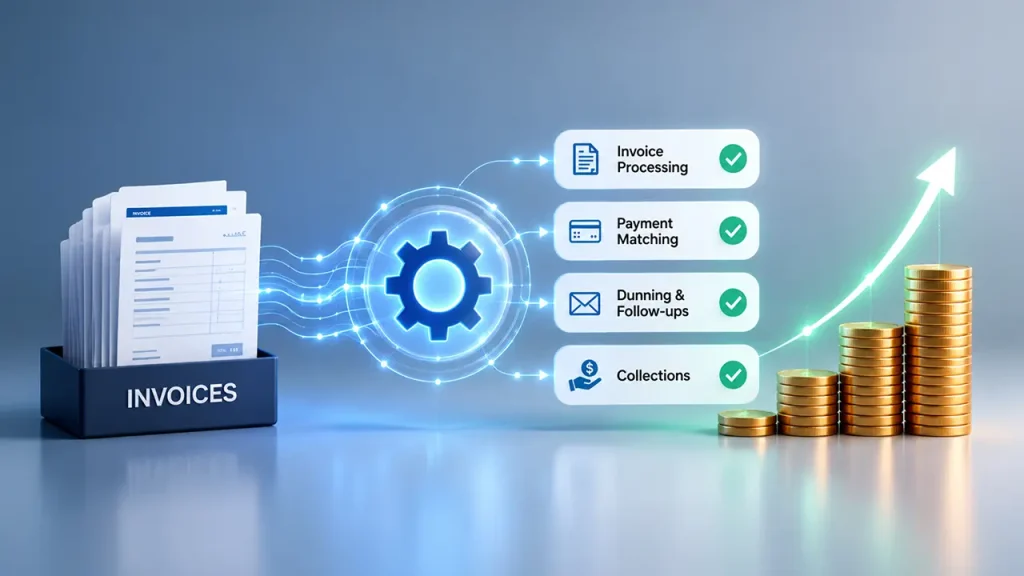
An automated AP workflow can capture invoices digitally, extract invoice data, validate information, perform two-way or three-way matching, route invoices for approval, identify exceptions, and trigger payment workflows. Instead of relying on employees to manually move every invoice through the process, technology handles predictable, rules-based activities while people focus on exceptions and decisions.
The fundamental difference in the automation vs outsourcing decision is ownership. With automation, the finance organization generally keeps the AP process in-house while technology performs much of the repetitive work. With outsourcing, a third party performs and manages defined parts of the process.
For organizations comparing platforms, it is useful to evaluate the best AP automation software based on ERP compatibility, workflow capabilities, AI and IDP functionality, exception handling, integration, security, and scalability rather than simply comparing feature lists.
AP automation can also extend beyond invoice processing. When AP is part of a broader procure-to-pay automation strategy, organizations can connect purchasing, receiving, invoice processing, approvals, and payments into a more integrated process.
For teams exploring broader AI automation services, AP is often a practical starting point because it combines high transaction volumes, structured data, repetitive activities, and clearly defined business rules.
AP Automation vs Outsourcing: Head-to-Head Comparison

The difference between accounts payable outsourcing and automation becomes clearer when you evaluate the two approaches across cost, control, scalability, compliance, and operational ownership.
| Factor | AP Automation | AP Outsourcing |
| Cost structure | Upfront implementation + software subscription | Per-invoice or per-FTE ongoing cost |
| Long-term cost | Can decrease as volume scales and manual work declines | Generally increases as invoice volume and service requirements increase |
| Control | Full control — process stays in-house | Limited operational control — vendor manages the process |
| Scalability | Scales through technology and workflow capacity | Scales by adding capacity/FTEs or expanding the service contract |
| Accuracy | Can achieve high extraction accuracy with mature AI/IDP and validation | Can achieve high accuracy through human processing and QA |
| Compliance | Centralized workflows and audit trails can remain within the organization’s systems | Requires vendor controls, contractual safeguards, and oversight |
| Implementation time | Typically requires implementation, integration, testing, and change management | Requires transition, process documentation, knowledge transfer, and stabilization |
| Ongoing management | Internal team manages technology and process governance | Vendor manages people and operational execution |
| Flexibility | Workflows can generally be reconfigured internally | Process changes may require vendor coordination |
| Best for | Teams that want control, scalability, and long-term automation capability | Teams that want to offload AP operations and management |
The biggest trade-off is control versus operational offloading. Accounts payable outsourcing can be attractive when finance leadership wants to transfer responsibility for staffing, training, daily processing, and process management. The organization still governs the relationship, but much of the operational execution sits with the provider.
AP automation takes the opposite approach. The organization retains ownership while technology handles repetitive activities. This approach can require more involvement from internal finance, IT, and transformation teams during implementation, but it also gives the organization greater control over workflows, integrations, data, and future changes.
Cost also behaves differently. Outsourcing typically follows transaction volume or staffing requirements. As invoice volumes grow, the cost of processing generally grows with them. Automation requires an initial investment in implementation and technology, but once the workflow is established, incremental invoice processing can require significantly less human intervention.
Neither approach is universally better. The right decision depends on whether the organization’s priority is offloading AP management or building a more scalable AP operating model.
When to Choose AP Automation
AP automation is usually the stronger option when finance leaders want to reduce manual work while retaining ownership of the AP process.
Choose automation when:
- You want long-term cost reduction. Automation can reduce the amount of manual effort required per invoice, allowing the cost structure to become more efficient as transaction volumes increase.
- You need greater control and visibility. Automated workflows can preserve approvals, invoice records, exceptions, and audit information within the organization’s systems.
- You already have an ERP. Platforms such as SAP, Oracle, and NetSuite can provide the foundation for integrating automated AP workflows into existing finance operations.
- You want to build internal automation capability. Finance teams looking to establish an automation center of excellence can use AP as a high-value process for developing repeatable automation capabilities.
- Your invoice volume is growing. Technology can absorb additional transaction volume without requiring a proportional increase in AP headcount.
- You want standardized processes. Automation can enforce approval rules, matching logic, validation checks, and escalation workflows consistently.
Organizations that want to modernize AP without completely handing the process to a third party can explore AP automation services to assess process readiness, technology requirements, ERP integration, and implementation priorities.
Automation is particularly valuable when organizations expect AP to become part of a broader finance transformation strategy rather than remain a standalone back-office function.
When to Choose AP Outsourcing
Accounts payable outsourcing can make more sense when the primary objective is to remove operational responsibility from the internal finance team.
Choose AP outsourcing when:
- You want to offload AP management entirely. The objective is not simply to reduce manual work but to transfer day-to-day processing, staffing, supervision, and operational management to an external provider.
- You have limited IT resources. Organizations without the internal resources to implement and maintain automation technology may prefer an established BPO operating model.
- Invoice volume is low or unpredictable. A variable outsourcing arrangement may be more practical than investing in technology for a relatively small transaction volume.
- You need a quick operational transition. If the priority is moving AP activities to an experienced provider rather than implementing a new technology environment, outsourcing can provide a practical transition path.
- You are between ERP systems. Organizations undergoing an ERP migration may temporarily use outsourcing while the future finance technology environment is being established.
- You lack internal process ownership. If AP management itself has become a distraction for finance leadership, outsourcing can transfer both execution and operational oversight.
However, organizations should evaluate more than the initial outsourcing price. The decision should account for service-level agreements, vendor governance, data security, knowledge retention, change requests, transition costs, and how the provider’s economics will change as transaction volumes increase.
For some organizations, finance and accounting outsourcing is also part of a broader strategy that includes AP, accounts receivable, reconciliation, reporting, and other finance processes. In those situations, AP outsourcing may be one component of a larger finance operating model.
The Hybrid Approach: Automation With Managed Services
Finance teams do not always have to choose between technology and people. A hybrid model combines AP automation with managed services.
In this model, automation handles the predictable core workflow: invoice capture, data extraction, validation, matching, routing, approvals, and payment preparation. A managed-services team supports activities that are harder to automate completely, such as complex exceptions, vendor communication, research, escalations, or temporary transaction-volume spikes.
This approach changes the role of outsourcing. Instead of paying an external team to manually process every invoice, the organization uses technology as the primary processing layer and applies human support where it creates the most value.
For example, an invoice that matches the purchase order and receipt can move through the workflow automatically. An invoice with a pricing discrepancy, missing purchase order, duplicate risk, or unusual vendor request can be routed to a managed-services team for investigation.
This model can combine the economics and scalability of automation with the flexibility of outsourcing. It also allows finance teams to maintain greater ownership of the core AP workflow while avoiding the need to build every operational capability internally.
For organizations looking for this model, automation as a service can provide a way to access automation capabilities without treating technology implementation as a completely internal responsibility.
For mid-to-large finance organizations, this hybrid approach can be particularly useful when invoice volumes are significant, exceptions remain complex, and finance leadership wants both technology-driven efficiency and access to specialized operational support.
Cost Comparison: Automation vs Outsourcing vs Keeping It Manual
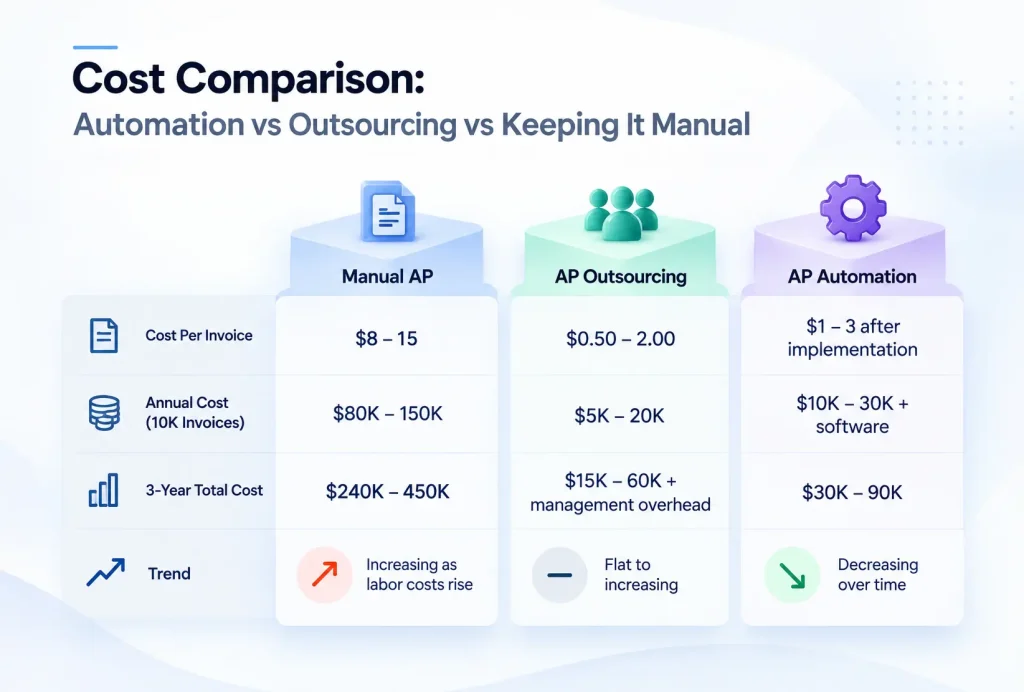
Cost is one of the most important factors in the decision, but finance leaders should distinguish between cost per invoice today and the long-term cost of operating the process.
A manual AP process can cost significantly more because every invoice requires human intervention across activities such as data entry, validation, matching, routing, follow-up, and exception handling.
Outsourcing can reduce the direct cost per invoice because providers benefit from shared resources and standardized processes. However, costs generally remain tied to transaction volumes, staffing, and service scope.
Automation has a different cost curve. Implementation and software costs can make the initial investment higher, but once the workflow is operational, the incremental cost of processing additional invoices can fall as automation absorbs more of the workload.
| Approach | Cost Per Invoice | Annual Cost (10K Invoices) | 3-Year Total Cost | Trend |
| Manual AP | $8–15 | $80K–150K | $240K–450K | Increasing as labor costs rise |
| AP Outsourcing | $0.50–2.00 | $5K–20K | $15K–60K + management overhead | Flat to increasing |
| AP Automation | $1–3 after implementation | $10K–30K + software | $30K–90K | Decreasing over time |
These figures should be treated as directional rather than universal benchmarks. Actual costs vary based on invoice complexity, ERP environment, exception rates, geographic labor costs, software licensing, implementation scope, payment requirements, and the level of human involvement.
The important point is the cost curve. Outsourcing can look less expensive at the beginning because there is limited technology investment, but transaction-based pricing means costs can scale with volume. Automation has a higher upfront investment but can reduce the marginal cost of processing over time.
This is why finance leaders evaluating automation vs outsourcing should calculate total cost of ownership rather than comparing only the initial price per invoice. A broader automation ROI analysis should consider labor savings, processing costs, exception reduction, working-capital impact, and the additional business value created by faster and more accurate financial operations.
Real Results: How Auxiliobits Clients Chose Automation
For finance teams comparing accounts payable outsourcing services with automation, real-world outcomes can help establish whether the economics justify the investment.
Auxiliobits has worked with organizations that evaluated the cost and operational trade-offs of continuing manual AP, outsourcing the process, and automating it. In one large-scale AP transformation, automation helped recover 9,700+ hours and deliver $200K+ in annual savings, with reported cost reductions of approximately 40–60%. The implementation was completed within approximately 6–8 weeks. The automation ROI can help finance teams assess these types of outcomes against implementation costs and expected operational savings.
The value extends beyond reducing invoice-processing effort. Automation can create a standardized AP operating model that is easier to scale as transaction volumes grow, while also reducing dependence on repetitive manual processing.
Finance leaders building the business case should evaluate these outcomes against their invoice volume, labor costs, exception rates, ERP environment, and current outsourcing arrangements. The AP automation business case can help structure that evaluation around measurable financial and operational outcomes.
The goal is not to assume that automation is always the answer. It is to determine whether the long-term economics, control, scalability, and process improvements justify moving away from a labor-dependent AP model.
Still deciding between automation and outsourcing? Take our free AP Efficiency Assessment to see where automation can deliver the most value for your team.