









Key Takeaways
- Finance transformation starts with process discovery. Organizations need to understand workflows, bottlenecks, exceptions, and manual effort before deciding what to automate.
- The right technology depends on the type of work. RPA, AI, intelligent document processing, workflow orchestration, and agentic process automation each address different levels of process complexity.
- Integration is critical to enterprise-scale automation. Auxiliobits’ approach works with existing ERP and finance systems, helping organizations modernize operations without automatically replacing their core technology stack.
- The goal is end-to-end process automation, not isolated task automation. Connecting capture, validation, matching, approvals, exceptions, posting, and reporting can eliminate manual handoffs across finance workflows.
- Successful transformation is measured by business outcomes. Improvements in manual effort, cycle time, exception rates, processing costs, straight-through processing, controls, and ROI provide a clearer picture of transformation value.
Finance transformation is often reduced to one question: What can we automate?
For finance leaders, that is no longer enough.
The bigger challenge is connecting fragmented processes, ERP systems, people, data, and automation into an operating model that can scale. A finance team may already have an ERP, RPA bots, workflow tools, document processing, and reporting platforms, yet still spend significant time moving information between systems, chasing approvals, resolving exceptions, and reconciling data.
This is where Auxiliobits takes a different approach.
Rather than treating automation as a collection of individual bots or tools, Auxiliobits combines AI, intelligent enterprise automation, workflow orchestration, RPA, and Agentic Process Automation (APA) to coordinate work across finance operations. Its approach is designed to work with existing ERP environments without requiring organizations to replace the systems that already run their finance function.
The objective is straightforward: reduce manual coordination, improve process performance, strengthen visibility and controls, and create a foundation for scalable finance operations.
Why Finance Transformation Needs a Process-Level Approach
Traditional automation typically focuses on individual activities: extracting invoice data, entering information into an ERP, sending an approval email, or reconciling two data sets.
The problem is that finance processes rarely end with one task.
An invoice, for example, can move through multiple stages:
Invoice received → Data captured → Validated → Matched → Approved → Exception resolved → Posted → Payment prepared → Audited
If only one stage is automated, people may still have to manually coordinate everything around it.
This creates a familiar problem: task automation without process orchestration.
Auxiliobits approaches finance transformation at the workflow level. Its current finance offering focuses on AP processing, approvals, exceptions, reconciliations, and broader finance workflows rather than limiting automation to a single task.
The transformation model can therefore be summarized as:
Discover → Design → Integrate → Automate → Orchestrate → Measure → Scale
That framework forms the foundation of how Auxiliobits approaches finance transformation.
1. Discover: Understand Where Finance Work Actually Happens
Transformation starts before technology is introduced. The first step is understanding how the process operates across applications, teams, data sources, approvals, and exceptions.
For example, an AP discovery exercise may examine:
- Where invoices enter the organization
- How invoice data is captured and validated
- Where matching takes place
- How approval decisions are routed
- How exceptions are identified and resolved
- Which systems are updated manually
- Where employees spend time on follow-ups and coordination
- Which activities create delays, rework, or control risks
This process-level visibility creates the baseline for transformation. It also prevents a common automation mistake: automating a process simply because it is repetitive, rather than because it is strategically valuable to automate.
Auxiliobits’ finance approach starts with process optimization and identifying where manual effort and operational bottlenecks exist before applying automation. Its current AP offering positions process discovery as the starting point for reducing manual finance work.
2. Design: Match the Right Technology to the Right Work
Not every finance activity should be automated in the same way. Some activities are deterministic and follow clear rules. Others require document understanding, contextual interpretation, or human judgment.
Auxiliobits brings multiple technologies into the transformation architecture:
| Finance requirement | Technology approach |
| Repetitive, rule-based tasks | RPA |
| Document and data understanding | AI / Intelligent Document Processing |
| Multi-step workflow coordination | Workflow orchestration |
| Context-driven decisions | AI |
| Cross-system autonomous execution | Agentic Process Automation |
| Complex or high-risk decisions | Human-in-the-loop |
This is important because finance transformation should not become an “AI everywhere” strategy. The right architecture uses the simplest technology capable of reliably handling each stage while introducing intelligence where rules alone are insufficient.
Auxiliobits’ broader automation portfolio combines Intelligent Enterprise Automation, Artificial Intelligence, Agentic Process Automation, and Automation-as-a-Service rather than treating one technology as the answer to every automation problem.
3. Integrate: Connect Automation to the Existing Finance Stack
A finance transformation strategy should not automatically require an ERP replacement.
For large enterprises, ERP systems contain years of financial data, business rules, integrations, controls, and operational dependencies. Replacing them simply to introduce automation can create unnecessary disruption.
Auxiliobits instead builds automation on top of the existing finance technology stack.
The architecture can connect AI-driven automation and workflow orchestration with systems such as SAP, Oracle, NetSuite, and Microsoft Dynamics while allowing the underlying ERP to continue serving as the core system of record.
This integration-first model enables:
- Existing ERP investments to remain in place
- Automation to operate across multiple applications
- Data to move between systems with less manual intervention
- Workflows to be coordinated centrally
- New automation capabilities to be introduced incrementally
The result is not another disconnected application. This is an automation layer that spans the entire finance environment.
4. Automate: Move Beyond Individual Tasks
Once the process and architecture are defined, automation can be applied across the workflow.
Consider an AP process. Instead of automating only invoice data entry, an end-to-end workflow can connect:
Capture → Extract → Validate → Match → Route → Approve → Resolve → Post → Prepare Payment → Audit
This is where the distinction between task automation and process automation becomes important.
Auxiliobits’ current AP automation offering includes invoice capture from multiple channels, AI-powered extraction and validation, 2-way and 3-way matching, approval workflows, exception handling, vendor communication, payment-run preparation, and reporting/audit trails.
The benefit is not simply fewer clicks. It is fewer manual handoffs between the stages of the process. That distinction becomes increasingly important as transaction volumes increase.
5. Orchestrate: Introduce Intelligence Into Finance Workflows
Automation becomes significantly more powerful when it can coordinate work rather than simply execute predefined instructions.
Traditional RPA works well when the process is predictable:
If X happens → perform Y.
Finance operations, however, contain exceptions and variations that do not always fit predetermined rules.
An invoice may have a mismatched quantity. A supplier may submit a new document format. An approval may require additional context. A reconciliation may reveal a discrepancy that needs investigation. This is where AI and agentic process automation become relevant.
Auxiliobits describes APA as a move beyond basic task automation toward workflows that can think, decide, and evolve, combining AI capabilities with automation and orchestration.
Its agentic architecture for P2P automation brings together components such as LLM reasoning, memory, document intelligence, tool use, and real-time ERP interaction.
The resulting model is closer to:
Understand → Decide → Act → Verify → Escalate when necessary
Rather than replacing human oversight, this model can reduce the amount of routine coordination that humans have to perform.
6. Control: Keep Governance and Human Judgment in the Architecture
Finance automation cannot be evaluated only on speed. A process that moves faster but weakens controls is not transformation—it is operational risk.
This is particularly important as organizations introduce AI and autonomous agents into financial workflows.
A mature finance automation architecture therefore needs:
- Defined decision boundaries
- Human approval for appropriate risk categories
- Audit trails
- Access controls
- Exception escalation
- Data governance
- Monitoring and performance visibility
Auxiliobits explicitly highlights the importance of guardrails around agentic automation, including risks related to autonomous decisions, compliance, data handling, and cascading errors.
The principle is simple: automate execution, but govern decisions.
This allows finance organizations to increase automation without treating autonomy as a substitute for financial controls.
7. Measure: Tie Automation to Finance Outcomes
Finance transformation should ultimately be measured through business performance, not the number of bots deployed.
Key metrics can include:
Manual effort: How much finance capacity is released from transactional work?
Cycle time: How quickly can a transaction move from receipt to completion?
Exception rate: How many transactions require human intervention?
Processing cost: What is the cost per transaction?
Straight-through processing: What percentage of transactions can move through the workflow without manual intervention?
Control performance: Can transactions be traced and audited effectively?
ROI: Does the improvement justify the technology and implementation investment?
Auxiliobits’ published AP outcomes currently include a 40–60% reduction in manual finance work, 2–3× faster invoice processing, and a 100% audit trail on invoices; its homepage also cites an example of $800K in annual savings from one engagement. These are published engagement outcomes, not universal benchmarks, so actual results will depend on process volume, complexity, systems, and baseline performance.
The critical point is that transformation starts with a baseline and ends with measurable operational improvement.
8. Scale: Move From AP Automation to Autonomous Finance
Accounts payable can be a practical starting point because it contains high transaction volumes, repetitive work, approval dependencies, exceptions, and measurable processing costs.
But the long-term objective should not be another isolated automation project.
Once the architecture is established, organizations can extend the same principles across:
- Accounts receivable
- Reconciliation
- Financial reporting
- Expense management
- Month-end close
- Vendor management
- Shared services
- Compliance workflows
Auxiliobits’ finance strategy explicitly positions AP as a starting point for broader finance operations, while its autonomous finance resources describe expansion into accounts payable, receivable, reconciliation, reporting, and compliance.
This creates a maturity path:
Manual Finance → Task Automation → Intelligent Workflows → Agentic Processes → Autonomous Finance Operations
The goal is not to make every finance process autonomous.
The goal is to determine where autonomy creates value, where automation is sufficient, and where human judgment should remain central.
What Auxiliobits Brings to Finance Transformation
Auxiliobits combines capabilities across intelligent enterprise automation, AI, Agentic Process Automation, Automation-as-a-Service, consulting and advisory, and application engineering.
This creates a transformation model built around five principles:
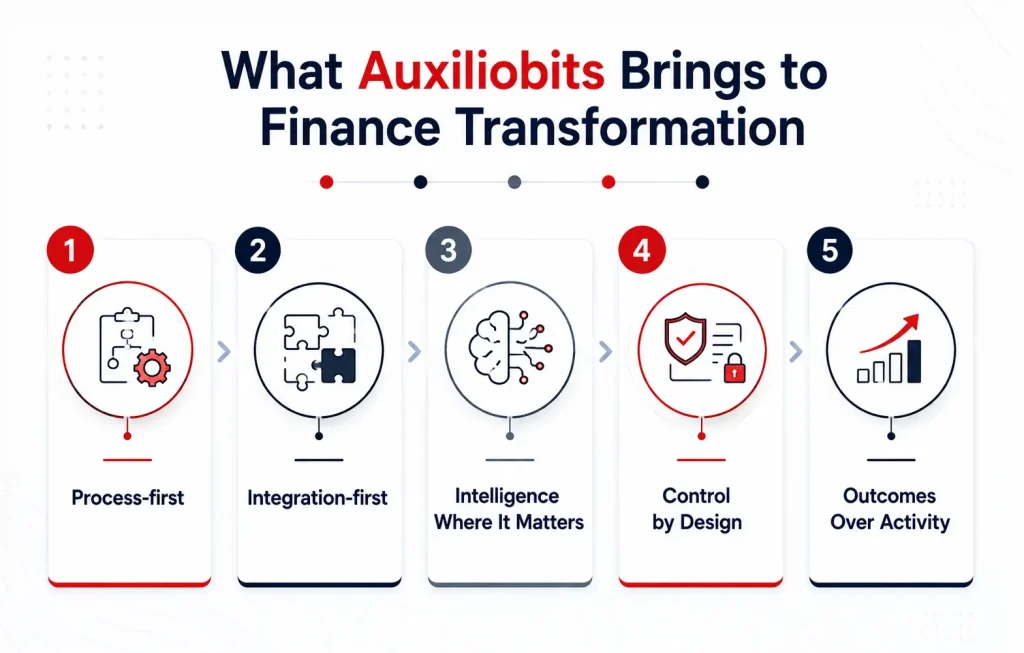
1. Process-first
Understand the workflow before selecting the automation technology.
2. Integration-first
Build around existing ERP and finance systems instead of automatically replacing them.
3. Intelligence where it matters
Use RPA for deterministic work and AI/APA where processes require interpretation and orchestration.
4. Control by design
Keep governance, auditability, escalation, and human oversight within the architecture.
5. Outcomes over activity
Measure transformation through cost, speed, capacity, quality, and control improvements.
From Finance Automation to Finance Transformation
The next phase of finance transformation will not be defined by how many processes an organization can automate. It will be defined by how effectively it can orchestrate work across systems, people, data, and intelligent automation.
That is the shift Auxiliobits is designed to enable.
The journey begins by understanding the process. It then moves through architecture, integration, automation, intelligent orchestration, governance, measurement, and scale.
Discover. Design. Integrate. Automate. Orchestrate. Measure. Scale.
That is how finance transformation moves from isolated automation initiatives to a connected, scalable, and increasingly intelligent finance operating model.