









Key Takeaways
- AI agents in accounts payable go beyond task automation by interpreting context, handling routine exceptions, and making decisions within defined guardrails.
- The ROI case is measurable, with industry benchmarks showing significant differences in invoice cost and processing time between average and highly automated AP operations.
- Real-world deployments show tangible gains, including faster invoice processing, higher match rates, reduced manual work, and the ability to scale invoice volumes without proportional increases in AP staffing.
- Implementation should be incremental, starting with ERP and intake integration, followed by calibration, controlled rollout, and ongoing optimization.
- The strongest buying decision comes from your own AP data, using a representative invoice pilot to validate automation coverage, exception handling, processing time, and expected ROI.
You already know the promise of AI agents in accounts payable: lower processing costs, fewer late-payment issues, faster invoice cycles, and less manual work for finance teams.
But for an AP leader evaluating an investment, the bigger question is no longer what can AI do? It is whether the technology can work reliably at your transaction volume, integrate with your ERP, manage exceptions, and deliver measurable value without creating another complex automation layer.
That is where the evaluation gets harder.
Traditional AP automation has already digitized invoice capture, matching, routing, and approvals. Yet many finance teams still depend on manual intervention whenever an invoice falls outside a predefined rule. AI agents take a different approach. Instead of simply executing a fixed sequence of tasks, they can interpret context, make decisions within defined boundaries, and escalate cases when human judgment is required.
For finance leaders considering their next AP transformation, that distinction matters.
Where AP Teams Get Stuck Before Buying
Most organizations evaluating AI agents in accounts payable are trying to answer five practical questions:
- Is this genuinely different from the RPA or OCR technology we already use?
- What is the realistic ROI rather than the vendor’s best-case scenario?
- How quickly can we reach value without disrupting live AP operations?
- Can the technology handle our exceptions, approval rules, vendors, and ERP environment?
- What happens when the agent makes the wrong decision?
These questions should shape the buying process.
A successful AP automation initiative is not simply about processing more invoices. It is about creating an operating model where routine work is handled autonomously, exceptions receive appropriate human attention, and the finance team gains better control over the entire invoice-to-payment lifecycle.
AI Agents vs RPA and OCR
The biggest misconception about AI agents in accounts payable is that they are simply a more advanced version of OCR or RPA.
They are not.
OCR primarily extracts information from documents. RPA executes predefined actions based on rules. AI agents can interpret information, evaluate context, determine the appropriate next step, and act within configured guardrails.
| Capability | Manual AP | RPA / OCR | AI Agents |
| Invoice data capture | Manual entry | Template-based extraction | Understands different invoice formats |
| Exception handling | Human review | Routes exceptions to people | Resolves routine exceptions autonomously |
| 2-way / 3-way matching | Manual comparison | Rule-based | Context-aware matching |
| Approval routing | Email and spreadsheets | Static workflows | Dynamic, context-based routing |
| New vendors and formats | Manual effort | Configuration required | Adapts with less reconfiguration |
| Maintenance | High | Medium to high | Lower ongoing maintenance |
The practical difference is what happens when the process encounters something unexpected.
A traditional automation workflow generally stops when a transaction falls outside its rules. An AI agent can assess the available information, determine whether the issue can be resolved within its authority, and escalate genuinely ambiguous cases to an AP professional.
That moves automation beyond task execution toward decision support and controlled execution.
What Implementation Should Actually Look Like?
Implementation is often the final barrier for finance leaders. The concern is understandable. AP is connected to payments, suppliers, accounting records, controls, and financial reporting. A poorly planned rollout can create more risk than value.
A controlled deployment should therefore be incremental.
Weeks 1–2: Connect and Observe
Connect the AI agent to the relevant ERP and invoice intake channels. Initially, the system can operate alongside the existing process, allowing the team to observe how it interprets invoices and transactions before making decisions in production.
This creates an opportunity to identify integration issues, unusual invoice formats, and policy exceptions without immediately changing payment operations.
Weeks 3–4: Calibrate
The AP team reviews decisions against real invoices. This is where matching logic, approval thresholds, exception rules, and escalation criteria are refined. The objective is not to eliminate human oversight. It is to determine where autonomous processing is appropriate and where human intervention remains necessary.
Weeks 5–8: Expand Incrementally
Once performance is validated, rollout can begin with a high-volume, relatively standardized vendor category. From there, organizations can expand coverage to additional invoice types, suppliers, business units, and exception scenarios.
Ongoing: Improve With Less Maintenance
One of the intended advantages of AI agents over traditional rule-based automation is reduced dependence on manually maintained templates and workflows.
Instead of creating a new automation rule every time an invoice format changes, the agent can interpret new information within its operating boundaries and escalate situations that require human judgment.
The exact timeline will vary by ERP environment, integration complexity, data quality, and process maturity. Any vendor should be able to provide its own median implementation and time-to-value data rather than relying exclusively on its fastest customer deployment.
The Questions You Should Ask Before Choosing a Platform
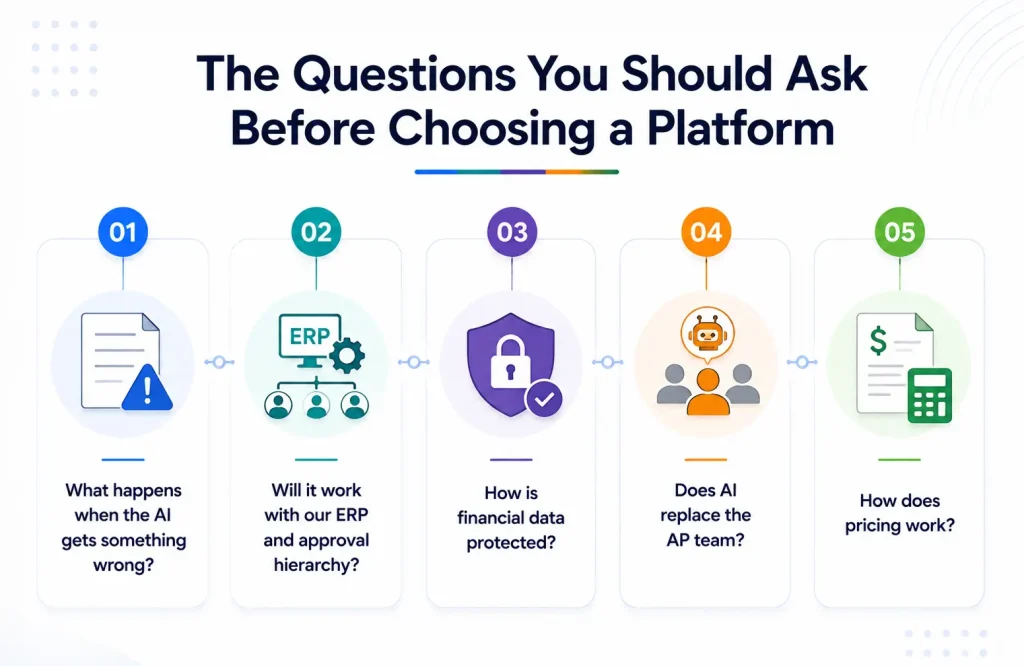
1. What happens when the AI gets something wrong?
This should be one of the first questions in your evaluation. Look for decision logging, confidence thresholds, clear audit trails, and automatic escalation. The system should not be designed to make a decision under any circumstances. It should recognize when available information is insufficient and route the transaction to a human.
2. Will it work with our ERP and approval hierarchy?
Your AP automation platform should fit into your existing technology environment rather than forcing finance to redesign its operating model around the tool. Ask specifically about your ERP, approval structure, supplier master data, and integration requirements. Request a customer reference that uses a comparable environment before signing.
3. How is financial data protected?
Security should be evaluated as part of the buying process, not after implementation. Ask for current security documentation, audit reports, access-control policies, encryption standards, and relevant compliance certifications. SOC 2 Type II, encryption in transit and at rest, and role-based access controls are among the baseline controls to evaluate.
4. Does AI replace the AP team?
The strongest business case does not depend on eliminating AP professionals. Instead, AI agents in accounts payable can absorb repetitive transaction work while people focus on exceptions, controls, supplier relationships, analysis, and higher-value finance activities.
Molina Healthcare’s documented example illustrates the scalability argument: invoice volume increased substantially while AP staffing grew only modestly.
5. How does pricing work?
Understand whether pricing is based on invoice volume, platform fees, usage tiers, or seats. A model based on invoice volume may better reflect the value you create. Ask vendors to price the solution using your actual monthly invoice volume and projected growth rather than an abstract user count.
Best Test Is Your Own AP Data
Benchmarks can establish the opportunity. Customer case studies can demonstrate what is possible. But neither can tell you exactly what your organization will achieve. Your invoice formats are different. Your ERP configuration is different. Your suppliers, approval hierarchy, exception rates, and payment policies are different.
That is why a controlled pilot is often the most valuable step before a full-scale commitment.
Give the technology a representative sample of your actual invoices. Measure extraction accuracy, matching, exception handling, approval routing, processing time, and the percentage of transactions that can move through the workflow without manual intervention.
Then compare those results against your current baseline.
The right question is not simply, “Can AI automate accounts payable?”
It is:
“How much of our AP operation can be handled autonomously, safely, and measurably better than it is today?”
That is the question that turns AI agents in accounts payable from an emerging technology conversation into a business case for finance transformation.