








Key Takeaways
- Shared services centers are shifting from cost-focused operating models to intelligent business platforms that drive automation, agility, and strategic value across enterprises.
- AI and automation are redefining shared services operations by enabling intelligent process execution, predictive insights, workflow orchestration, and faster decision-making.
- The next generation of shared services centers will leverage AI agents and intelligent automation to manage complex workflows, resolve exceptions, and continuously improve business processes.
- Human-AI collaboration will shape the future workforce model, allowing employees to focus on higher-value activities such as analysis, innovation, and strategic decision-making.
- Enterprises must modernize their shared services strategy by investing in process intelligence, scalable automation, strong data foundations, and outcome-driven transformation approaches.
Shared services centers have evolved significantly over the last few decades. What started as a cost optimization model focused on consolidating repetitive back-office activities has transformed into a strategic enterprise capability that drives efficiency, agility, and innovation.
Today, organizations are rethinking the role of shared services centers in response to increasing operational complexity, global competition, rising customer expectations, and the need for real-time decision-making. Traditional shared service models built around standardization and labor arbitrage are no longer enough. Enterprises are moving toward intelligent, AI-powered operating models that combine automation, analytics, and human expertise.
The future of shared services centers lies in becoming intelligent business platforms—capable of orchestrating processes, predicting business needs, and continuously improving operations.
Organizations that successfully modernize their shared services functions will move beyond transactional efficiency and create a foundation for enterprise-wide transformation.
The Evolution of Shared Services Centers
The first generation of shared services centers focused primarily on consolidation. Organizations centralized finance, HR, procurement, IT support, and administrative activities into centralized locations to reduce operational costs and improve consistency.
This model delivered significant value by:
- liminating duplicate processes across business units
- Creating standardized workflows
- Improving process visibility
- Reducing operational expenses
However, as business environments became more dynamic, enterprises began expecting more from their shared service functions.
The second generation of shared services centers introduced process optimization, digital workflows, and business analytics. Organizations started leveraging technologies such as robotic process automation (RPA), cloud platforms, and workflow automation to improve productivity.
Today, enterprises are entering the next phase: intelligent shared services centers.
These modern centers not only execute processes but also analyze data, make recommendations, resolve exceptions, and support strategic decision-making.
Why Traditional Shared Services Models Are Under Pressure
While traditional shared services centers have delivered measurable improvements, many organizations are facing limitations with existing operating models.
Several challenges are driving the need for transformation:
1. Increasing Process Complexity
Business processes have become more interconnected across finance, supply chain, procurement, and customer operations. Managing these complex workflows through manual intervention creates delays and operational inefficiencies.
For example, finance teams managing accounts payable processes must coordinate with procurement teams, suppliers, business units, and compliance functions. Without intelligent automation, these interactions often result in bottlenecks.
2. Rising Expectations for Faster Decision
Modern enterprises require real-time insights to respond quickly to market changes. Shared services centers that only focus on transaction processing cannot provide the strategic intelligence business leaders need.
Organizations now expect shared service teams to answer critical questions:
- Where are operational inefficiencies occurring?
- Which processes require improvement?
- How can resources be optimized?
- What risks should leadership address?
The Role of AI and Automation in Next-Generation Shared Services
Artificial intelligence is becoming a fundamental driver of the future of shared services centers.
Unlike traditional automation approaches that focus on predefined tasks, AI-powered systems can understand context, analyze information, and support complex decision-making.
Key technologies shaping intelligent shared services include:
1. Intelligent Process Automation
Intelligent automation combines AI, machine learning, workflow automation, and analytics to streamline end-to-end processes.
For example, in finance operations, intelligent automation can:
- Extract information from invoices
- Validate financial data
- Identify exceptions
- Recommend approval actions
- Predict payment risks
This enables shared services teams to improve accuracy while reducing manual effort.
2. Generative AI and AI Assistants
Generative AI is introducing new possibilities for shared service operations.
AI assistants can help employees:
- Retrieve information instantly
- Generate reports
- Summarize documents
- Answer operational queries
- Support decision-making
Instead of searching through multiple systems, employees can interact with intelligent assistants that provide contextual responses.
3. Autonomous AI Agents
The next evolution involves AI agents capable of independently managing workflows.
Agentic automation enables systems to:
- Understand business objectives
- Plan process steps
- Execute tasks across applications
- Escalate complex issues when required
- Continuously improve performance
This moves shared services centers closer to autonomous operations.
Moving from Shared Services to Intelligent Operations Centers
The future of shared services centers is not simply about automation. It is about creating intelligent operations ecosystems.
Traditional shared services:
- Process transactions
- Follow predefined workflows
- Measure efficiency through volume and cost
Intelligent shared services:
- Predict business requirements
- Optimize processes continuously
- Provide actionable insights
- Enable strategic decisions
This shift transforms shared services from a support function into a business value engine.
For example, a traditional accounts payable team may focus on processing invoices faster. An intelligent shared services center analyzes supplier behavior, predicts cash flow impacts, identifies compliance risks, and recommends optimization opportunities.
The focus shifts from: “How quickly can we complete a process?”
to:
“How intelligently can we improve business outcomes?”
Key Capabilities Shaping the Future of Shared Services Centers
1. AI-Powered Decision Intelligence
Future shared services centers will rely heavily on data-driven decision-making. Advanced analytics will help organizations identify trends, predict challenges, and optimize operations.
Examples include:
- Predicting invoice payment delays
- Forecasting resource requirements
- Identifying process bottlenecks
- Detecting compliance risks
Decision intelligence enables leaders to move from reactive problem-solving to proactive management.
2. End-to-End Process Orchestration
Future operating models will focus on complete business processes rather than isolated tasks.
Instead of automating individual activities, organizations will redesign entire workflows.
For example:
Procure-to-pay transformation can connect:
- Supplier onboarding
- Purchase requests
- Approvals
- Invoice processing
- Payments
- Reporting
This creates seamless, intelligent process experiences.
3. Human + AI Collaboration
The future of shared services centers is not about replacing people. It is about augmenting human capabilities.
AI handles repetitive and data-intensive activities, while employees focus on:
- Strategic analysis
- Relationship management
- Exception handling
- Continuous improvement
This human-AI collaboration creates more productive and innovative teams.
4. Continuous Improvement Through Automation Analytics
Modern shared services organizations require visibility into automation performance.
Automation analytics can help measure:
- Process efficiency
- Automation adoption
- Error reduction
- Cycle time improvements
- Business impact
This allows organizations to continuously optimize their operations.
Benefits of Building an Intelligent Shared Services Model
Organizations investing in next-generation shared services centers can achieve several business advantages.
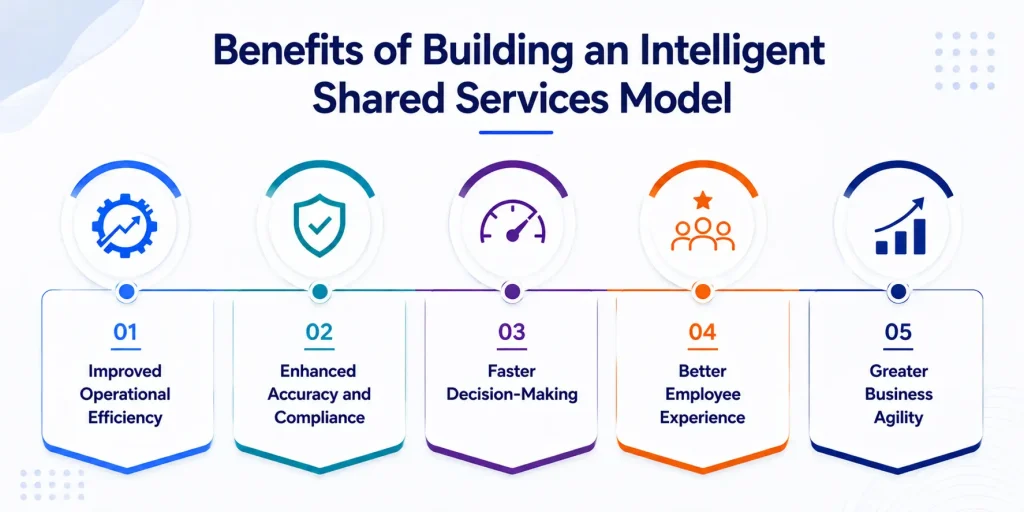
1. Improved Operational Efficiency
Automation reduces manual effort, eliminates repetitive activities, and accelerates process execution.
2. Enhanced Accuracy and Compliance
AI-powered systems improve data quality and help organizations maintain stronger controls.
3. Faster Decision-Making
Real-time analytics provide leaders with actionable insights to make informed decisions.
4. Better Employee Experience
Employees spend less time managing routine tasks and more time contributing strategic value.
5. Greater Business Agility
Intelligent shared services enable organizations to adapt quickly to changing market conditions.
How Enterprises Can Prepare for the Future
Building intelligent shared services requires more than implementing new technology. Organizations need a structured transformation strategy.
1. Start with Process Intelligence
Before automating processes, enterprises must understand existing workflows, identify inefficiencies, and prioritize high-impact opportunities.
2. Establish a Strong Data Foundation
AI-driven operations depend on reliable data. Organizations need integrated systems, consistent data standards, and strong governance frameworks.
3. Adopt a Scalable Automation Strategy
Organizations should move beyond isolated automation projects and create enterprise-wide automation roadmaps.
4. Develop Future-Ready Skills
Employees need new capabilities in areas such as analytics, AI collaboration, and process optimization.
5. Measure Business Outcomes
Success should not only be measured through cost reduction. Organizations should evaluate improvements in customer experience, agility, innovation, and strategic value.
Conclusion
The future of shared services centers is defined by intelligence, automation, and continuous innovation. Organizations are moving beyond traditional cost-focused models toward intelligent operating environments that deliver measurable business value.
AI, automation, and advanced analytics are enabling shared services teams to become proactive partners in enterprise transformation. The organizations that embrace this shift will create more agile operations, empower employees, and build stronger foundations for future growth.
Shared services centers are no longer just centralized processing hubs. They are becoming intelligent engines that help enterprises operate smarter, faster, and more efficiently in the digital era.