





Key Takeaways
- Contract compliance in procurement is a continuous discipline that ensures suppliers and buying organizations meet agreed pricing, delivery, quality, regulatory, and performance obligations throughout the contract lifecycle.
- Most compliance failures stem from structural issues such as fragmented contract storage, unclear obligation ownership, siloed teams, weak monitoring processes, and inconsistent accountability.
- High-performing procurement organizations establish centralized contract repositories, assign ownership for every obligation, monitor supplier performance through scorecards, and automate compliance tracking.
- Automated contract-to-invoice matching can significantly reduce invoice discrepancies, recover lost spend, improve processing efficiency, and strengthen enforcement of negotiated terms.
- Long-term compliance success depends on a combination of governance, cross-functional collaboration, executive sponsorship, supplier engagement, and integrated technology platforms that enable proactive compliance management.
Your team spent weeks negotiating the perfect supplier contract — better pricing, tighter SLAs, and stronger quality clauses. Three months in, your supplier is invoicing above the agreed rates. No one flagged it. No one even noticed.
This is what broken contract compliance in procurement looks like. And it’s far more common than most procurement leaders want to admit.
How many of you are aware of the term contract compliance in procurement? If you are new to procurement, we will guide you through it. It is the ongoing process of ensuring that both the buying organization and its suppliers fulfill every obligation defined in a procurement contract — from pricing accuracy and delivery timelines to quality standards, regulatory requirements, and sustainability commitments.
It’s not a one-time review at contract signing. It’s a continuous management discipline that spans the entire contract lifecycle: onboarding, execution, performance review, renewal, and close-out.
When contract compliance in procurement works well, it protects the financial value locked inside every negotiated agreement. When it breaks down, that value leaks — quietly, consistently, and at scale.
Why Contract Compliance in Procurement Breaks Down
Before building a better compliance program, procurement leaders need to understand why compliance fails in the first place. The root causes are almost always structural, not intentional.
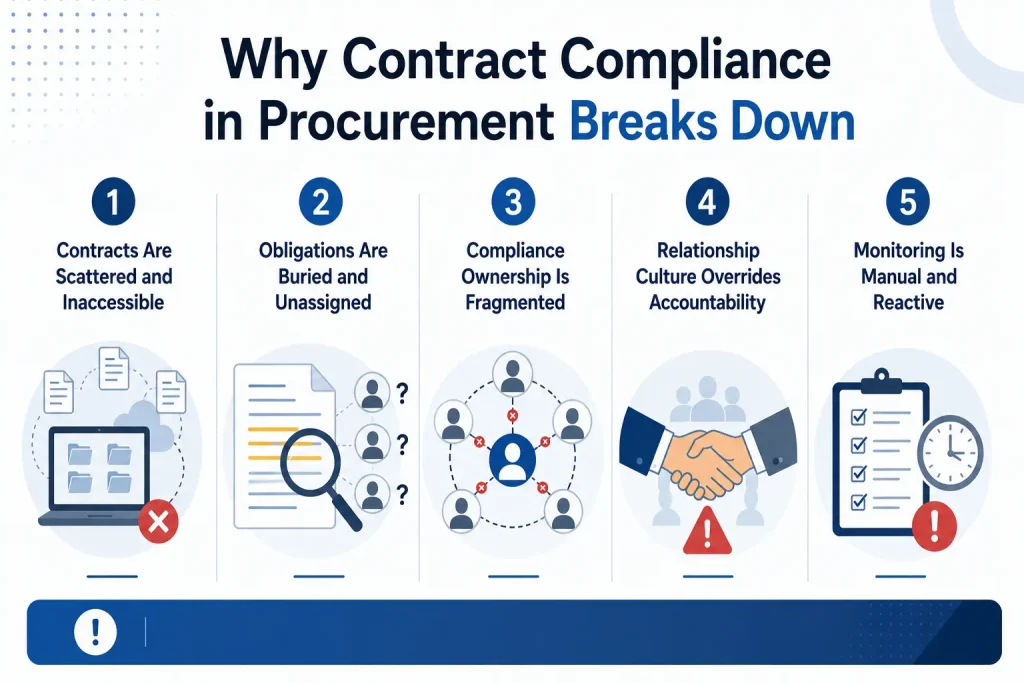
1. Contracts Are Scattered and Inaccessible
Most organizations store contracts across email inboxes, shared drives, department folders, and legacy systems. There is no single place where a category manager can look up contract terms, check renewal dates, or identify who owns which obligation. If contracts can’t be found, they can’t be enforced.
2. Obligations Are Buried and Unassigned
A standard procurement contract contains dozens of obligations — pricing tiers, volume commitments, delivery windows, certification requirements, and reporting cadences. These are embedded in dense legal language across multiple pages. Without a deliberate process to extract, document, and assign ownership to each obligation, they simply go unmonitored.
3. Compliance Ownership Is Fragmented
Procurement signs the contract. Legal approves the language. Finance processes the invoices. Operations receives the goods. No single function has a full view of whether the contract is actually being honored. Fragmented ownership means compliance gaps fall between teams.
4. Relationship Culture Overrides Accountability
Many procurement teams deprioritize compliance conversations to preserve supplier relationships. The short-term result feels smooth. The long-term result is a supply base that has learned the contract terms are negotiable — and prices, quality, and service levels drift accordingly.
6. Monitoring Is Manual and Reactive
Without automated alerts, systematic invoice matching, or structured supplier reviews, contract compliance in procurement becomes an audit activity rather than a management activity. Issues often emerge late, after significant value has already been lost.
A Framework for Strong Contract Compliance in Procurement
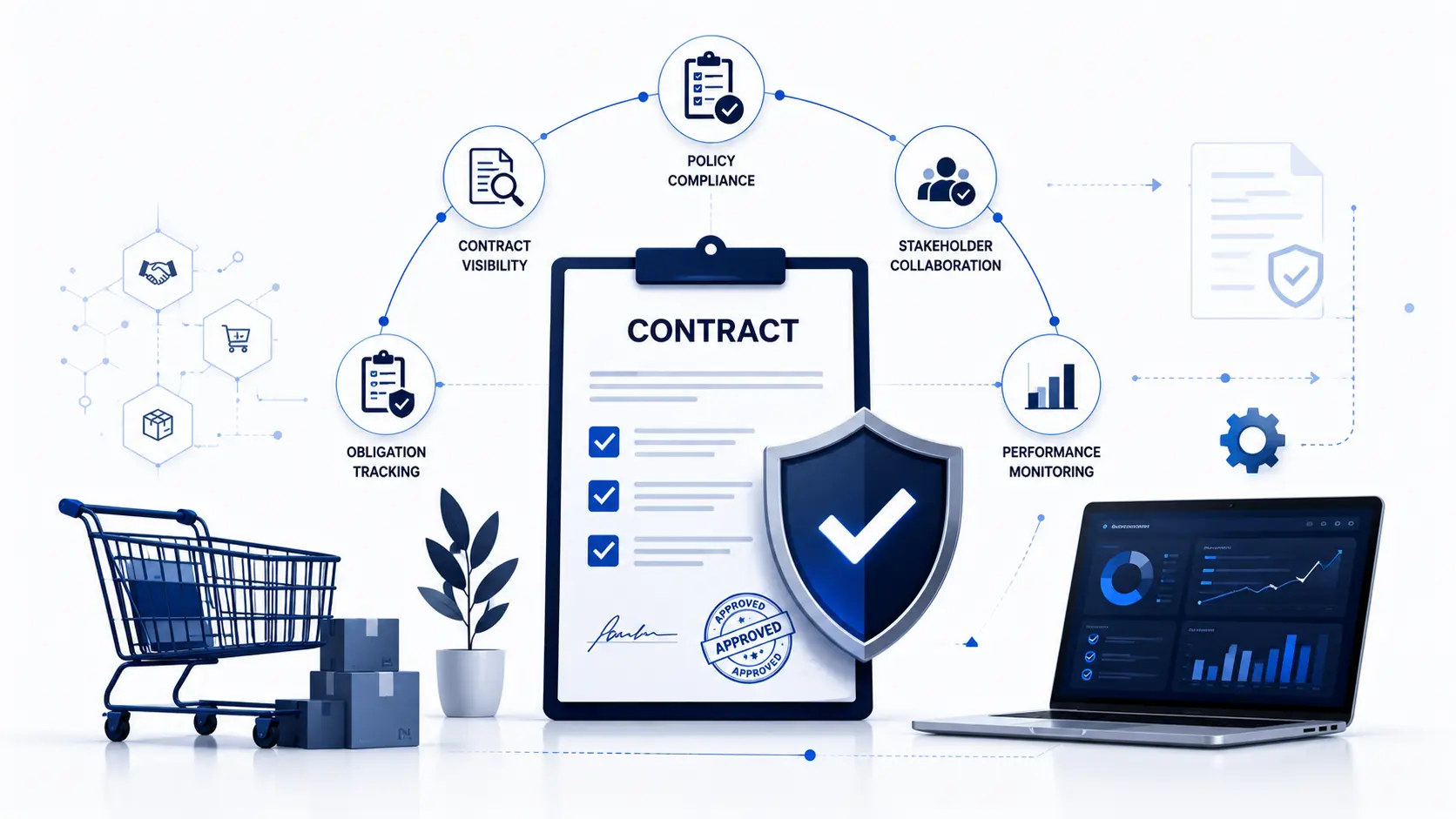
High-performing procurement organizations build contract compliance as a structured program — not a periodic audit. Here is the five-pillar framework that underpins that program.
Pillar 1: Contract Visibility — One Source of Truth
Effective contract compliance in procurement starts with a centralized, searchable contract repository. Every active agreement, amendment, and addendum should be accessible in one system — with metadata that enables both search and management:
- Supplier name and category
- Contract value and spend to date
- Start date, end date, and renewal trigger dates
- Named obligation owners across procurement, legal, and finance
- Contract status (active, expiring, in renegotiation)
Automated alerts for upcoming renewals, expiring certifications, and milestone dates are non-negotiable at any meaningful scale.
Practical note: Many organizations attempt to build such systems in spreadsheets. Spreadsheets break as soon as the contract volume exceeds what one person can maintain. Dedicated contract lifecycle management (CLM) tools or procurement platforms with integrated contract management are the right infrastructure.
Pillar 2: Obligation Extraction and Ownership Assignment
A contract is a set of obligations. Contract compliance in procurement requires that every material obligation be surfaced, categorized, and assigned to a named owner who is accountable for monitoring it.
The process looks like this:
- Extract — Pull every obligation from the contract text. AI-assisted contract analysis tools are increasingly able to do this at scale, dramatically reducing the manual burden.
- Categorize — Sort obligations by type: financial (pricing, volume rebates), operational (delivery timelines, inventory levels), quality (defect rates, certifications), regulatory (compliance reporting, data protection), and performance (SLAs, KPIs).
- Assign — Every obligation gets a named owner and a monitoring frequency.
- Track — Obligations are tracked in the system, with status updated based on actual supplier performance.
Without obligation ownership, contract compliance in procurement is aspirational. With it, it becomes operational.
Pillar 3: Supplier Performance Monitoring and Scorecards
Compliance doesn’t happen once — it happens over the life of the contract. That requires structured performance monitoring.
Supplier scorecards are the operational instrument. A well-designed scorecard measures actual performance against contracted thresholds across every relevant dimension:
| Performance Dimension | Example KPI | Contracted Threshold |
| Delivery | On-time, in-full (OTIF) rate | ≥ 95% |
| Quality | Defect / rejection rate | ≤ 0.5% |
| Pricing | Invoice accuracy rate | 100% |
| Responsiveness | Issue resolution time | ≤ 48 hours |
| Regulatory | Certifications current | 100% |
| ESG | Audit completion rate | Annual |
Scorecards serve two functions: they provide an objective basis for compliance conversations with suppliers, and they create a documented performance record if formal remediation or contract termination becomes necessary.
Review cycle
- Strategic / tier-1 suppliers: Monthly or quarterly business reviews (QBRs)
- Tactical suppliers: Semi-annual review
- Commodity and tail spend: Annual review or exception-triggered
Pillar 4: Contract-to-Invoice Matching
One of the highest-ROI activities in contract compliance in procurement is automated contract-to-invoice matching — systematically verifying that supplier invoices reflect the pricing, quantities, and terms in the executed contract.
Organizations that implement three-way matching (purchase order → goods receipt → contract) consistently report:
- 15–40% reduction in invoice exceptions and disputes
- 1–3% of total spend recovered in identified pricing overcharges
- Faster invoice processing cycles and fewer manual interventions
Modern procure-to-pay (P2P) platforms can automate most of this matching logic, flagging exceptions for human review rather than requiring manual line-item audits. The business case is typically measured in weeks, not quarters.
Pillar 5: Governance, Escalation, and Continuous Improvement
Even well-designed compliance programs surface issues. The differentiator is having a clear escalation structure and a mechanism for learning.
Governance levels for contract compliance in procurement:
- Operational — Category managers and supplier relationship managers handle day-to-day monitoring, first-line compliance conversations, and minor deviations within contracted tolerances
- Tactical — Procurement leadership reviews systemic compliance trends, approves formal deviations, and manages supplier escalations
- Strategic — CPO and cross-functional leadership address compliance failures with material financial, regulatory, or reputational impact
Continuous improvement loop: Every compliance failure is data. Document what went wrong and trace it to a root cause: Was it ambiguous contract language? A supplier onboarding gap? A monitoring blind spot? A missing obligation owner? Each failure, properly analyzed, improves the next contract and the next compliance process.
Technology That Enables Contract Compliance in Procurement
Technology scales compliance – it doesn’t replace the discipline. Here is how the key tool categories map to the compliance lifecycle:
| Compliance Stage | Tool Category | Core Function |
| Contract storage & management | CLM platform | Centralized repository, obligation tracking, alerts |
| Obligation extraction | AI contract analysis | Automated identification and tagging of obligations |
| Supplier performance | SRM / supplier portal | Scorecards, KPI tracking, issue management |
| Invoice validation | P2P / AP automation | Contract-to-invoice matching, exception flagging |
| Third-party risk | TPRM platform | Supplier financial, regulatory, and ESG risk monitoring |
| Analytics & reporting | BI / spend analytics | Compliance dashboards, trend analysis, exception reporting |
The integration imperative: These tools deliver compounding value when they are connected. A compliance alert in your CLM system that automatically triggers a review task in your SRM platform — and flags a payment hold in your P2P system — is far more powerful than three separate alerts in three siloed systems.
When prioritizing technology investment, start with contract repository and contract-to-invoice matching. These deliver the fastest, most measurable returns and create the infrastructure that everything else builds on.
Building the Organizational Conditions for Contract Compliance in Procurement
Process and technology are necessary. But contract compliance in procurement ultimately runs on organizational alignment. Without it, even the best systems stall.
- Executive sponsorship signals priority. When the CPO visibly champions compliance as a strategic management discipline — not just an audit function — it signals to both internal stakeholders and the supplier base that obligations will be enforced.
- Cross-functional ownership closes the gaps. Legal drafts the contracts. Finance processes the invoices. Operations receives the goods. IT manages data security obligations. Compliance programs that live only inside procurement will always have blind spots. The most effective programs establish shared accountability across functions, with procurement as the integrating owner.
- Incentives must align with outcomes. If category managers are evaluated exclusively on savings at contract signing – with no accountability for compliance performance over the contract life — behavior follows those incentives. Incorporating contract compliance metrics into performance reviews for category managers creates the right accountability structure.
- Supplier communication sets expectations. Compliance starts at contract execution. The best procurement organizations conduct structured supplier onboarding sessions when major contracts are signed — walking through key obligations, agreed KPIs, reporting requirements, and the escalation path. Suppliers who understand expectations from day one are far more likely to meet them.
Contract compliance in procurement is a discipline that compounds over time. The procurement teams investing in it today are the ones whose supplier relationships, spend quality, and risk profiles will look fundamentally different three years from now — and whose numbers will prove it.