








Key Takeaways
- Automation vs Outsourcing represents two different approaches to finance transformation—outsourcing transfers operational responsibility to external providers, while automation redesigns processes using AI, RPA, and intelligent workflows.
- Finance automation helps organizations build scalable and intelligent operations by reducing manual tasks, improving accuracy, enabling real-time insights, and allowing finance teams to focus on strategic decision-making.
- Outsourcing remains a valuable strategy for organizations seeking specialized expertise, faster operational support, and access to external finance capabilities without expanding internal teams.
- The right choice between automation and outsourcing depends on business priorities, process complexity, scalability needs, control requirements, and long-term transformation goals.
- Future-ready finance organizations will adopt a hybrid model combining automation, human expertise, and strategic partnerships to create agile, efficient, and resilient finance operations.
Finance organizations are under increasing pressure to do more than manage transactions. Today’s CFOs are expected to improve efficiency, strengthen controls, accelerate decision-making, and create measurable business value while operating in an environment of constant change.
Traditional finance models that rely on manual processes, spreadsheets, and large operational teams are finding it increasingly difficult to keep up. As organizations expand globally and transaction volumes increase, leaders are evaluating two common approaches to improve efficiency: finance automation and outsourcing.
The conversation around automation vs outsourcing is not simply about reducing costs. It is about building a finance function that is agile, intelligent, and capable of supporting long-term business growth.
While outsourcing has helped organizations access specialized talent and reduce operational burden, automation is enabling finance teams to redesign processes, eliminate repetitive work, and create more autonomous operations.
The right choice depends on business objectives, process maturity, scalability requirements, and the level of control organizations want over their finance operations.
Automation vs Outsourcing: Understanding the Core Difference
At a fundamental level, outsourcing and automation solve different business challenges.
Outsourcing transfers responsibility for executing finance activities to an external service provider. Organizations rely on third-party teams to perform processes such as accounts payable, accounts receivable, payroll, reconciliation, and reporting.
Automation transforms finance processes by using technology to execute tasks with minimal human intervention. Through technologies such as artificial intelligence (AI), robotic process automation (RPA), machine learning, and intelligent workflows, finance teams can automate repetitive activities and improve operational accuracy.
The difference can be summarized as:
| Factor | Finance Outsourcing | Finance Automation |
| Primary Goal | Transfer operational responsibility | Transform business processes |
| Execution Model | People-driven | Technology-driven |
| Scalability | Requires additional resources | Scales digitally |
| Control | Shared with service provider | Retained internally |
| Process Improvement | Depends on provider capabilities | Built into workflows |
| Long-term Impact | Reduces operational workload | Creates intelligent operations |
Organizations evaluating automation vs outsourcing must look beyond immediate cost savings and consider which approach creates sustainable value.
How Finance Automation Transforms Business Processes
Finance automation is changing the way organizations manage critical financial operations.
Many finance teams still spend significant time handling manual activities such as invoice processing, data entry, payment approvals, account reconciliation, and reporting preparation. These tasks consume valuable resources while increasing the risk of errors and delays.
Automation addresses these challenges by creating intelligent, connected workflows.
For example, in accounts payable, automation can:
- Capture invoice data automatically using intelligent document processing
- Validate invoices against purchase orders and contracts
- Route approvals based on business rules
- Detect duplicate payments
- Provide real-time visibility into payment status
Similarly, accounts receivable automation can help organizations:
- Prioritize collections activities
- Predict payment behavior
- Automate customer communications
- Improve cash flow forecasting
Modern automation solutions are moving beyond task execution. With AI-powered capabilities, finance systems can analyze patterns, recommend actions, and support better decision-making.
This shift represents a move from traditional finance operations toward an intelligent finance model where technology handles transactional complexity while finance professionals focus on strategic activities.
The Role of Outsourcing in Modern Finance Operations
Despite the growth of automation, outsourcing continues to play an important role in finance transformation.
Organizations often choose outsourcing when they need immediate access to specialized expertise, operational support, or global delivery capabilities.
Commonly outsourced finance functions include:
- Accounts payable processing
- Payroll management
- Tax compliance support
- Data management
- Transaction processing
- Financial reporting support
Outsourcing can provide several advantages:
1. Access to Specialized Skills
External providers often have experienced teams, established processes, and industry knowledge that organizations may not have internally.
2. Faster Operational Scaling
Companies entering new markets or experiencing rapid growth can leverage outsourcing partners to quickly expand finance capabilities.
3. Reduced Operational Management
By transferring certain activities externally, finance leaders can focus internal resources on higher-value initiatives.
However, outsourcing does not automatically solve process inefficiencies. If an organization has fragmented workflows or outdated processes, outsourcing may simply move inefficient operations outside the company rather than eliminating the underlying challenges.
Automation vs Outsourcing: A Strategic Comparison
The decision between automation and outsourcing depends on what organizations want to achieve.
1. Cost Optimization
Outsourcing can reduce immediate operational expenses by lowering internal staffing requirements.
Automation requires upfront investment in technology, implementation, and process redesign. However, over time, automation can generate significant cost savings by reducing dependency on manual effort and improving productivity.
2. Process Control
With outsourcing, organizations rely on external providers to execute processes according to agreed service levels.
Automation enables organizations to maintain greater control over workflows, data, compliance, and operational decisions.
3. Scalability
Outsourcing typically scales by adding more people or increasing provider capacity.
Automation scales through technology. Once workflows are established, organizations can handle increasing transaction volumes without proportional increases in operational costs.
4. Accuracy and Compliance
Manual processes performed by outsourced teams can still introduce errors. Automation improves consistency by applying predefined rules, validation checks, and audit trails across finance processes.
5. Business Agility
Organizations operating in dynamic markets need finance processes that can adapt quickly.
Automation provides flexibility by enabling organizations to modify workflows, integrate systems, and respond faster to changing business requirements.
When Should Organizations Choose Automation?
Automation is particularly valuable when organizations face:
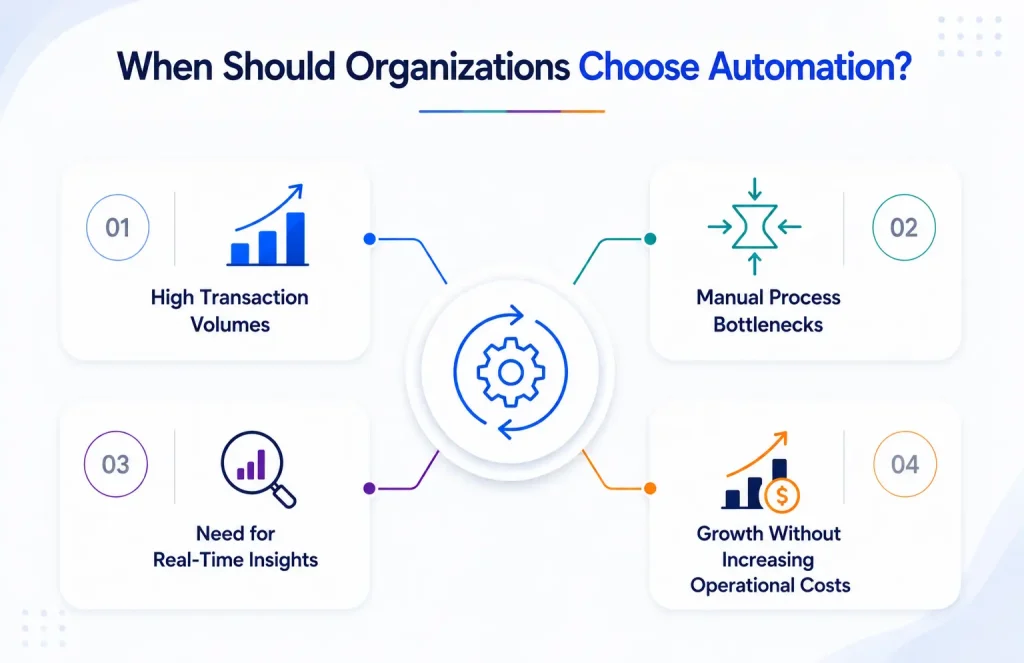
1. High Transaction Volumes
Processes involving thousands of repetitive transactions are strong candidates for automation.
2. Manual Process Bottlenecks
If employees spend significant time on repetitive administrative work, automation can improve productivity.
3. Need for Real-Time Insights
Automation enables faster reporting, analytics, and decision-making by connecting financial data across systems.
4. Growth Without Increasing Operational Costs
Organizations looking to scale finance operations without continuously expanding teams can benefit from automation.
For example, a growing enterprise may find that manually processing invoices across multiple regions creates delays and compliance challenges. Implementing intelligent AP automation can standardize operations while improving visibility and control.
When Does Outsourcing Make More Sense?
Outsourcing remains valuable in situations where organizations need:
1. Immediate Operational Support
Companies undergoing transformation or experiencing resource constraints may require external expertise.
2. Specialized Knowledge
Certain areas, such as regulatory compliance or regional tax requirements, may benefit from specialized providers.
3. Non-Core Activities
Organizations may choose to outsource processes that do not directly differentiate their business.
However, outsourcing decisions should be made carefully. Organizations should evaluate whether the process itself needs improvement before transferring responsibility to an external partner.
The Future of Finance: Combining Automation and Human Expertise
The future of finance operations is unlikely to be based on automation or outsourcing alone.
Leading organizations are moving toward hybrid operating models that combine:
- Intelligent automation for repetitive processes
- Human expertise for strategic decision-making
- External partners for specialized capabilities
For example, a company may automate invoice processing while using an outsourcing partner for complex exception handling. Finance teams can then focus on forecasting, financial strategy, and business growth.
This approach allows organizations to achieve operational efficiency while maintaining flexibility and expertise.
Building a Scalable Finance Operating Model
The decision around automation vs outsourcing should begin with a clear understanding of business priorities.
Organizations should evaluate:
1. Process Complexity
Which activities are repetitive, rule-based, and suitable for automation?
2. Strategic Importance
Which processes require internal ownership and decision-making?
3. Technology Readiness
Does the organization have the infrastructure required for automation?
4. Long-Term Objectives
Is the goal short-term cost reduction or long-term operational transformation?
Successful finance transformation requires more than selecting a technology or outsourcing provider. It requires redesigning processes around efficiency, intelligence, and continuous improvement.
Conclusion
The debate around automation vs outsourcing is evolving. Organizations are no longer choosing between technology and people—they are determining how to create the right combination of both.
Outsourcing can provide operational support, specialized expertise, and faster execution. Automation enables scalability, intelligence, and long-term process transformation.
For finance leaders, the question is not simply “Should we automate or outsource?” The more strategic question is:
How can we build a finance operating model that delivers efficiency today while creating the foundation for tomorrow’s intelligent enterprise?
Organizations that successfully combine automation, human expertise, and strategic partnerships will be better positioned to drive innovation, improve agility, and create lasting business value.