






- Manual reconciliation increases operational costs, slows financial close cycles, and creates greater compliance and audit risks as transaction volumes continue to grow.
- Reconciliation process automation improves efficiency by automating transaction matching, streamlining exception management, and providing complete audit trails across financial workflows.
- The most effective reconciliation platforms offer intelligent matching, flexible business rules, seamless ERP integrations, and robust governance capabilities rather than basic automation alone.
- A phased implementation approach—starting with simple reconciliations, validating results, and expanding gradually—helps reduce deployment risks while delivering faster ROI.
- Organizations that invest in reconciliation process automation can improve financial accuracy, strengthen compliance, accelerate decision-making, and enable finance teams to focus on higher-value strategic initiatives.
Financial reconciliation has become one of the biggest operational bottlenecks for modern finance teams. As transaction volumes grow, systems multiply, and reporting timelines tighten, manual reconciliation processes struggle to keep pace. What once required occasional effort has become a recurring challenge that consumes valuable time, delays financial close, and increases operational risk.
Reconciliation process automation helps finance organizations overcome these challenges by replacing manual matching, spreadsheet-based tracking, and repetitive exception handling with intelligent, rules-driven workflows. Instead of spending hours reconciling data across multiple systems, finance teams can automate routine tasks, improve accuracy, accelerate financial close, and redirect resources toward higher-value analysis.
As interest in reconciliation process automation continues to grow, so does the number of platforms claiming to offer end-to-end automation. However, implementation approaches, scalability, and intelligent capabilities can vary significantly. Choosing the right solution requires looking beyond feature lists to understand how effectively a platform can support your organization’s reconciliation needs today and as they evolve.
This guide explains what reconciliation process automation actually involves, the capabilities that matter most, the common pitfalls to avoid during evaluation, and how to choose a solution that delivers measurable business value rather than simply digitizing existing manual processes.
The Cost of Delaying Reconciliation Process Automation
Waiting to implement reconciliation process automation comes with hidden costs that extend beyond inefficient manual work. Every delayed decision means more time spent on repetitive tasks, higher operational risk, and missed opportunities to improve finance performance.
- Skilled teams spend time on low-value work. Finance professionals often devote hours to matching transactions and updating spreadsheets instead of analyzing exceptions, supporting business decisions, or driving strategic initiatives.
- Errors become more likely as transaction volumes grow. Manual reconciliation may seem manageable today, but increasing data volumes, multiple systems, and tighter reporting deadlines make inaccuracies and delays more difficult to avoid over time.
- Audit and compliance risks continue to increase. Without automated workflows and a complete audit trail, tracking reconciliation history, approvals, and supporting documentation becomes more time-consuming and error-prone during audits.
The longer organizations postpone reconciliation process automation, the longer they continue to absorb these operational costs. The goal isn’t to rush into a purchase—it’s to evaluate solutions efficiently and choose a platform that delivers lasting business value.
What to Look for in Reconciliation Process Automation Solutions
Not all reconciliation process automation platforms deliver the same level of value. Many solutions offer similar feature lists, but the real difference lies in how well they handle complex, real-world finance operations. As you evaluate vendors, focus on capabilities that have a measurable impact on efficiency, accuracy, and scalability.
- Support for complex matching scenarios. Look for platforms that can perform multi-way matching across bank statements, general ledgers, invoices, purchase orders, and payments—not just simple two-way reconciliation.
- Flexible matching rules and tolerance settings. The best solutions allow configurable tolerances by entity, account, currency, transaction type, or business unit, helping reduce false exceptions while maintaining accuracy.
- Reliable integrations with enterprise systems. Ensure the platform integrates seamlessly with your ERP, banking, and financial systems while providing monitoring, alerts, and resilience when source data changes.
- Intelligent exception management. Effective reconciliation process automation doesn’t just identify discrepancies—it routes exceptions to the right users, provides context for faster resolution, and supports collaborative workflows.
- Complete audit trails and compliance support. Every reconciliation, approval, adjustment, and exception should be fully documented with timestamps, user activity, and supporting evidence to simplify audits and strengthen governance.
When evaluating reconciliation process automation platforms, prioritize solutions that demonstrate these capabilities using realistic business scenarios. A platform that performs well with your actual reconciliation challenges is far more valuable than one that simply checks every box on a feature comparison sheet.
Common Challenges When Adopting Reconciliation Process Automation
Many finance leaders recognize the value of reconciliation process automation, but a few common concerns often delay implementation. Addressing these early can make the evaluation process more effective.
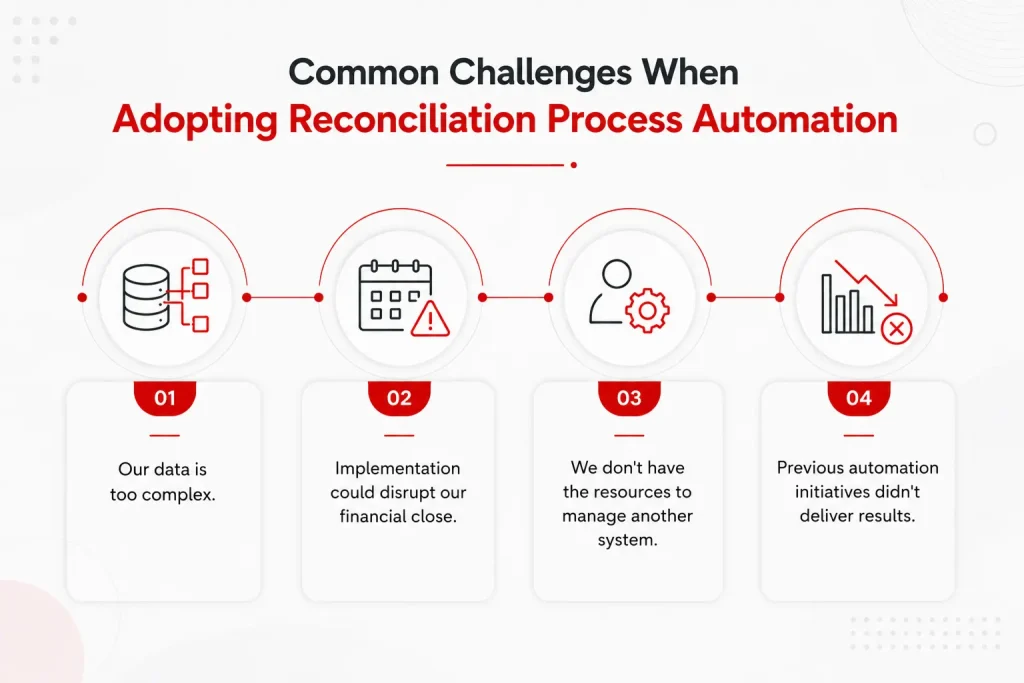
- Our data is too complex. Most organizations have inconsistencies across systems, but modern reconciliation platforms can handle complex data through configurable rules, intelligent matching, and phased implementation approaches.
- Implementation could disrupt our financial close. A well-planned rollout minimizes risk by running automated and manual reconciliation processes in parallel before transitioning fully, ensuring business continuity throughout implementation.
- We don’t have the resources to manage another system. While implementation requires an initial investment of time, reconciliation process automation significantly reduces ongoing manual effort, allowing finance teams to spend less time on repetitive tasks and more time on strategic work.
- Previous automation initiatives didn’t deliver results. Earlier projects often struggled because of limited matching capabilities, inflexible rules, or poor exception handling. Today’s leading platforms provide more intelligent automation, greater flexibility, and continuous optimization to support long-term success.
These challenges are valid, but they shouldn’t prevent organizations from modernizing their reconciliation processes. With the right implementation strategy and technology partner, reconciliation process automation can deliver measurable improvements in efficiency, accuracy, and compliance.
A Practical Approach to Reconciliation Process Automation
Successful reconciliation process automation initiatives don’t begin with a complete transformation. Instead, organizations achieve better results by adopting a phased implementation that minimizes risk while delivering early value.
- Start with high-volume, straightforward reconciliations. Begin by automating processes such as bank-to-general ledger (GL) reconciliation, where results are easy to validate and benefits become visible quickly.
- Run automation alongside existing processes. Validate automated reconciliations during at least one financial close cycle before fully transitioning, ensuring accuracy and building confidence among stakeholders.
- Refine matching rules and exception handling. Use real transaction data to optimize tolerance levels, matching logic, and workflows, improving accuracy while reducing unnecessary exceptions.
- Expand to more complex reconciliation processes. Once the initial implementation is stable, extend reconciliation process automation to intercompany, multi-entity, and high-volume reconciliations that offer greater operational impact.
- Strengthen governance and compliance. Incorporate automated audit trails, approvals, and reconciliation records into your financial controls to simplify compliance and support audit readiness.
A phased implementation allows organizations to realize value quickly while reducing deployment risk. Rather than attempting to automate every reconciliation process at once, finance teams can build confidence, optimize performance, and scale reconciliation process automation strategically across the enterprise.
Conclusion
Financial reconciliation is no longer just an accounting task—it’s a critical process that affects financial accuracy, compliance, operational efficiency, and business agility. As organizations manage increasing transaction volumes and more complex financial ecosystems, manual reconciliation methods become increasingly difficult to sustain.
Reconciliation process automation enables finance teams to streamline matching, reduce manual effort, improve audit readiness, and accelerate the financial close while maintaining greater control over exceptions and compliance. The key to success lies in selecting a solution that goes beyond basic automation, integrates seamlessly with existing systems, and can scale alongside your business.
Rather than viewing automation as a one-time technology investment, organizations should approach it as a strategic initiative that strengthens finance operations and creates long-term value. By taking a phased implementation approach and focusing on capabilities that solve real business challenges, finance leaders can deliver measurable improvements in efficiency, accuracy, and decision-making.
Ready to Modernize Your Financial Reconciliation?
If you’re looking to eliminate manual reconciliation, reduce financial close times, and improve audit readiness, Auxiliobits can help. Our expertise in Agentic Process Automation and Intelligent Enterprise Automation enables organizations to automate complex reconciliation workflows while integrating seamlessly with existing finance systems.
Contact Auxiliobits today to see how our intelligent automation solutions can help your finance team achieve faster, more accurate, and scalable reconciliation processes.