








Key Takeaways
- Build automation when the process is strategically differentiated, highly customised or requires proprietary business logic that commercial solutions cannot adequately support.
- Buy when a proven automation solution already addresses the process, particularly when the organisation prioritises faster deployment, predictable functionality and reduced internal development effort.
- Partner when automation involves complex integrations, significant process redesign, AI or agentic capabilities, or when internal teams lack the specialised expertise required for successful implementation.
- The build vs buy automation decision should go beyond upfront costs. Enterprises should assess total cost of ownership, time to value, integration complexity, scalability, internal capabilities, security and governance.
- A hybrid approach can deliver the strongest results by combining purchased automation technology, internally owned strategic capabilities and specialist partner expertise for implementation, integration and scale.
Automation has moved from an operational efficiency initiative to a strategic enterprise capability. As organisations look to automate finance, procurement, customer operations and shared services, one decision increasingly determines the success of the programme: should the organisation build the automation, buy an existing solution or partner with a specialist provider?
The build vs buy automation decision is not simply a technology question. It affects time to value, total cost of ownership, scalability, internal capabilities and long-term control.
Building can provide deep customisation but requires significant technical resources. Buying can accelerate deployment but may not address complex processes. Partnering can provide specialised expertise and implementation support but introduces reliance on an external provider.
For enterprise leaders, the right choice is therefore not about selecting the cheapest option. It is about determining which model delivers the strongest combination of business value, speed, control and scalability.
Build vs Buy vs Partner: Why the Decision Matters
Many organisations approach automation by asking whether they should develop a solution internally or purchase one from a technology provider. That binary decision is increasingly inadequate.
Enterprise automation now involves more than workflow automation or RPA. Organisations may need AI, intelligent document processing, APIs, orchestration, analytics and agentic capabilities to automate processes across multiple applications.
This creates three distinct approaches:
| Approach | What it means | Best suited for |
| Build | Develop the automation internally | Proprietary and highly differentiated processes |
| Buy | Implement an existing automation product | Standardised processes with proven solutions |
| Partner | Engage a specialist to design and implement automation | Complex transformations requiring expertise |
The decision should be based on the business outcome, not the technology preference of an individual team.
When Should You Build Automation?
Building automation internally gives the organisation maximum control over architecture, functionality, data and business logic.
Building automation can be the right option when it closely ties to a company’s competitive differentiation or when available commercial solutions cannot meet critical requirements.
Build when:
- The process contains proprietary business logic.
- Existing products cannot meet important requirements.
- The organisation has strong engineering and automation capabilities.
- Long-term control is strategically important.
- Customisation is more valuable than rapid deployment.
- The expected business value justifies ongoing development costs.
However, the cost of building extends beyond initial development. Organisations must account for testing, infrastructure, security, maintenance, upgrades, documentation and specialist talent.
This creates a key consideration: Can the organisation maintain the automation as technology and business requirements change? A solution that is inexpensive to build can become expensive to operate when internal teams must continuously fix, enhance and govern it.
When Should You Buy Automation?
Buying an existing solution can be more effective when the process is standardised and mature technology already exists to address it. Common examples include invoice processing, expense management, reconciliation, workflow management and customer communication.
The primary advantage is speed to value. Instead of spending months on development, an organisation can configure and deploy an existing capability. Buying can also provide access to continuous product innovation. Vendors can invest in new AI capabilities, integrations, security improvements and functionality that would otherwise require internal development.
Buy when:
- A mature product already addresses the use case.
- The process is relatively standardised.
- Rapid deployment is a priority.
- Internal development resources are limited.
- The product integrates effectively with the existing technology environment.
- Ongoing vendor support is valuable.
However, buying does not mean implementation is effortless. Organisations still need to assess integration, data quality, security, configuration, user adoption and process fit. A product that performs well in isolation may not deliver value if it cannot work effectively with the enterprise’s existing systems.
When Should You Partner With an Automation Provider?
Partnering becomes particularly valuable when an organisation has a clear automation objective but lacks the specialised expertise or capacity required to execute it. A specialist automation partner can support process discovery, redesign, technology selection, integration, implementation and optimisation.
This can be particularly important when automation crosses multiple enterprise applications or involves emerging technologies such as AI and agentic automation.
Partner when:
- Processes span multiple systems or functions.
- Internal automation expertise is limited.
- Significant process redesign is required.
- Integration complexity is high.
- AI or agentic automation introduces new technical requirements.
- The organisation wants to scale beyond isolated automation projects.
The primary advantage is reduced execution risk. Instead of building every capability internally, the organisation can access specialised skills and implementation experience. The key consideration is partner selection. Enterprises should evaluate technical expertise, security practices, delivery methodology, integration capabilities, governance and post-implementation support.
Build vs Buy vs Partner: Key Differences
The three models involve different trade-offs.
| Factor | Build | Buy | Partner |
| Customisation | Very high | Medium | High |
| Time to value | Low–medium | High | Medium–high |
| Internal expertise | High | Low–medium | Low–medium |
| Control | High | Medium | Medium |
| Implementation complexity | High | Medium | Medium |
| Best fit | Proprietary processes | Standardised processes | Complex transformation |
The comparison shows why there is no universally correct answer. The objective should be to match the operating model to the characteristics of the automation opportunity.
Seven Factors to Evaluate Before Deciding
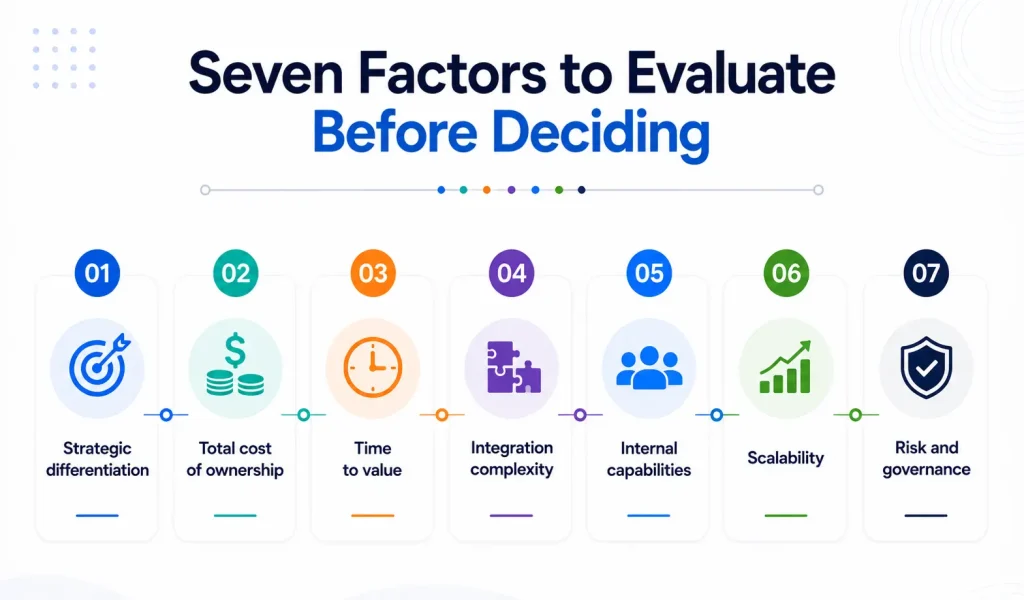
1. Strategic differentiation
If the process creates a competitive advantage, it may justify building or customising the capability. If the process is common across organisations, buying may be more efficient.
2. Total cost of ownership
Evaluate the complete lifecycle cost rather than only the initial investment. Consider development or subscription costs, integration, infrastructure, security, maintenance, upgrades, staffing, training and support.
3. Time to value
A solution that takes a year to deploy may deliver less practical value than one that achieves measurable results within months. When speed is critical, buying or partnering can often be more effective than building from scratch.
4. Integration complexity
Assess how many systems, data sources and workflows are involved. The more fragmented the technology landscape, the stronger the case for specialised implementation expertise.
5. Internal capabilities
Building requires more than developers. Organisations need expertise across process design, automation architecture, integration, AI, security and governance. If these skills are unavailable, buying or partnering may provide a more sustainable approach.
6. Scalability
Do not evaluate an automation strategy only against the first use case. Consider whether the approach can support additional processes, business units, geographies, users and increasingly sophisticated AI capabilities.
7. Risk and governance
Automation can affect financial transactions, customer experiences and operational decisions. Security, data governance, compliance, auditability and access controls should therefore be part of the decision from the beginning.
A Practical Build vs Buy Automation Framework
Enterprise leaders can simplify the decision by asking five questions:
1. Is the process strategically differentiating?
If yes, consider building or customising.
2. Does a mature solution already exist?
If yes, evaluate buying before investing in internal development.
3. How complex are the integrations?
If the process crosses multiple systems, partnering may reduce implementation risk.
4. Does the organisation have the required expertise?
If not, consider buying or partnering rather than creating a capability from scratch.
5. How quickly must value be realised?
If speed is critical, prioritise proven technology and experienced implementation.
This produces a straightforward decision logic:
Standardised process + mature solution → Buy
Proprietary process + strong internal capabilities → Build
Complex process + integration challenges + capability gaps → Partner
Strategically important process + complex technology → Build with a specialist partner
Why a Hybrid Approach May Be the Best Choice
Enterprises do not necessarily need one model for every automation initiative. A hybrid approach can combine the strengths of all three.
For example, an organisation could buy an automation platform, build proprietary components that create differentiation and partner with a specialist for implementation and integration.
This approach can provide greater flexibility while avoiding the two common extremes: building everything internally or assuming that purchasing software alone will deliver transformation.
The organisation retains ownership of the strategy and governance while using external expertise where it creates greater value. For large-scale automation programmes, this can be a more practical operating model than applying a single approach across every process.
Making the Right Automation Decision
The build vs buy automation decision should ultimately be treated as a business strategy decision rather than a procurement exercise. Build when proprietary capabilities and control justify the investment. Buy when proven technology can solve a standardised process faster and more economically. Partner when complexity, integration or capability gaps make specialist expertise critical.
For many enterprises, the optimal answer will not be one of these models in isolation. It will be a deliberate combination of buying technology, building strategic capabilities and partnering for implementation and scale.
The right question is therefore not simply “Should we build or buy?”
It is, ‘Which combination of technology, internal capability and external expertise will deliver sustainable automation value at the required speed, cost and scale?’
That is the decision that turns automation from an isolated technology project into an enterprise capability.