






Key Takeaways
- RPA automates tasks. APA automates outcomes.
- Digitized doesn’t mean automated.
- Agentic AI combines AI, RPA, and orchestration into a single intelligent layer.
- Auxiliobits delivers APA with intelligence, context, and action.
- Accurate automation = minimal human stitching, maximum process fluidity.
Automation is no longer just about mimicking human clicks. As enterprises digitize, the next frontier is intelligent, autonomous, goal-driven process automation, and Agentic AI powers it.
Automation used to mean one thing: making repetitive tasks faster using scripts, macros, or bots. But today’s enterprise landscape is far more complex. Business workflows span multiple systems, including SAP, Excel, shared drives, and inboxes. The problem? Most of these systems don’t talk to each other intelligently.
You might have bots. You might have an ERP. You might even have standard operating procedures. But if a human is still logging into a portal, manually reading a document, emailing for clarification, or tracking a file’s status, you’re not truly automated.
Also read: Agentic Automation for Freight Procurement: Compare, Negotiate, Award
The Illusion of Automation: What Enterprises Think vs. What’s Real
It’s a familiar story:
- “We use SAP, so we’re automated.”
- “We have bots, so everything is running smoothly.”
- “We’ve standardized forms. What else is left?”
But dig deeper, and the story changes.
| What’s Claimed | What’s Happening |
| ERP deployed | Employees log in and fill out forms manually |
| Bots built | They break when the UI changes or inputs vary |
| SOPs written | Followed inconsistently, often bypassed |
| Digital forms | Shared via email, with clarifications needed |
| Alerts set up | Endless email loops still manage approvals |
This is the illusion of automation—a façade where systems exist, but the glue holding them together is still human effort.
RPA’s Limitations in Today’s Enterprise Workflows
Robotic Process Automation brought a wave of enthusiasm. It allowed businesses to:
- Reduce keystrokes
- Copy-paste data between systems
- Avoid minor, repetitive labor.
However, RPA comes with key constraints:
- Rule-based and brittle: Changes in layout, format, or system UI break bots.
- Lack of context: Bots don’t “understand” what they’re doing.
- Not decision-capable: Can’t approve, reject, or escalate intelligently.
- No memory: Bots don’t learn from past interactions or errors.
RPA is excellent for isolated tasks, but modern business operations require end-to-end intelligent orchestration.
What Is Agentic Process Automation?
Agentic Process Automation is the next evolution in automation. It combines RPA, AI, and orchestration into autonomous, context-aware AI agents that can execute entire processes, not just individual tasks.
Think of it as moving from a script-following robot to an intelligent digital employee that:
- Understands documents and data
- Remembers previous steps
- Decides based on business rules
- Interacts with systems and people
- Adapts to change and exceptions
Core Components of APA Architecture
Let’s break down the architecture of APA:
| Layer | Role |
| Agentic AI Layer | Manages outcomes, not just steps; understands process context |
| RPA Layer | Executes repetitive actions (e.g., form fills, button clicks) |
| Cognitive Services | OCR, NLP, and data classification from unstructured sources |
| API & Integration Layer | Real-time interaction with ERP, CRM, shared drives, and cloud storage |
| Orchestration Engine | Routes work intelligently between agents, systems, and humans |
| Memory + Context Store | Retains past actions, decisions, and anomalies |
Each layer plays a vital role in turning static process scripts into living, learning workflows.
Use Case Walkthrough: Procurement Before and After APA
Traditional Procurement Workflow (Without APA)
- Vendor emails documents
- Procurement checks them manually.
- Data entered in SAP
- Email sent to Finance for approval.
- Errors found → back to Procurement → back to Vendor.
- Delays, confusion, no tracking
Agentic Procurement Workflow (With APA)
- An agent receives vendor documents via web/email
- Uses LLMs + rules to extract, validate, and classify data
- The bot fills out the SAP vendor creation form.
- Intelligent routing to Finance with audit trail and logic explanation
- Live status dashboard updated for all stakeholders
- If an exception occurs, the agent initiates clarification directly with the vendor.
Outcome: Zero manual stitching, faster cycle time, and full traceability.
Deep Dive: APA vs. Traditional Automation
| Feature | Traditional Automation (RPA) | Agentic Automation (APA) |
| Scope | Task-level (e.g., field fill) | Outcome-level (e.g., vendor onboarding) |
| Adaptability | Low (brittle scripts) | High (rule + ML-based agents) |
| Decision-making | Human-led | AI-led, with rules and learning |
| System Integration | Limited to UI | API, UI, email, cloud, all channels |
| Error Handling | Breaks easily | Handles exceptions, learns from feedback |
| Visibility | Siloed status | Real-time dashboards |
| Human Effort | High | Low (intervenes only on edge cases) |
Where Auxiliobits Fits In?
At Auxiliobits, we don’t replace your ERP or tools—we add intelligence where it’s missing. Our Agentic AI frameworks seamlessly integrate with your existing systems, orchestrating intelligent automation flows that reduce manual tasks, eliminate handoffs, and drive autonomous process completion.
Our APA stack includes:
- AI Document Intelligence: Reads PDFs, scans, and images
- Agentic Layer: AI agents for approvals, routing, and exception handling
- RPA Bots: UI automation for SAP, Oracle, and legacy systems
- ERP-Agnostic Logic: Makes your rigid systems more adaptive
- Live Dashboards: Real-time SLA tracking and notifications
- Context-Aware Agents: Handle edge cases with memory and logic
We don’t digitize—we automate intelligently.
Transition Strategy: Evolving from RPA to APA
Step-by-step APA adoption strategy:
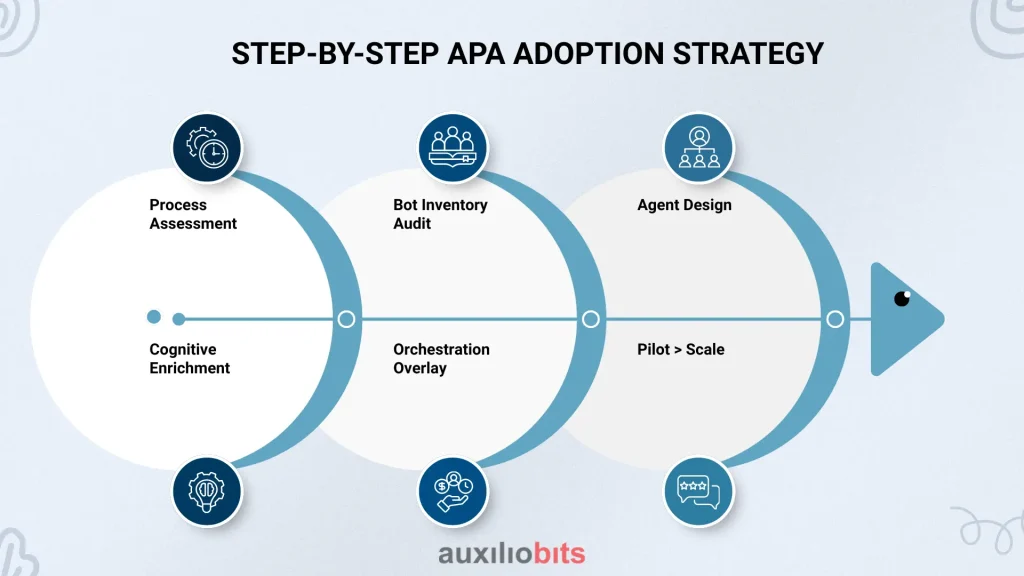
- Process Assessment: Identify processes with repetitive logic, fragmented visibility, and human routing.
- Bot Inventory Audit: Review existing bots for fragility and scope.
- Agent Design: Build agents to handle end-to-end process flows.
- Cognitive Enrichment: Add AI document readers and decision logic.
- Orchestration Overlay: Implement dashboards, service-level agreements (SLAs), and proactive alerts.
- Pilot > Scale: Start with one process (e.g., vendor onboarding), then expand.
Business Benefits of APA: Beyond Cost Reduction
APA isn’t just about saving hours—it’s about building resilience and intelligence into business operations.
Tangible Gains:
- 60–80% faster process cycle times
- 70% fewer human touchpoints
- 50% fewer manual errors
- SLA compliance improves by 90%
- Operational cost reduction of 30–50%
Intangible Gains:
- Better stakeholder experience
- Improved process transparency
- Business continuity (APA agents work 24/7)
- Continuous improvement through learning loops
Future Outlook: Automation That Learns, Adapts, and Collaborates
The future of automation isn’t in building more bots—it’s in building fewer, more intelligent agents.
APA is the foundation for:
- Autonomous Enterprises
- Dynamic Process Design
- Proactive Exception Management
- Human + AI Collaboration
Just like the shift from on-premise to cloud, the shift from RPA to APA is inevitable—and it’s already begun.
From RPA to APA in Finance: Real Implementation Examples
The transition from robotic process automation (RPA) to agentic process automation (APA) does not require finance teams to abandon their existing automation investments. Instead, organizations can progressively introduce AI agents into workflows where traditional bots struggle with exceptions, changing conditions, and multi-step decisions. The result is a shift from automation that follows instructions to automation that can work toward a defined business outcome within controlled boundaries.
- AP Automation: From Rules-Based Bots to Intelligent Agents
Traditional RPA can automate invoice capture, data entry, and rules-based invoice matching. For example, a bot can compare an invoice number and amount against a purchase order and route the transaction when predefined conditions are met.
The limitation appears when an invoice does not match exactly. An APA-based workflow can investigate the mismatch by checking purchase orders, goods receipts, previous transactions, supplier information, and business rules. The agent can determine whether the If the discrepancy is explainable, resolve the approved exceptions; otherwise, escalate the invoice with the relevant context.
This creates a more flexible model for AP automation services, where deterministic RPA handles predictable transactions while agents manage more complex exceptions.
- Reconciliation: From Matching to Investigation
RPA is effective at matching transactions according to predefined rules. However, unmatched transactions still require finance employees to investigate why balances differ.
With APA, an agent can go beyond matching. It can investigate transaction histories, compare related records across systems, identify recurring variance patterns, and recommend or execute an approved resolution. Over time, organizations can use these patterns to improve matching logic and reduce repetitive investigation.
This is where AI agents in finance can extend traditional automation from transaction processing into exception management and financial analysis.
- Financial Close: From Checklist Execution to Orchestration
Traditional RPA can execute individual close activities such as downloading reports, updating files, posting predefined entries, or checking whether a task has been completed.
An APA-based close workflow can coordinate the broader process. Agents can monitor activities across entities, identify incomplete reconciliations, follow up with responsible teams, collect supporting information, flag potential risks, and update the overall close status.
Instead of automating individual checklist items, the objective becomes orchestrating the close process while keeping approval and control points with finance professionals.
How Finance Teams Can Transition From RPA to APA
A practical transition can happen in stages:
1. Map existing automation: Identify current RPA bots, their dependencies, business rules, failure points, and exception volumes.
2. Identify agent-ready processes: Prioritize workflows where exceptions, investigation, or multi-step decision-making create significant manual effort.
3. Establish boundaries: Define what the agent can access, what actions it can take independently, and which activities require human approval.
4. Introduce agents alongside existing RPA: Rather than replacing stable bots immediately, use agents for exception investigation, decision support, and orchestration while existing RPA continues handling deterministic tasks.
5. Run a controlled pilot: Measure performance against the existing process before expanding the agent’s scope.
6. Scale gradually: Once accuracy, controls, and business outcomes are validated, connect additional workflows and systems through agentic process automation.
Measuring the Move From RPA to APA
The transition should be measured using operational outcomes rather than simply counting how many agents have been deployed.
Important metrics include:
- Touchless rate: Percentage of transactions completed without human intervention.
- Exception handling time: Average time required to investigate and resolve exceptions.
- Cycle time: Time from transaction initiation to completion.
- Exception resolution rate: Percentage of exceptions resolved automatically or with minimal intervention.
- Human escalation rate: Percentage of transactions requiring human judgment.
- Accuracy: Percentage of automated decisions or transactions completed correctly.
- Manual effort: Hours spent on repetitive processing and exception management.
Organizations can use these metrics to determine whether APA is actually improving the finance process. The goal is not to replace every RPA bot with an AI agent. Instead, finance teams can combine deterministic automation with adaptive agent capabilities and use intelligent enterprise automation to create a more flexible operating model.
Ready to Move From RPA to APA?
Plan your transition from RPA to agentic process automation. Book a free discovery call.
Conclusion: From Task Automation to Autonomous Enterprise
If your automation still relies on people to “check, approve, forward, escalate, or update”—you haven’t truly automated.
You’ve digitized.
Agentic process automation closes that gap, creating self-managed, outcome-driven workflows that operate with intelligence and autonomy. It’s not about replacing humans. It’s about giving them higher-value work while automation handles the grunt work, from end to end.