






Key Takeaways
- Agentic AI revolutionizes freight procurement by automating the entire lifecycle, reducing the time from days to a few minutes.
- Organized data gathering, negotiation facilitated through automation, and straightforward awarding streamline this process.
- Systems are integrated with TMS systems and carrier APIs to automate RFQs, manage the responses from bids, and complete awards with end-to-end traceability.
- Businesses achieve faster procurement, lower costs, improved carrier compliance, and the ability to scale operations without requiring additional staff.
- Freight automation addresses shipment urgency, market rate, and SLA sensitivity in real-time to provide data-driven procurement at scale.
Freight procurement encompasses obtaining spot quotes, managing tenders, monitoring carrier performance, negotiating prices, and issuing contracts. It is a high-risk activity with reliance on timelines, cost thresholds, and service level agreements.
Manual processing of emails, spreadsheets, and siloed portals results in slow decision-making, suboptimal carrier selection, and limited visibility, ultimately leading to increased complexity.
Limitations of Traditional Freight Procurement Systems
The following are the key points highlighting the limitations of Traditional Freight Procurement Systems:
| Challenge | Description |
| Manual Tendering | Logistics teams manually issue RFQs (Requests for Quotations) via email or portals, which can lead to delays. |
| Siloed Rate Data | Freight rate benchmarks are scattered between the sheets, emails, or PDFs. |
| Static Bid Evaluation | Slow and tedious human bid evaluation reduces consistency across service-level agreements (SLAs), compliance, and other key areas of focus. |
| Limited Negotiation Bandwidth | Teams are unable to negotiate with all carriers due to dynamic timing issues. |
| Delayed Award Decisions | Award decisions are delayed because of slow analysis, approval loops, and unstructured data. |
Why Agentic AI is a Game Changer?
Agentic AI introduces goal-focused, context-aware agents that can execute freight procurement actions autonomously, like:
- Issuing RFQs (Request for Quotations)
- Receiving and examining the bids.
- Participating in various types of dynamic negotiations
- Selecting the optimal carriers needed
- Issuing contract awards
These agents can speak, plan, reason, and interact with applications like TMS systems, carrier APIs, spreadsheets, and emails. This leads to faster procurement cycles, cost savings, and better agility.
Three Pillars of Agentic Freight Automation
Together, these three elements form the center of a fully independent freight purchasing process, enabling intelligent, real-time decision-making from bid solicitation through to final contract award.
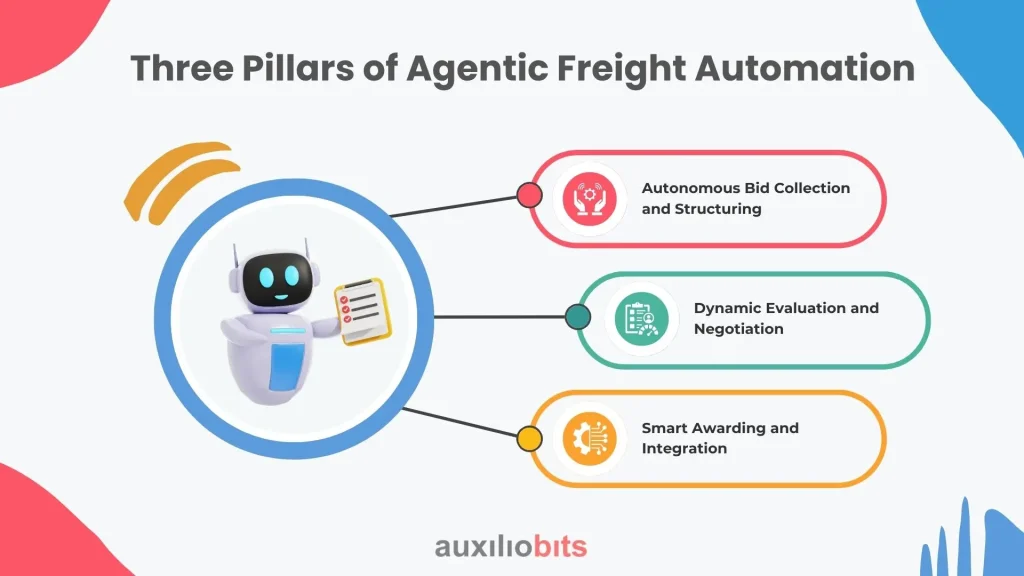
1. Autonomous Bid Collection and Structuring
This pillar streamlines the process of sending RFQs and gathering tiny pieces of bids through various channels:
- RFQ Broadcasting: AI systems automatically dispatch such organized tenders to pre-selected carriers based on their shipping details, timeliness, etc.
- Multichannel Ingestion: The quotes are harvested from carrier APIs, email responses, and portal exports.
- Bid Structuring: Natural language or semi-structured answers are then broken down into clean datasets (e.g., JSON or tabular) with fields such as fuel charges, transit time, and rate automatically pulled out and normalized.
The bids are then formatted into the same template, and timestamps are marked for comparison on an equal platform.
2. Dynamic Evaluation and Negotiation
Following the formatting of bids, AI-powered assessors apply decision logic to come up with the most viable offers:
- Multi-Criteria Evaluation: The bids are assessed against cost, SLA conformity, historical reliability, capacity conformity, and other criteria.
- Negotiation Logic: If a quote exceeds the target, the system automatically generates counter-proposals or follow-ups with pre-declared carriers, using pre-specified thresholds.
- Context-Aware Reasoning: The system can adjust decision weights based on shipment criticality
This establishes a dynamic, real-time feedback cycle with carriers that maximizes price and service quality.
3. Smart Awarding and Integration
After optimal bids are determined, the award finalization stage is then automated:
- Award Finalization: Winning bids are validated and stored with electronic audit trails, thus enabling traceability.
- TMS Integration: The system communicates with the booking and dispatch modules through API or native adapters (e.g., SAP TM, Oracle OTM).
- Documentation and Compliance: Auto-generated award confirmations, rate sheets, and compliance logs are pushed to shared drives, DMS, or carrier portals.
The outcome is a decreased cycle time, from several hours or days to just minutes, without sacrificing control or accountability
Business Value of Agentic Freight Automation
The agentic automation contributes to the business in the following ways.
- Cost Efficiency: It enables real-time comparisons and negotiations to achieve the best rates.
- Speed: The procurement cycles decrease from many days to just minutes with its help.
- Consistency: Its rule-based evaluations eliminate any kind of subjectivity.
- Agility: System adjusts to shipment priority, carrier response time, and exceptions
- Scalability: Supports 100s of tenders in parallel without increased headcount.
Future Outlook
With even more unstable supply chains and increasing logistics costs, Agentic AI will play an even greater role. Watch out for agents that:
- Optimally predict modes and shipping lanes in real time
- Pre-tender on projected demand
- Bid assessment comparison with carbon footprint
- Tone and negotiate strategy based on the carrier’s past behavior
Conclusion
Agentic AI is revolutionizing freight procurement. By leveraging expert and collaborative agents that imitate our procurement experts, logistics groups can automate RFQs, spot bidding, and awards, and achieve better cost, speed, and compliance outcomes. Auxiliobits facilitates this shift with enterprise-class Agentic Automation platforms for supply chain processes.