








Key Takeaways
- Generative AI bots can simulate the human brain to understand context anticipate user’s needs and provide relevant suggestions and assistance.
- Human behavior is essentially a complex interplay between the genetic predisposition of the individual and external influences.
- Human behavior is analyzed based on the unstructured data gathered from different sources. This data is used to train ML algorithms to understand and predict human behavior.
- Generative AI models can process, understand, and respond to commands in a given language. They can also process images, perform computational functions, and are capable of reasoning.
- Technologies like Machine Learning, Deep Learning, Neural Networks, Computer Vision, etc. are leveraged to develop AI agents that resemble humans.
- We are heading towards a future where autonomous systems will work alongside humans so both humans and AI must understand each other.
- Human behavior simulation helps AI understand humans better.
Multitasking or trying to do too much in a little time can be exasperating!
Whenever we are trying this, don’t we wish that there could be someone who could take over some of our tasks and relieve our burden?
Guess What?
Generative AI promises to provide us with a solution to fix this!
Generative AI-based virtual assistants can perform tasks like scheduling appointments, sending emails, and performing a host of tasks to ease our workload.
What’s more?
These virtual assistants understand our preferences and habits and complete tasks just like we would!
Generative AI bots can simulate the human brain to understand context anticipate user’s needs and provide relevant suggestions and assistance.
Personalized virtual assistants are just one example, we are familiar with another example of human behavior simulation in GenAI-powered chatbots. These chatbots interact with users just like humans and provide them with solutions and answers to their queries! Besides these, there are several use cases of how generative AI can simulate human behavior.
Before we dig deeper into how generative AI simulates human behavior, let us look at the basics of human behavior!
Human behavior is essentially the actions, reactions, and conduct humans exhibit in different situations and environments. Factors like genetics, upbringing, culture, personal behavior, etc. are critical components that shape human behavior.
In a nutshell, human behavior is a complex interplay between the genetic predisposition of the individual and external influences.
Let us now delve into the interplay of AI and human behavior!
Artificial Intelligence has impacted several facets of our lives both on personal and professional fronts. One of the most interesting aspects is its ability to comprehend and predict human behavior.
The question is, “How can AI predict human behavior when it depends so much on something so intrinsic as the genetics of an individual?”
Well! Two factors have made it possible! One is Data and the other is advanced (ML) Machine Learning algorithms.
ML algorithms are trained based on existing datasets. This self-learning technology can understand and predict human behavior based on the datasets it has been trained with.
Human behavior is analyzed based on the unstructured data gathered from different sources. One of the most important sources of data about human behavior is the social media interactions of an individual.
Data is collected from likes, shares, comments, video views, etc. Even human actions from video sources are vital data points that help AI to understand human behavior.
AI is being leveraged not just to mimic human behavior but also to simulate the human brain which is the power behind human behavior. Cognitive scientists study how the brain functions to perform different tasks and make decisions.
This is as far as how AI understands human behavior is concerned!
Next, emerges the question of whether or not AI can simulate human behavior.
The answer is YES!
Advanced AI models or Generative AI models can simulate human behavior!
Generative AI models like Chatgpt are technologies that can generate content in different formats like text, video, audio, etc., just like a human. GenAI models generate content in response to a prompt given to them.
These models have cognitive abilities and are capable of complex decision-making. They can process, understand, and respond to commands in a given language. They can process images, perform computational functions, and are capable of reasoning.
Generative AI works by using a deep learning model called a Generative Adversarial Network (GAN). GANs consist of two neural networks, a generator and a discriminator that are trained together competitively. GAN generates new content by learning the underlying patterns and structures of the input data.
The generator network generates new data, such as images, text, or music, based on a set of input data provided during training. The discriminator network then tries to distinguish between the generated data and real data from the training set. The two networks continue to improve and adapt to each other’s outputs to generate data that is indistinguishable from real data.
Through this process of iteration and competition, the generator learns to produce increasingly realistic outputs, while the discriminator becomes more accurate at identifying fake data. This results in generative AI that can create new, original content that closely resembles real data.
Generative AI agents are powered by different subsets of AI with features that mimic human-like abilities!
Technologies that Drive Human-level AI
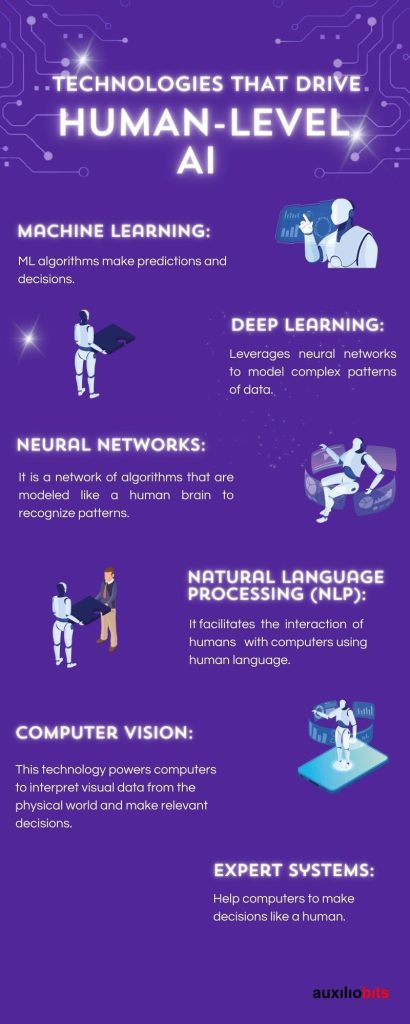
- Machine Learning
ML algorithms can learn from data and make predictions and decisions.
- Deep Learning
It is a subset of ML technology that uses neural networks with several layers and sophisticated architecture to model complex patterns of data.
- Neural Networks
It is a vital component of deep learning which comprises a network of algorithms that are modeled like a human brain. These networks are modeled to recognize patterns.
- Natural Language Processing (NLP)
It facilitates the interaction of humans with computers using human language. NLP algorithms can understand human language, interpret, and also generate human language.
- Computer Vision
This technology powers computers to interpret visual data from the physical world and make relevant decisions.
- Expert Systems
These systems use pre-loaded knowledge interpretive logic and AI to enable computers to make decisions just like a human.
Powered by these technologies, GenAI models can generate responses akin to how a human thinks, behaves, or speaks in a given situation. The self-learning technology continuously learns and improves its responses according to the feedback and interactions with users. This helps these models simulate and adapt to human behavior effectively.
How does Generative AI Simulate Human Behavior?
The first bots that mimicked human behavior worked according to a rule-based approach. These bots were capable of rudimentary social behavior as well. However, these bots could not reflect the consequences of their actions or respond to situations that they had not been programmed for.
ML-based self-learning overcame the shortcomings of the earlier models. The ML algorithms are capable of learning from their behavior. Reinforced learning with ML algorithms paved the way for generative AI models. These models use a combination of reinforced learning and supervised learning to simulate human behavior.
A GenAI model, stores, synthesizes, and applies relevant memories to generate human behavior with the help of
LLMs or Large Language Models. These models can generate and decompose action sequences.
Furthermore, a generative AI model architecture has memory modules that record a comprehensive list of behaviors the model displays. These behaviors are recorded in natural language. The information about the model’s moment-to-moment behavior is synthesized based on factors such as recency, relevance, and significance.
Short natural language descriptions of personas and their behaviors as they appear in the system are prototyped using a prompt chain to code LLMs. LLMs encode a comprehensive extent of human behavior based on training data. LLMs can generate interactive human behavior as well.
The model can conclude itself and others based on the synthesized data. The behavior of the model is directed by these conclusions and the current environment. These conclusions translate into high-level action plans and behaviors that reflect action and reaction.
These action plans are stored in the memory to guide future actions.
Why do we Need to Simulate Human Behavior?
Technologies like generative AI are being leveraged to simulate human behavior to overcome the limitations of human abilities.
The next-gen autonomous systems will have AI and humans working collaboratively. This can be achieved only when autonomous agents have the ability to embed practical models of human behavior. These agents will not only mimic humans but also understand the actions of users and anticipate their behavior.
Simulation of human behavior extends beyond individuals to impact systems. Human beings can be perceived as intelligent systems. Human behavior simulation is relevant to businesses as well because a business is also a system.
From a systems perspective for a business, AI augments humans and helps a business scale and sustain.
Simulation of human behavior helps AI recognize how we talk, move make decisions, etc. This helps AI respond to our needs more effectively.
Since AI responds to us in ways that are natural to humans making it easier for us to develop user-friendly designs of AI-based systems. User-friendly designs pave the way for seamless interactions between humans and bots.
AI enhances customer service because bots can understand and respond in a human-like fashion to customers.
Since AI systems learn by observing and analyzing human behavior, they can adapt to our preferences and are more effective in different applications.
Artificial Intelligence simulates human thinking and behavior. This enables AI to demonstrate empathy and understanding even though AI does not actually feel them. This aspect is especially useful in areas like virtual assistants or healthcare, etc., where users expect an empathetic response.
Use Cases of Human Behavior Simulation
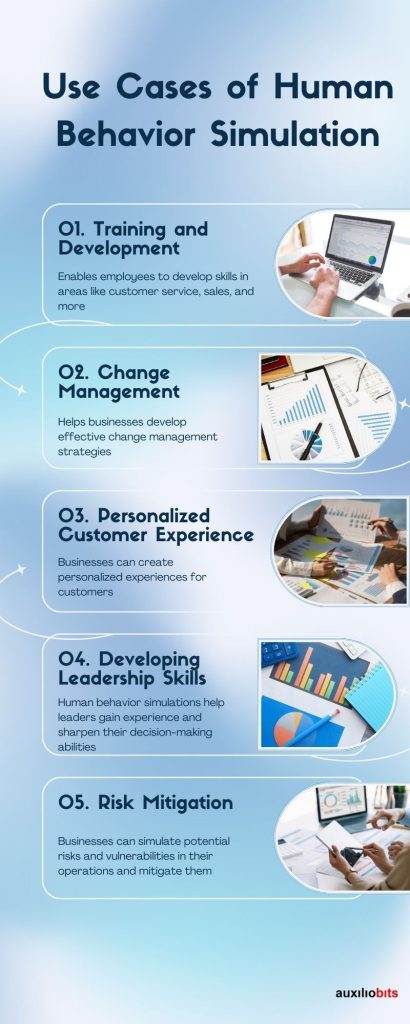
- Training and Development
Human behavior simulation can be deployed to help employees develop skills in areas like customer service, sales, and more.
- Personalized Customer Experience
By simulating human behavior, businesses get a better understanding of their customers and can create personalized experiences for them.
- Change Management
Businesses can simulate different scenarios and outcomes when implementing organizational change. Human behavior simulation helps businesses anticipate potential challenges and develop effective change management strategies.
- Developing Leadership Skills
Businesses can simulate different leadership styles, communication techniques, and conflict resolution strategies, etc. These simulations help leaders gain experience and sharpen their decision-making abilities.
- Risk Mitigation
Businesses can simulate potential risks and vulnerabilities in their operations and mitigate them. These risks could be cybersecurity threats, supply chain disruptions, etc.
Besides these, there are several other areas where simulation of human behavior can enhance outcomes.
Autonomous vehicles are a classic case of human behavior simulation. The behavior of a human driver is simulated to make the vehicle function autonomously. We also have examples of robotic surgeries where the bots are programmed to work like surgeons.
We are going to witness more examples of bots that work, think, speak, and make decisions, etc., like humans in the future.
In Conclusion
We are heading towards a world of human AI integration where AI augments human intelligence. For AI and humans to work symbiotically, it is imperative that both these entities understand each other. Human behavior simulation helps AI agents to understand various aspects of human behavior which fosters an environment where AI and humans work together to achieve greater goals.
How Auxiliobits can Help?
Auxiliobits has a team of professionals who are knowledgeable and experienced in generative AI. We have domain-specific experts who can guide you in choosing the best tools for your business. We provide you with cost-effective automation solutions that are tailored according to the specific needs of your business. Our professionals work with your in-house team and support you through the different stages of your digital transformation journey ensuring a seamless transition.
Call Us Now for Customized Automation Solutions!





