







Key Takeaways
- Traditional RPA is limited by fragility and high maintenance, especially in dynamic environments.
- Intelligent Automation added AI/ML capabilities but remained reliant on human oversight.
- Self-Healing Agents mark a transformative shift—delivering context-aware, autonomous correction and resilience.
- Enterprises adopting agentic automation report up to a 70% reduction in downtime and a 40% improvement in SLA.
- The future is goal-driven, proactive automation, where agents operate like digital teammates, not just tools.
The journey of process automation reflects the digital transformation of enterprises over the past two decades. Initially applied to manufacturing in the form of industrial robots, automation began to infiltrate business processes with the rise of Robotic Process Automation (RPA) around 2005–2010. These early bots offered value by mimicking human actions on structured digital systems
However, enterprises quickly realized that real-world processes are rarely linear. Human exceptions, judgment-based decisions, and system variability demanded more than hardcoded workflows. This led to the emergence of Intelligent Automation (IA), followed by today’s most advanced evolution: self-healing agents—autonomous, adaptive systems capable of learning and self-correcting.
Also read: Transitioning from Rule-Based Bots to Intelligent Agentic AI.
The First Wave: Rule-Based RPA Bots
Rule-based RPA systems operate like macros on steroids. They mimic keystrokes, mouse clicks, and data manipulation—ideal for processes that follow consistent rules. Early adopters saw substantial returns in automating repetitive back-office tasks.
Example Processes Automated:
- Logging into ERP systems to extract invoices
- Copying data from emails to CRM tools
- Updating status fields in case management tools
- Processing insurance claims
Despite early success, RPA bots had a significant flaw: they were brittle. A change in screen layout, unexpected data format, or internet latency can cause the bot to crash. They were non-cognitive, relying solely on scripted instructions.
Note: According to Deloitte’s 2023 Global RPA Survey, 67% of respondents experienced RPA bot failures weekly due to minor system changes, costing teams 10–20 hours per week in rework.
While RPA saved costs and improved consistency, its dependency on static environments created a ceiling for scalability.
The Second Wave: Intelligent Automation with AI and ML
Intelligent Automation emerged as a response to RPA’s limitations. By integrating AI technologies such as natural language processing, machine learning, and computer vision, bots can now understand, analyze, and make basic decisions.
Capabilities Introduced:
- NLP for interpreting emails or support tickets
- ML models for fraud detection and risk scoring
- OCR and document understanding for invoices and contracts
- Intelligent chatbots that respond conversationally
This phase was a turning point. Automation could now process unstructured data (e.g., images, PDFs, emails), unlocking vast new use cases in banking, HR, and customer support.
Yet, intelligent automation was not fully autonomous. It often followed a human-in-the-loop model, where decisions outside of model confidence thresholds were routed to humans. Moreover, it lacked self-awareness—the ability to detect if it had failed or needed to escalate.
Note: Gartner’s 2024 Market Guide for IA highlighted that while 80% of businesses adopted IA, less than 20% had mature governance to scale it across critical processes.
The Third Wave: Agentic and Self-Healing Systems
The third and most advanced wave of process automation introduces Agentic AI and self-healing systems. These agents go beyond execution—they think, reason, plan, and adapt.
What Sets Self-Healing Agents Apart?
Unlike traditional bots that follow a script, agents are goal-oriented. They monitor process performance, identify anomalies, understand the cause, and autonomously apply corrections—without human escalation. This marks a shift from task automation to autonomous process ownership.
Real Example:
Imagine an AI agent overseeing API integrations between Salesforce and SAP. If the SAP server fails, a traditional bot crashes. A self-healing agent, however, detects the failure, reroutes the flow to a backup service, and notifies admins, ensuring business continuity.
Note: McKinsey’s 2024 Automation Outlook reveals that early adopters of agentic automation report a reduction of up to 70% in unplanned downtime and a 40% improvement in SLA adhere
This evolution is not just about automation—it’s about resilience, adaptability, and intelligence at the core of enterprise systems.
Core Technologies Enabling the Shift
A convergence of modern tech stacks enables this new automation paradigm:
| Technology | Function in Self-Healing Automation |
| Large Language Models (LLMs) | Interpret instructions, reason through actions |
| LangChain / AutoGen | Chain agents and tools for task orchestration |
| Event-Driven Architecture | Trigger agent behavior based on system signals |
| Digital Twins | Simulate real-world systems for testing and diagnostics |
| Observability Platforms | Continuously monitor metrics, logs, and traces |
| Graph Neural Networks | Capture interdependencies for intelligent root cause analysis |
Agents thrive in environments where systems emit events, data is observable, and decisions can be made contextually rather than procedurally.
Real-World Use Cases: How Enterprises Are Adapting?
Enterprises across industries are no longer just experimenting with automation—they’re actively deploying autonomous agents to solve real-world challenges, from healthcare data integrity to self-healing IT systems.
1. Healthcare:
A large hospital group in the U.S. deployed autonomous agents to oversee EHR data pipelines. When anomalies like out-of-sync patient IDs appeared, agents corrected data at the source, reducing escalation tickets by 93%.
2. Finance & Accounting:
Accounts receivable processes utilized agents to identify discrepancies between the ERP and payment systems. When variances were identified, the agent matched the correct invoice to the payment using machine learning (ML), reducing human intervention by 60%.
3. Logistics & Supply Chain:
During the COVID-19 pandemic, a logistics giant utilized agents to reroute packages in response to last-minute flight cancellations in a dynamic manner. These agents factored in cost, weather, and SLA impact to select the best alternative path.
4. IT Operations:
An e-commerce company applied self-healing agents to infrastructure monitoring. Upon detecting a CPU spike in Kubernetes clusters, the agents scaled resources. They automatically restarted pods, eliminating the need for human intervention and resulting in significant savings in incident response costs.
These examples reflect a shift from assistive automation to autonomous orchestration.
Challenges and Limitations
Adopting self-healing systems is not without friction.
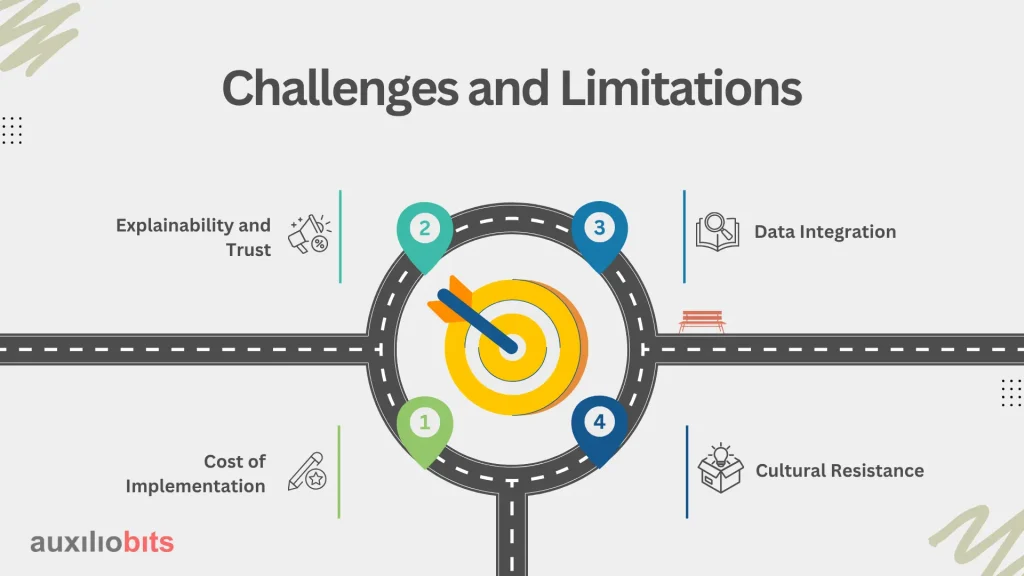
a. Explainability and Trust
Enterprises are reluctant to fully delegate control to agents unless they can explain why a decision was made. This demands transparent reasoning and traceability.
b. Data Integration
Agents must analyze data from multiple systems (ERP, CRM, legacy apps). Without standardized APIs and centralized observability, they operate with partial visibility.
c. Cost of Implementation
Setting up telemetry, LLM integrations, and real-time event flows can be expensive upfront, particularly for enterprises with legacy systems.
d. Cultural Resistance
IT and business teams often resist handing over decision-making to systems they don’t fully understand or trust.
Note: Capgemini’s 2024 report stated that 42% of automation programs stalled due to a lack of cross-functional alignment and integration readiness.
The Future Outlook: Autonomous, Proactive Enterprises
Looking ahead, process automation will evolve into zero-touch enterprise ecosystems, where systems run themselves under strategic human oversight. Here’s what we’ll likely see:
- Goal-Oriented Agents: Not just completing tasks, but achieving business KPIs autonomously.
- Collaborative Intelligence: Agents that work in concert with humans, other agents, and systems.
- Regulatory-Aware Agents: Built-in compliance and ethical frameworks ensure safe operations.
- Self-Learning Loops: Agents continuously improve by learning from new data, outcomes, and exceptions.
By 2030, enterprise automation will resemble a cohesive system, rather than a patchwork of scripts and bots, and will be capable of evolving in response to its environment.
Note: Forrester predicts that by 2027, 50% of large organizations will have at least one critical business function run entirely by autonomous agents.
Key Statistics That Define the Evolution
| Metric | RPA Bots | Intelligent Automation | Self-Healing Agents |
| Failure Rate | 25–30% | 10–15% | <5% |
| Downtime Impact | High | Medium | Low |
| Scaling Difficulty | High | Medium | Low |
| Human Dependency | High | Moderate | Minimal |
| Avg. ROI (per year) | $1M–$2M | $2M–$5M | $5M+ |
| Speed of Deployment | Fast | Moderate | Slower Initial, Fast Thereafter |
These numbers reflect not just improvement, but a paradigm shift in how automation delivers value.
Conclusion: From Reactive to Resilient Automation
The story of process automation is evolving from scripts and bots into autonomous, resilient digital systems. RPA brought speed, IA brought intelligence, and self-healing agents now bring adaptability and resilience. This isn’t merely a tech upgrade—it’s a rethinking of enterprise operations.
Organizations that leap to agentic, self-healing automation will unlock new levels of uptime, compliance, and agility. As digital systems become more complex and interconnected, resilience is no longer a luxury—it’s a necessity.
The future belongs to enterprises that embrace intelligent autonomy.