





Key Takeaways
- Rule-based bots break easily in dynamic workflows. Agentic AI adapts, learns, and makes goal-driven decisions.
- Agentic AI introduces protocol-driven communication, allowing agents to collaborate without direct integration.
- Autonomous decision-making and self-optimization make Agentic AI better suited for compliance-heavy, exception-prone industries.
- Enterprises should start with Minimal Viable Agents and scale through orchestration, not hard-coded logic.
- Emerging protocols like MCP and A2A are critical for building multi-agent ecosystems in the enterprise landscape.
RPA and rule-based bots helped automate basic tasks, but they fall short in dynamic, unstructured environments. Agentic AI is a leap forward, offering adaptive, goal-driven, and collaborative automation that can learn, reflect, and scale autonomously. This post outlines what sets Agentic AI apart, provides practical transition steps, and highlights underutilized enterprise applications.
Also read: From RPA to APA: How Agentic AI Is Redefining Automation?
The Evolution of Automation
From scripts and macros to Robotic Process Automation (RPA), businesses have long pursued efficiency. These technologies were well-suited to stable, repetitive processes such as data entry or system integration. However, static logic can’t keep pace with today’s fast-changing, exception-prone workflows.
RPA lacks the adaptability required to handle variability, exceptions, or evolving business rules. As digital transformation accelerates, enterprises need systems that can reason, learn, and interact across silos. Enter Agentic AI: intelligent agents designed to orchestrate outcomes rather than execute tasks. This is not just another tech upgrade—it’s a foundational shift in how work is executed.
What Are Rule-Based Bots—and Why Do They Fail?
Rule-based bots operate on fixed if-then logic. They excel at:
- Repetitive, structured tasks
- High-volume data entry
- Form population
- System-to-system data migration
But they break when faced with:
- Exceptions and edge cases
- Unstructured inputs (emails, scans)
- Situational judgment
- UI or schema changes
“Is your RPA setup breaking under complexity?”
While these bots have delivered value in specific domains, they lack the agility needed for real-time, dynamic decision-making. Their rigidity often leads to frequent breakdowns when business logic changes or when upstream systems modify their interfaces.
Silent Failures: Perhaps the most costly limitation is their fragility. Bots often fail unnoticed after minor UI tweaks or schema updates. These silent failures can cascade into missed service-level agreements (SLAs), data compliance risks, and operational disruptions—costs that are rarely factored into ROI calculations.
Agentic AI: A Paradigm Shift
Agentic AI introduces intelligent software agents that operate with autonomy, context awareness, and learning capabilities. These agents don’t just automate actions; they pursue goals, reason through complexity, and collaborate dynamically with other agents and systems.
Key Capabilities:
- Goal-Driven Logic: Agents interpret the desired outcome, not just follow steps.
- Autonomy: Operate independently, requiring minimal human oversight.
- Context Awareness: Evaluate the current state, history, and data to adapt effectively.
- Intent Protocols: Use communication frameworks like MCP or Google’s A2A to coordinate with other agents.
Think of MCP like Bluetooth for agents—enabling seamless communication without custom API wiring.
Unlike traditional bots that operate in isolation, Agentic AI systems are designed for decentralized, orchestrated automation. This allows them to work in fluid, heterogeneous environments with minimal reprogramming or human intervention.
What Makes Agentic AI “Agentic”?
Many confuse Agentic AI with simply more intelligent bots. But agentic systems bring five transformative capabilities that redefine automation:
- Real-Time Decision Memory: Agents store and log past decisions, along with their rationale. This supports transparency, compliance audits, and retrospective optimization.
- Self-Improvement: Agents learn from feedback loops, adapting their actions over time based on outcomes.
- Goal Abstraction: Instead of executing tasks, they pursue business outcomes. This abstraction makes them highly reusable and robust across varied contexts.
- Protocol-Based Collaboration: Instead of hard-coded integrations, agents use standardized protocols to work in concert.
- Scalability: As your needs grow, new agents can join and integrate into workflows with minimal overhead.
This makes them ideal for regulated industries such as healthcare, finance, and insurance, where auditability, transparency, and adaptability are non-negotiable.
Comparing Rule-Based Bots vs. Agentic AI
This table underlines the fundamental shift: Agentic AI represents an evolution from procedural task automation to strategic goal orchestration.
| Feature | Rule-Based Bots | Agentic AI |
| Logic | Static if-else rules | Dynamic, goal-based |
| Adaptability | Low | High |
| Input Handling | Structured only | Structured & Unstructured |
| Collaboration | Standalone | Multi-agent orchestration |
| Exception Handling | Manual | Autonomous escalation |
| Learning | None | Continuous feedback learning |
Step-by-Step Strategy to Transition
If you’re ready to evolve from RPA to Agentic AI, follow these steps:
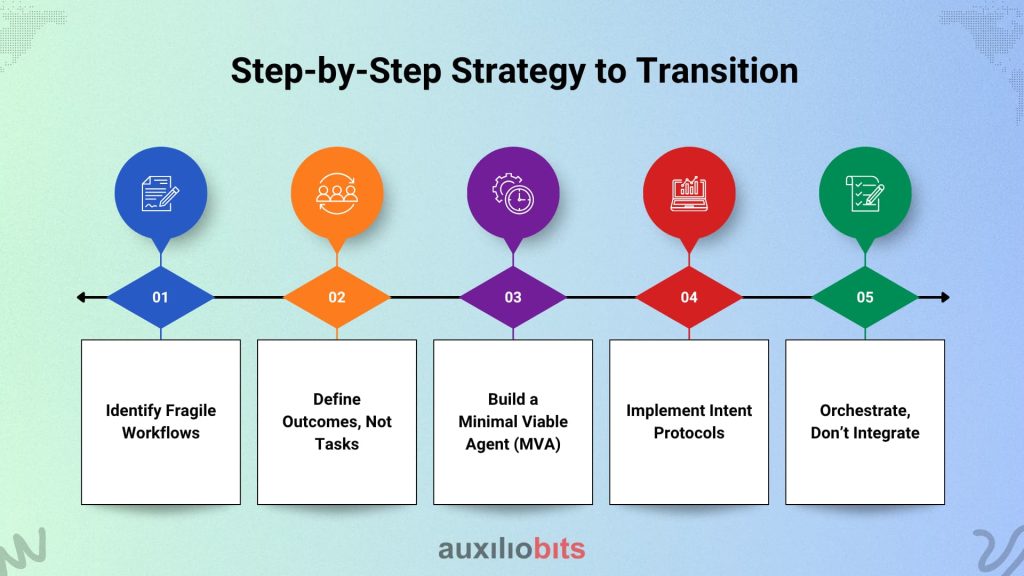
1. Identify Fragile Workflows
Begin by auditing processes that frequently require human intervention. Look for:
- Invoice processing with varied formats
- Procurement approvals with exceptions
- Customer escalations requiring judgment
These are high-variability zones where bots struggle, and agents excel.
2. Define Outcomes, Not Tasks
Rather than mapping process steps, define what each workflow is trying to accomplish.
- Instead of “populate form fields,” say “process new customer application.”
- Shift the mindset from process modeling to goal modeling.
3. Build a Minimal Viable Agent (MVA)
Develop a lightweight agent in a sandbox environment. It should:
- Learn from interactions
- Handle a narrow but variable scenario.
- Provide explainable outputs
Iterate rapidly to establish confidence in its decision-making
4. Implement Intent Protocols
Adopt standards like:
- MCP (Multi-Agent Communication Protocol)
- Google’s A2A (Agent-to-Agent Communication)
These enable decentralized orchestration, letting agents interact without brittle API dependencies.
5. Orchestrate, Don’t Integrate
Unlike bots that depend on precise API calls, agents operate with autonomy. They observe systems, interpret states, and act accordingly. This reduces integration debt and improves resilience.
Surprising Enterprise Use Cases
Here are four high-impact use cases where Agentic AI is quietly winning:
- Demand Forecasting in Manufacturing: Agents reconcile ERP forecasts with real-time market intelligence to prevent overproduction or stockouts.
- Contract Negotiation in Legal: AI agents identify risky clauses, suggest edits based on historical agreements, and propose acceptable terms.
- Healthcare Claim Escalation: Multi-modal agents analyze patient records, claim histories, and physician notes to recommend or auto-approve claims.
- Compliance Enforcement in Banking: Governance agents track policy adherence across systems, highlight violations, and recommend fixes.
These examples demonstrate that agentic systems are versatile and capable of making nuanced, cross-domain decisions.
Key Challenges to Prepare For
Despite the promise, implementing Agentic AI requires groundwork:
Data Fragmentation
- Agents need real-time, contextual data.
- Solution: Create agent-readable data lakes or digital twins.
Governance and Auditability
- Enterprises must audit how agents make decisions.
- Solution: Build transparency dashboards that log agent reasoning.
Change Management
- Teams may resist handing over control.
- Solution: Position agents as cognitive enhancers, not replacements. Show how they remove low-value decisions, not high-value roles.
Security and Trust
- Autonomous systems must operate within defined guardrails.
- Solution: Enforce policy boundaries and supervised autonomy levels.
Conclusion
Rule-based bots were about task execution. Agentic AI is about judgment, adaptability, and orchestration. The shift from RPA to intelligent agents is not just about doing things faster—it’s about doing the right things, even in complex and ambiguous environments.
This transition empowers businesses to:
- Scale operations intelligently
- Improve compliance and traceability.
- Respond to change with agility.
If traditional RPA automates steps, Agentic AI automates outcomes.
The future belongs to enterprises that build self-optimizing, goal-driven automation ecosystems. And that future begins by thinking agentically.