





Key Takeaways
- Agentic AI enables the intelligent automation of unstructured data, including audio and text.
- LangChain provides agent orchestration and reasoning, while WhisperAI handles transcription.
- Together, they build autonomous systems that can understand, plan, and act.
- Use cases include meeting analysis, contract parsing, sentiment monitoring, and policy digitization.
- This approach goes beyond NLP—it represents the next stage of evolution in enterprise AI.
Unstructured data is the silent giant in every enterprise. From overflowing repositories of audio logs and scanned contracts to sprawling document archives and untranscribed meetings, companies are accumulating more data than they can analyze, let alone act on. Yet, inside these formats lie the key to competitive intelligence, customer sentiment, operational inefficiencies, and strategic risk exposure.
The rise of Agentic AI—autonomous, goal-driven, and context-aware agents—is changing how businesses handle this challenge. Powered by technologies like LangChain and WhisperAI, Agentic AI is breaking the barriers of static automation and moving toward systems that listen, read, understand, and most importantly, act.
In this blog, we dive deep into how these technologies work together to unlock the value of unstructured data. More than just another automation hype, this is about building intelligent workflows that self-navigate, self-correct, and scale across the unstructured terrain.
Also read: Building a Roadmap for Agentic Automation in Manufacturing
The Unstructured Data Problem in Enterprises
Unstructured data makes up roughly 80-90% of all enterprise data. Unlike structured data, which fits neatly into databases and spreadsheets, unstructured data includes:
- Customer support call recordings
- Legal contracts and scanned documents
- Emails, internal chat messages
- Social media mentions and reviews.
- Images and handwritten forms
This data holds valuable insights. But traditional systems falter here, as they rely on structured schemas, keyword-based searches, or rule-based parsing—all ineffective in dealing with ambiguity, varied formats, and language complexity.
The key pain points include:
- Lack of standardization: Every audio file, contract, or document can vary in tone, format, and language, resulting in inconsistencies.
- Inability to interpret context: Simple keyword extraction can’t identify nuance, sentiment, or implied meaning.
- No end-to-end workflows: Even if insights are extracted, no system autonomously acts on them.
The result? Valuable data sits unused, creating bottlenecks in decision-making and compliance.
Why Traditional Automation Fails with Unstructured Data?
Conventional automation platforms, such as RPA (Robotic Process Automation) and OCR (Optical Character Recognition), were never designed to handle unstructured logic. Their limitations become evident quickly:
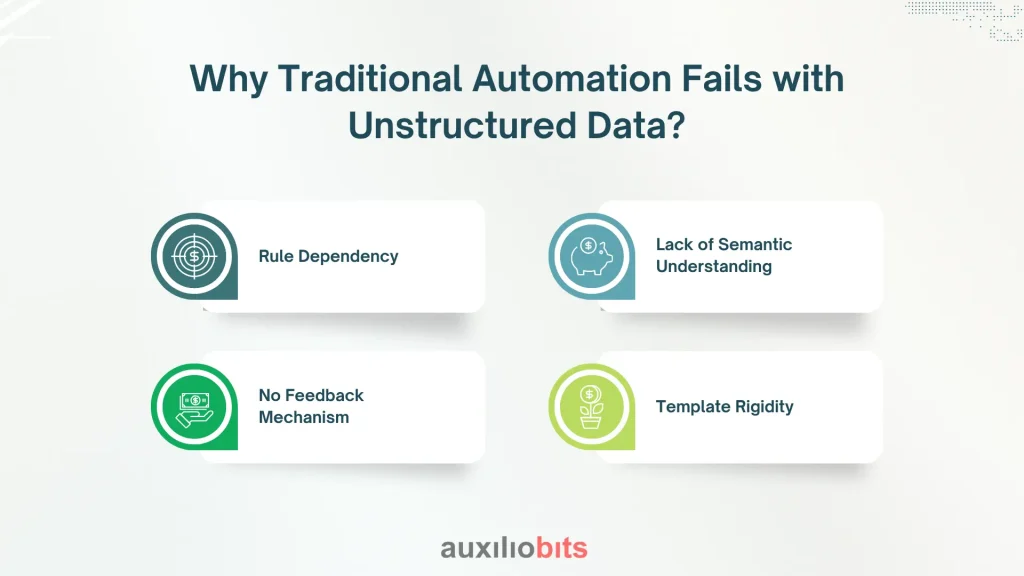
- Rule Dependency: Most automation workflows rely on deterministic rules. If the input varies (which it does in unstructured data), the bot breaks.
- Lack of Semantic Understanding: These systems can’t derive intent or meaning from language. They can extract but not interpret.
- No Feedback Mechanism: Traditional bots cannot revise their actions based on the results. There’s no “thinking loop.”
- Template Rigidity: If a document’s layout changes even slightly, the automation might fail.
In an enterprise setting, this means that unstructured data tasks, such as summarizing calls, extracting clauses from contracts, or understanding customer complaints, cannot be reliably handled with rule-based automation.
Enter LangChain and WhisperAI: Enablers of Agentic Intelligence
In Agentic AI, where autonomous agents must perceive, reason, and act, LangChain and WhisperAI emerge as foundational enablers, bridging language understanding with real-world interactivity and audio perception.
LangChain: Language-First Orchestration
LangChain is an open-source framework that allows developers to create language model-driven agents. Unlike tools that just run prompts or queries, LangChain enables:
- Sequential reasoning: Chain-of-thought execution allows agents to break down tasks.
- Access to tools: Agents can call APIs, search the web, and interact with databases.
- Memory support: Agents recall prior conversations and decisions, providing them with context.
- Autonomous loops: The agent can decide whether to continue, retry, or escalate a task.
LangChain essentially transforms a large language model into a reasoning entity—a software agent capable of thinking and acting.
WhisperAI: Audio-to-Text Intelligence
WhisperAI, developed by OpenAI, is a state-of-the-art automatic speech recognition (ASR) system. It turns audio into structured, high-quality text with:
- Multilingual support
- Speaker diarization and timestamps
- High accuracy in noisy environments
When combined with LangChain, WhisperAI becomes the sensory input layer of an Agentic AI system, enabling it to understand spoken content, detect actionable items, and trigger downstream actions.
Real-World Use Cases of Agentic AI with LangChain & WhisperAI
By combining LangChain’s reasoning capabilities with WhisperAI’s speech-to-text precision, enterprises can unlock powerful Agentic AI use cases that go far beyond simple automation, transforming how work is perceived, interpreted, and executed in real time.
Automated Meeting Insights
Imagine a cross-functional team meeting recorded on Zoom. WhisperAI transcribes the conversation. LangChain processes the transcription to:
- Identify action items and assign them to stakeholders
- Summarize the discussion by topic.c
- Detect deadlines and create reminders in calendars.
The agent not only understands the conversation but also coordinates post-meeting follow-up.
Intelligent Contract Agents
Legal teams deal with thousands of contracts. An Agentic AI system can:
- Parse legal documents using LangChain
- Compare clauses to standard templates.
- Flag potential risks or unusual terms
- Suggest negotiation points or auto-draft responses
All without human intervention, except for final review.
Voice-Based Customer Sentiment Monitoring
Enterprises running call centers can:
- Use WhisperAI to transcribe calls
- Let LangChain agents assess sentiment, urgency, or risk.
- Trigger escalation, refunds, or follow-up tickets based on real-time agent interpretation
This enables real-time action, not just passive monitoring.
SOP Automation from Policy Documents
Organizations with outdated Standard Operating Procedures (SOPs) often face compliance risks. Agentic AI agents can:
- Read the PDF policies
- Extract procedures and standard operating sequences
- Format them into task checklists or BPMN diagrams.
Instead of manual document review, agents digitize and operationalize knowledge.
Technical Deep Dive: How It All Works?
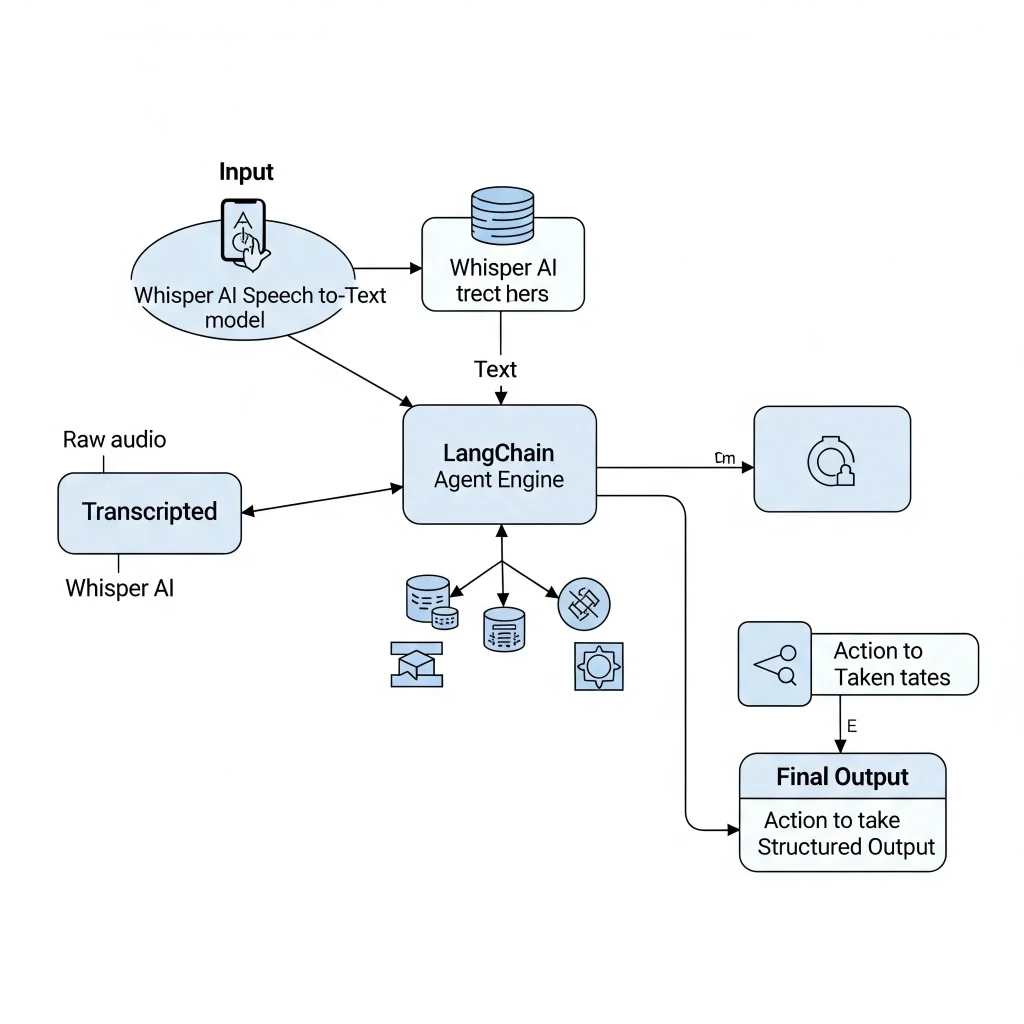
Here’s a closer look at how the full Agentic AI pipeline functions:
1. Input Ingestion:
- Audio files from meetings, calls, or interviews are passed into WhisperAI.
- PDFs or documents are loaded using LangChain-compatible loaders.
2. Transcription and Parsing:
- WhisperAI outputs structured transcripts with timestamps and speakers.
- LangChain processes these into manageable chunks.
3. Context Building:
- LangChain uses memory components to store prior data.
- Agents build semantic understanding of the text.
4. Planning and Tool Use:
- Based on their goals (e.g., summarizing, extracting tasks, updating the system), agents plan their next steps.
- They may use external tools, such as APIs, vector databases, and CRM systems.
5. Execution and Iteration:
- Outputs are created (JSON, email drafts, ticket updates).
- If confidence is low, the agent retries with a new approach.
6. Logging and Escalation:
- Final actions are logged.
- Escalation occurs when ambiguity or risk is detected.
This continuous loop of perception, planning, and execution is what makes the system agentic.
Architectural Overview
Each layer contributes to an end-to-end agentic workflow—from ingestion to actionable intelligence.
What Makes This Approach Truly Agentic?
Unlike single-pass AI tools, Agentic AI systems operate with:
- Goal orientation: The system has a defined outcome in mind.
- Tool-use reasoning: Agents decide which tools (API, search, retrieval) to use based on context.
- Memory-enabled adaptation: Prior interactions influence decisions.
- Autonomous planning: Agents choose the sequence of actions.
- Feedback loops: Outputs are evaluated and improved iteratively.
It’s this multi-loop, tool-aware, self-guided behavior that distinguishes Agentic AI from past NLP or automation efforts.
Emerging Benefits: Beyond Conventional NLP
The practical advantages of using LangChain + WhisperAI in an Agentic AI context include:
- Increased automation coverage: Unstructured tasks like meeting summaries, contract interpretation, and call scoring become automatable.
- Faster decision-making: Agents compress long documents or calls into actionable decisions in minutes.
- Lower operational costs: Eliminate manual review tasks and reduce dependency on human SMEs.
- Dynamic scalability: New document types, languages, or goals can be introduced without reprogramming the entire system.
- Continuous learning: With feedback and memory, agents become better over time.
The compounding value of these benefits only grows as agents are deployed across more departments and workflows.
Future Outlook and Challenges
The Road Ahead
We can expect rapid evolution in:
- Multimodal agentic systems: Integrating video, images, text, and voice.
- Agent marketplaces: Deploy off-the-shelf agents for specific business goals.
- Auto-reasoning enhancements: Smarter planning engines within LangChain.
- Enterprise integration plugins: Seamless links with ERPs, CRMs, and legacy systems.
Key Challenges
- Latency and compute: Complex workflows require optimization for real-time use.
- Security and access control: Agentic systems must honor data governance policies.
- Debugging agent behavior: Non-deterministic outputs mean agents must be auditable.
- Human trust: Adoption depends on stakeholder confidence in agent recommendations.
Enterprises must invest in sandboxed deployment, clear audit trails, and human-in-the-loop mechanisms to scale agentic workflows safely and securely .
Final Thoughts
Unstructured data is no longer a black box. With WhisperAI and LangChain powering Agentic AI, organizations can finally extract value from content that was once too chaotic to automate.
This shift isn’t just technical—it’s strategic. Agentic AI doesn’t just do things faster—it does them smarter, with autonomy, adaptability, and awareness. It doesn’t just extract data—it turns data into direct action.
For enterprises willing to embrace this architecture, unstructured data can become the most intelligent asset they own