








Enterprise automation has entered a new phase.
Over the last decade, organizations have invested significantly in robotic process automation, workflow platforms, artificial intelligence, and intelligent automation solutions. These technologies have helped businesses reduce manual effort, improve operational speed, and create new opportunities for digital transformation.
However, a growing number of organizations are discovering an uncomfortable reality: automation alone does not guarantee transformation.
Many automation initiatives fail to deliver expected value because businesses focus on deploying technology before understanding the processes they are trying to improve. They automate fragmented workflows, preserve unnecessary complexity, and create digital versions of inefficient manual processes.
The result is automation that works but does not transform.
The organizations achieving sustainable value from process automation are taking a different approach. They are putting processes before platforms, business outcomes before technology capabilities, and operational redesign before automation deployment.
This approach, known as process-first automation, focuses on understanding how work gets done, identifying opportunities for improvement, and then applying automation where it creates measurable business impact. The future of enterprise automation will not be defined by how many tasks organizations automate. It will be defined by how intelligently they redesign operations before automation begins.
Why Technology-First Automation Falls Short
Traditional automation programs often start with a technology conversation.
Organizations ask:
- Which automation platform should we implement?
- How many processes can we automate?
- How quickly can we deploy bots?
- Which AI capabilities can improve productivity?
These questions are important, but they are not the starting point.
When organizations begin with technology, they often overlook the operational complexity hidden within existing processes.
A finance process that appears simple may involve multiple approval paths, inconsistent policies, manual exceptions, disconnected systems, and regional variations. Automating this process without redesigning it simply allows inefficiency to move faster.
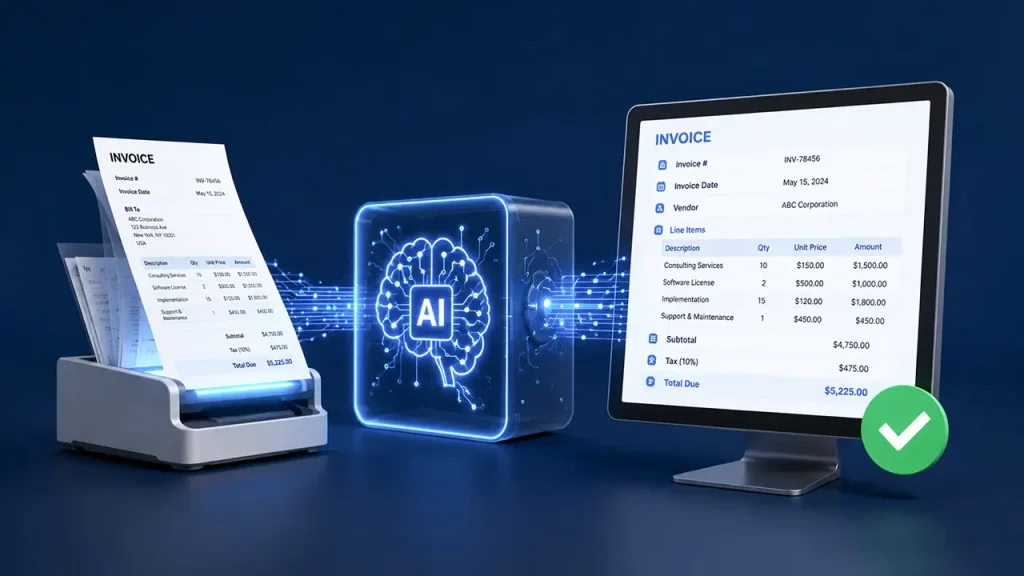
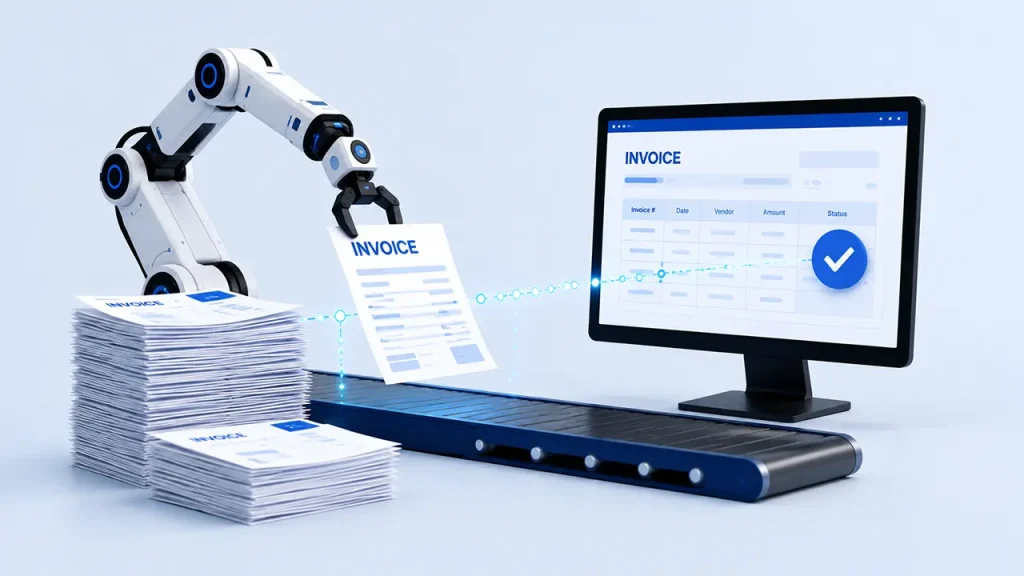
For example, an accounts payable workflow may automate invoice extraction and approval routing. However, if approval rules are unclear, vendor information is inconsistent, or exception handling remains manual, the automation will struggle to achieve its intended value.
Technology can accelerate a process. It cannot fix a process that was never optimized.
This is why many organizations experience automation fatigue. Initial pilots demonstrate success, but scaling becomes difficult because the underlying processes were never standardized or simplified.
What Is Process-First Automation?
ocess-first automation is a business transformation approach where organizations optimize workflows before introducing automation technologies.
Instead of asking:“What technology can automate this process?”
Organizations begin with: “How should this process operate in the most efficient way?”
This shift changes automation from a technology implementation project into an operational improvement initiative.
A process-first approach typically involves:
- Understanding current workflows
- Identifying inefficiencies and bottlenecks
- Removing unnecessary activities
- Standardizing business rules
- Redesigning processes for scalability
- Selecting the right automation technology
The objective is not simply to automate existing work. The objective is to create better ways of working and then use automation to amplify those improvements.
Process Discovery: The Foundation of Successful Automation
Before organizations automate, they need visibility into how processes actually operate. In many enterprises, there is a gap between documented processes and real-world execution.
A process document may show a standardized workflow, while employees rely on spreadsheets, emails, manual approvals, and workarounds to complete daily operations.
Process discovery helps uncover this hidden complexity.
Using process mining, operational data analysis, stakeholder interviews, and workflow assessment, organizations can identify:
- Where delays occur
- Which activities consume the most effort
- Where exceptions frequently happen
- Which steps create business value
- Which tasks can be eliminated or automated
This visibility enables organizations to prioritize automation opportunities based on measurable impact rather than assumptions.
For example, instead of automating every invoice-related activity, an organization may discover that the biggest opportunity lies in improving vendor onboarding, reducing approval delays, or eliminating duplicate data entry. Process intelligence ensures automation investments target the areas where they create the greatest business value.
Why Process-First Automation Creates Better Business Outcomes
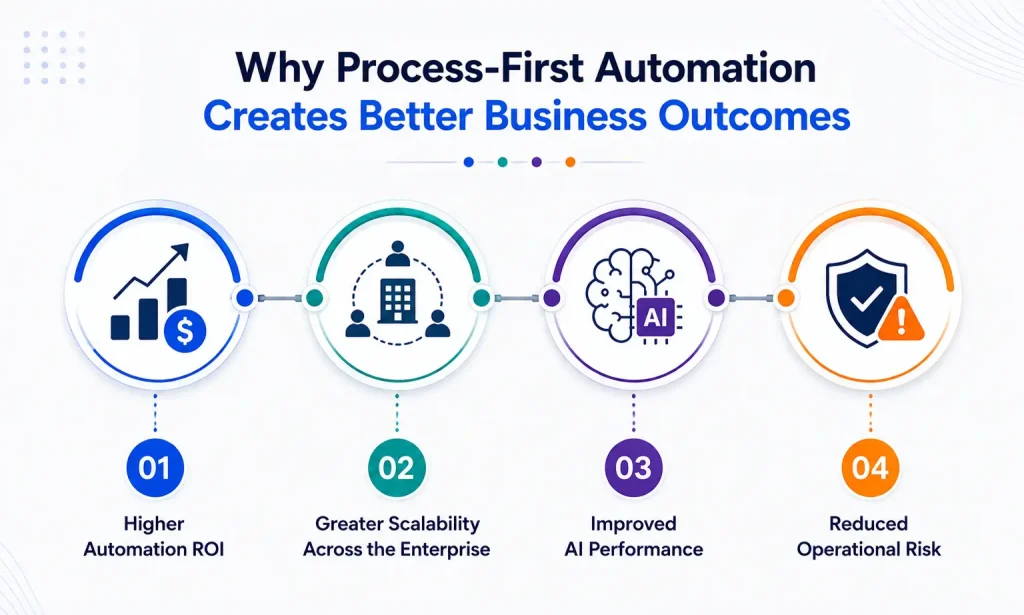
1. Higher Automation ROI
The success of automation should not be measured by the number of bots deployed or workflows created.
Business leaders measure success through outcomes:
- Reduced operating costs
- Faster cycle times
- Improved compliance
- Better customer experience
- Increased employee productivity
Process-first automation improves ROI because it removes inefficiencies before technology investment begins. When processes are standardized, automation operates more effectively. There are fewer exceptions, fewer manual interventions, and less maintenance required.
The organization gains more value from the same technology investment.
2. Greater Scalability Across the Enterprise
Many organizations successfully automate individual processes but struggle to scale automation across business functions.
The reason is process inconsistency. Different departments often execute similar workflows differently. Regional teams may follow different approval structures. Business units may maintain unique systems and policies.
Without process standardization, automation becomes difficult to replicate. A process-first approach creates reusable automation frameworks. Once processes are optimized, organizations can expand automation across finance, procurement, HR, customer operations, and shared services with greater speed and consistency.
Scalability becomes an operational capability rather than a collection of isolated automation projects.
3. Improved AI Performance
The emergence of generative AI and AI agents is accelerating enterprise automation. However, AI effectiveness depends heavily on process maturity.
AI systems require clear rules, structured information, reliable data, and defined decision pathways. When processes are fragmented, AI outcomes become inconsistent.
For example, an AI agent supporting financial operations needs clear approval policies, accurate data sources, and well-defined escalation paths to make reliable decisions.
Process-first automation creates the foundation required for AI-driven operations.
Organizations that optimize processes today will be better positioned to leverage advanced AI capabilities tomorrow.
4. Reduced Operational Risk
Automation introduces new responsibilities around governance, compliance, and control. Poorly designed automated processes can create operational risks, including:
- Incorrect approvals
- Compliance gaps
- Data inconsistencies
- Lack of process ownership
A process-first approach addresses these risks by defining clear ownership, controls, and decision frameworks before automation deployment. This is especially important for highly regulated industries where accuracy and compliance are critical.
Automation should not only make processes faster. It should make them more reliable and controlled.
Process-First Framework for Enterprise Automation
Organizations can adopt a structured approach to build successful automation programs.
| Stage | Key Activities | Business Outcome |
| Process Assessment | Analyze workflows, identify bottlenecks, review performance data | Clear understanding of current operations |
| Process Optimization | Remove unnecessary steps, standardize rules, simplify workflows | Improved process efficiency |
| Automation Prioritization | Evaluate value, complexity, and feasibility | Focus on high-impact opportunities |
| Technology Implementation | Deploy AI, RPA, workflow, or automation platforms | Scalable automation execution |
| Continuous Improvement | Monitor performance and optimize workflows | Long-term automation value |
This approach ensures automation investments align with business objectives rather than technology availability.
Common Mistakes Organizations Should Avoid
1. Automating Before Simplifying
The fastest way to create automation complexity is to automate a process that has not been optimized. Organizations should first remove unnecessary steps and reduce variations.
2. Measuring Automation Activity Instead of Business Impact
Counting automated tasks does not demonstrate transformation. Organizations should focus on outcomes such as cost reduction, cycle-time improvement, accuracy, and customer experience.
3. Treating Automation as an IT Initiative
Technology teams enable automation, but business teams own the processes. Successful automation requires collaboration between operations, finance, IT, compliance, and process owners.
4. Ignoring Change Management
Automation changes how employees work. Without communication, training, and adoption strategies, even technically successful automation initiatives can fail to deliver value.
The Future Belongs to Process-Led Intelligent Automation
The next generation of enterprise automation will not be defined by isolated bots or disconnected workflows. It will be defined by intelligent, adaptive operations where AI, automation, and human expertise work together.
Organizations moving toward autonomous operations must first build strong process foundations. A poorly designed process limits automation potential. A well-designed process unlocks it.
The companies that succeed will not be those that automate the most activities. They will be the ones who understand their operations deeply enough to automate the right activities in the right way.
Conclusion: Process Before Automation
Automation is no longer a question of whether technology can perform a task. The bigger question is whether the underlying process is designed for success.
A process-first approach enables organizations to eliminate inefficiencies, improve scalability, reduce risk, and maximize the value of automation investments.
By focusing on process improvement before technology deployment, enterprises can move beyond basic task automation toward intelligent operations that continuously improve. The future of process automation belongs to organizations that recognize one fundamental principle:
Better processes create better automation outcomes.