







Key takeways
- RPA opens doors for innovation by integrating new business processes that were out of the reach of legacy systems. In turn, it creates new revenue streams thereby enhancing profitability.
- RPA bots can automate several front-end and back-end processes in an organization.
- RPA resolves the most complex of business problems with effective solutions that save time, money, and effort. It fosters highly accurate and efficient systems with enhanced productivity.
- We are heading towards a future where technology and humans will collaborate to create innovative systems that will provide better outcomes.
When we hear the term Robotic Process Automation or RPA, we conjure images of a world of robots that are taking away our jobs! But the truth is far from it!
Simply put Robotic Process Automation is here to solve many of the business problems you are facing! Also, bear in mind that technologies such as artificial intelligence (AI), robotic process automation, etc., cannot function without human intervention. Humans are required to program bots and ensure that they function seamlessly. Besides AI-based systems are also built by humans. So, it is safe to conclude that we are heading towards a future where technology and humans will collaborate to create innovative systems that will provide better outcomes!
So, where does RPA feature?
The purpose of RPA is to automate routine tasks. Here’s an example of automation using a bot-We have all seen chatbots on various websites that provide assistance and resolve our queries on the spot. Just imagine if there were no chatbots! Humans would be performing this task. You will need to designate dedicated employees to resolve the queries of your customers. This will become a cumbersome task for the employee. A human can’t respond as quickly as a bot to the queries raised. Besides, the answers are prone to human errors. And, then the question arises, how will you address multiple queries by different customers. So, we see how a single chatbot addresses the complexities of the issue. A chatbot also offers a better customer experience. This is because the customers get quick resolutions to their problems.
This is one example of how automating the process using a bot provides better outcomes.
We have also seen employees experience burnout because of the monotony of work due to routine tasks. These are cases where the employee reports for work and goes through the same rigmarole of checking emails, preparing reports, etc. If such tasks could be automated, employees will have the time to focus on creative and skilled processes.
It would be fair to conclude that robotic process automation is not exactly there to “take away” jobs, but it is there to enhance the quality of output and relieve employees from mundane jobs.
Once teams understand that bots are not here to take away their jobs but to assist them in their jobs, they will be more willing to accept the automation of processes. This will create an environment of growth in the organization.
RPA opens doors for innovation by integrating new business processes that were out of the reach of legacy systems. This in turn creates new revenue streams leading to improved profitability.
Robotic process automation can automate all those processes that have pre-established steps. It uses data just like a human. It interprets data and sends commands to other systems to perform the tasks.
RPA can be leveraged to automate the front-end and back-end processes in an organization. According to Automation Anywhere, a typical rule-based process can be 70-80% automated. RPA ensures that all your processes function seamlessly in the background. This gives you enough time to focus on areas of growth for your business.
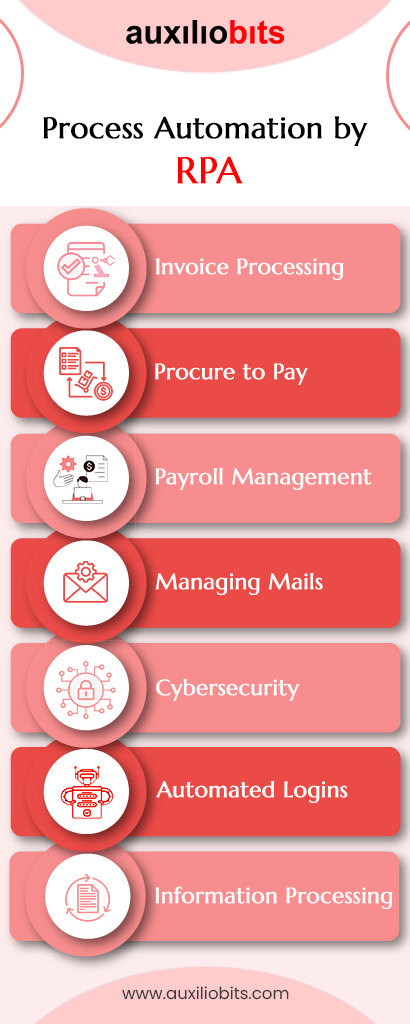
Let us dig a little deeper into some of the routine processes robotic process automation can resolve for a business:
Invoice Processing
This is one of the basic functions of any organization. Invoice processing is a repetitive process that is time-consuming process. According to SAP Concur research, typical SMBs have a 1.29% duplication rate in invoice processing. (Source: Flobotics) This can result in financial losses for the enterprise. Besides, 50% of companies typically spend $5-$25 for manual invoice processing. (Source: Automation Anywhere)
Invoice processing can be automated using RPA. The software automates data, reconciles errors, and makes all the vital decisions involved in invoice processing. Automating the process reduces the workforce required for the task, minimizes errors, and makes it easier to keep track of the process. This reduces the overall cost of the process, minimizes errors, and enhances the speed of the process.
Procure to Pay
Procurement is an essential part of any organization. There is a centralized procurement department with standardized processes in most organizations.
The procurement process involves processes such as:
- Vendor Management
- Sourcing
- Contracting
- Processing Purchase Order
- Receiving Goods
- Payments
Legacy procurement processes comprise a set of manual and electronic systems. The process is quite complicated that involves several steps to complete each order.
Automating the procurement process with RPA streamlines it enhancing accuracy, consistency, and productivity.
Read the case study here.
Payroll Management
One of the routine tasks of the HR department in organizations is payroll management. This process follows rule-based formulas and calculations that are repeated monthly. This makes it an ideal process for robotic process automation. Automating the process greatly reduces the time and effort spent. Besides, it facilitates managing large volumes of data. RPA can also be integrated to automate other payroll-related processes such as paycheck generation, etc.
Managing Mails
Any business requires large volumes of mail to be managed. Mails are received, sorted, and distributed to the concerned users. Mails also need to be analyzed for further processing. The entire process is managed manually in most organizations. This process can be tedious and time-consuming. Integrating RPA to mail management digitalizes the entire process and automates each task. This reduces the man-hours spent on each task and minimizes the errors in the process.
RPA can also be used to read messages and emails to comprehend the content and automatically reply to those messages.
Cybersecurity
RPA provides a secure environment for all business processes in an organization. Regular security checks and monitoring can be automated using RPA. This helps in detecting any malicious activities and corrective action can be taken on time to ensure that the security of the systems is not compromised.
Automated Logins to System
RPA can log in to a system as a user and trigger processes. It also facilitates logging in and adding information to a browser-based application. RPA creates an easy audit trail of successful transactions by facilitating transaction logging to a spreadsheet or into a log file. Auto-login simplifies error handling.
Information Processing
Businesses need to manage large volumes of data for different activities. Any errors in data management can prove to be extremely costly. Automating the process eliminates errors and speeds up the process.
- RPA can find the right values from a computer screen by interpreting labels.
- It can accurately place data in data tables by reading data and values from PDF files.
- An automated process mimics users’ actions and inserts values into the capture screen.
- RPA is also capable of scraping data posted on a web page and providing it to users.
- RPA can evaluate different pieces of data and determine the next best action or the corrective action required.
- It can easily access information from multiple rows of an excel sheet saving time and effort.
- RPA facilitates adding relevant data to applications.
- Bots can retrieve login details from an encrypted credentials vault.
These are some of the processes that RPA can automate. However, the scope of RPA extends far beyond these applications. The ability of RPA to perform a variety of tasks makes it suitable for several business verticals. Robotic Process Automation is being deployed successfully in healthcare, BPO, banking, finance, manufacturing, logistics, and more.
Final Words
RPA resolves the most complex of business problems with effective solutions that save time, money, and effort. It fosters highly accurate and efficient systems with enhanced productivity.
Connect with the experienced team at Auxiliobits to build bots for all the processes in your business. We provide highly efficient RPA bots at budget-friendly prices customized to your processes.
Watch this space for more about process automation using RPA!