








As organizations expand across locations, business units, and digital platforms, managing IT operations becomes increasingly complex. Businesses must maintain reliable infrastructure, control technology spending, strengthen cybersecurity, and deliver consistent support without slowing innovation. Two common approaches to addressing these challenges are IT shared services and IT managed services. Although both aim to improve efficiency and service quality, they differ significantly in ownership, governance, accountability, and operational control.
The IT shared services model enables an organization to consolidate internal IT capabilities and deliver standardized services to multiple departments or business units. IT managed services, by contrast, involve outsourcing specific IT responsibilities to an external provider under an agreed service arrangement.
Understanding these differences is essential for deciding how to organize, fund, and manage technology resources. The right approach depends on the organization’s strategic priorities, internal capabilities, risk tolerance, and desired level of control.
Organizations evaluating their IT delivery strategy can explore our IT consulting services to identify the right balance between centralized capabilities and external expertise.
What Are IT Shared Services?
IT shared services is an operating approach in which a centralized internal function provides technology services to multiple departments, business units, subsidiaries, or geographic locations. Instead of maintaining separate IT teams for similar activities, an organization consolidates resources to reduce duplication, improve consistency, and establish common standards.
For example, a multinational company might operate a central IT team responsible for identity management, enterprise applications, service desk operations, cloud governance, and infrastructure standards. Individual business units consume these services through defined service catalogs and agreed performance expectations.
An IT shared services model typically remains under the organization’s ownership and governance, even when certain activities are supported by external vendors.
How IT Shared Services Operate?
A shared services function generally includes several interconnected elements:
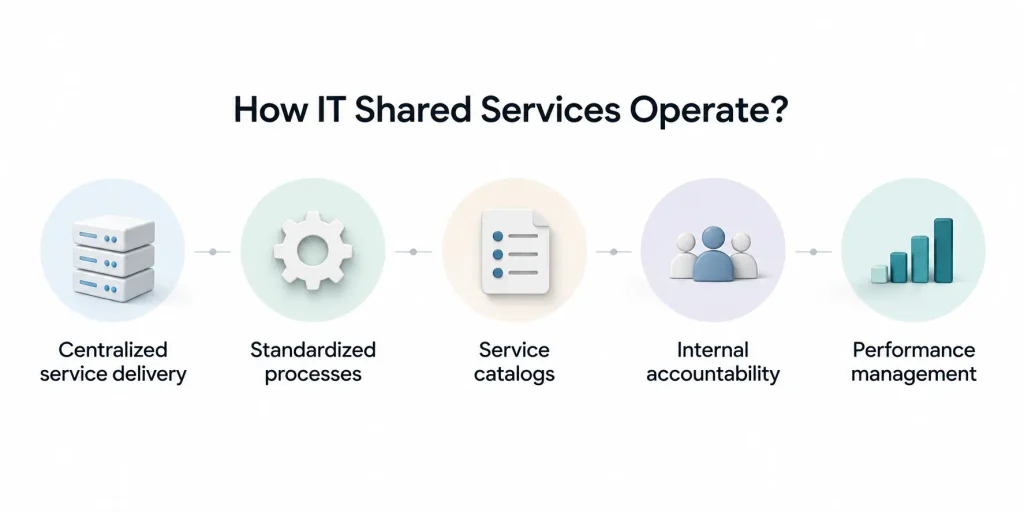
- Centralized service delivery: Common IT activities are delivered through a coordinated function rather than duplicated across departments.
- Standardized processes: Incident management, access requests, device provisioning, and software deployment follow consistent procedures.
- Service catalogs: Employees and business units can identify available services, eligibility requirements, expected delivery times, and applicable charges.
- Internal accountability: The organization retains responsibility for priorities, governance, risk management, and overall service outcomes.
- Performance management: Service owners track quality, demand, costs, user satisfaction, and operational efficiency.
A successful shared services function is not simply a central IT department. It operates with defined service ownership, transparent performance measures, and a clear understanding of the needs of the business units it supports.
What Are IT Managed Services?
IT managed services involve engaging an external provider to manage specific technology functions on an ongoing basis. The provider assumes responsibility for agreed activities, operational targets, and service obligations defined in a contract or service-level agreement.
Organizations commonly outsource network monitoring, endpoint management, cloud infrastructure operations, cybersecurity monitoring, backup administration, and technical support.
For instance, a company may contract a managed service provider to monitor its servers around the clock, investigate alerts, apply approved patches, and escalate major incidents. The provider supplies the operational expertise and resources required to deliver those services.
Managed services do not necessarily mean transferring complete control of the IT environment. The organization can retain strategic decision-making, architecture ownership, vendor oversight, and security policy responsibilities while outsourcing day-to-day execution.
How IT Managed Services Operate?
The relationship typically involves:
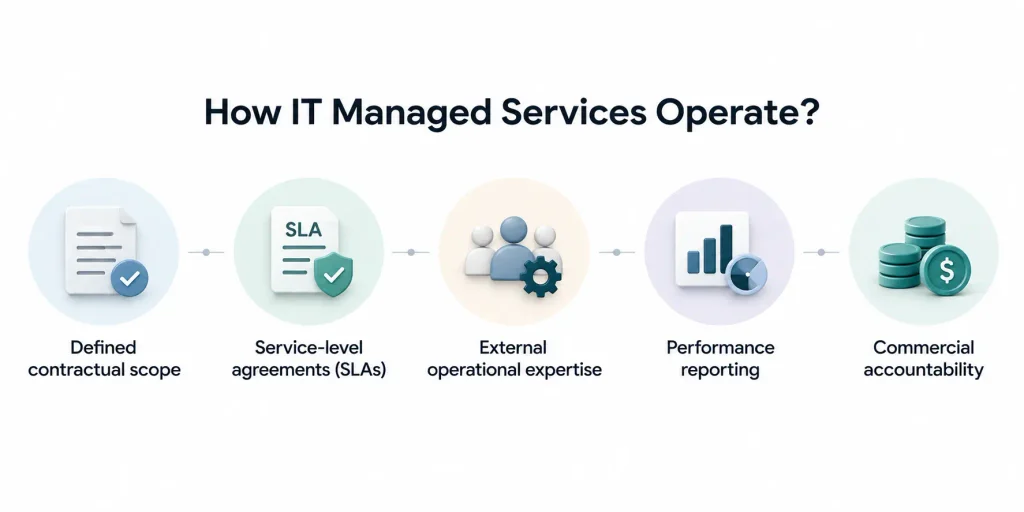
- Defined contractual scope: The contract specifies covered systems, responsibilities, exclusions, and deliverables.
- Service-level agreements (SLAs): Measurable commitments establish expectations for response times, availability, resolution targets, or other outcomes.
- External operational expertise: The provider supplies specialists, processes, tools, and support capabilities.
- Performance reporting: Service reviews evaluate compliance, incident trends, service quality, and improvement opportunities.
- Commercial accountability: Fees may be based on users, devices, workloads, service tiers, consumption, or fixed monthly arrangements.
The effectiveness of managed services depends heavily on contract quality, provider capability, integration with internal teams, and the organization’s ability to monitor performance.
IT Shared Services vs IT Managed Services: Key Differences
The central distinction is who owns and governs the service delivery function. Shared services generally consolidate capabilities within the organization, whereas managed services delegate defined responsibilities to an external provider.
| Comparison factor | IT shared services | IT managed services |
| Ownership | Primarily internal | Operational responsibilities assigned externally |
| Governance | Internal leadership and business stakeholders | Shared governance through contracts and service reviews |
| Workforce | Internal employees, sometimes supplemented by vendors | Provider employees and specialist resources |
| Cost structure | Internal operating costs and allocated budgets | Contracted fees, consumption charges, or service-based pricing |
| Operational control | Greater direct control over processes and priorities | Control bounded by contract and agreed responsibilities |
| Expertise | Depends on internal hiring and development | Access to provider capabilities and specialist teams |
| Scalability | May require internal recruitment, tooling, or restructuring | Often available through contractual capacity or service adjustments |
| Accountability | Internal service owners and IT leadership | Provider accountable for contracted obligations; client retains relevant oversight |
| Best suited for | Organizations seeking internal ownership and enterprise-wide standardization | Organizations seeking external operational capacity or specialized expertise |
These distinctions are not absolute. A shared services organization can use outsourced technology platforms, while a managed services arrangement can retain substantial client oversight. The practical difference lies in the operating model and allocation of responsibilities, not simply the technology being used.
Cost Structure and Financial Accountability
Cost is often the first consideration, but comparing internal and outsourced delivery requires more than examining salaries or monthly vendor quotations.
An IT shared services model involves costs such as employee compensation, recruitment, training, infrastructure, software licenses, service management platforms, cybersecurity controls, and ongoing process improvement. These costs are often allocated across business units using measures such as headcount, device numbers, service consumption, or transaction volume.
Its financial advantage comes from reducing duplicated capabilities and increasing the utilization of existing resources. However, centralized services can become expensive if demand is poorly managed, processes remain manual, or the organization builds unnecessary layers of management.
Managed services replace some internal operating expenses with contractual payments. This can improve budget predictability, especially when you clearly define pricing and service boundaries. Nevertheless, additional charges may arise from out-of-scope requests, major changes, excess consumption, emergency support, or contract renewals.
A fair comparison should calculate the total cost of ownership over a multiyear period. Include transition costs, retained internal staff, integration, compliance, vendor management, service credits, exit costs, and the financial impact of service interruptions.
The cheapest proposal is not necessarily the most economical operating model. A slightly higher-cost arrangement may deliver better resilience, faster recovery, or stronger risk management.
Service Quality, Control, and User Experience
Service quality depends on how well IT services match business requirements, not merely on whether tickets are closed within a target timeframe.
Shared services can improve consistency by establishing common support channels, standard procedures, reusable solutions, and enterprise-wide service expectations. They also provide internal leaders with greater flexibility to reprioritize work as business needs change.
However, excessive centralization can create bottlenecks. A process designed for a large corporate department may not adequately address the needs of a smaller subsidiary or a business operating under different regulatory requirements.
Managed services can offer continuous monitoring, specialized troubleshooting, and mature operational processes. Providers with suitable scale may deliver coverage that would be expensive to build internally.
The potential disadvantage is contractual rigidity. Requests outside the agreed scope may require additional fees or formal change approvals. Poor communication between the provider and internal stakeholders can also create delays.
Organizations should evaluate user experience through first-contact resolution, recurring incidents, request fulfillment time, employee satisfaction, service availability, and the business impact of unresolved problems.
Security, Compliance, and Risk Management
Neither operating model automatically guarantees stronger cybersecurity. Security depends on controls, technical architecture, governance, staff capability, and the quality of execution.
With shared services, an organization can maintain direct oversight of access policies, data handling, technology standards, and internal compliance requirements. Centralization also makes it easier to establish common security baselines across business units. However, a poorly secured central platform can create a single point of failure or expose multiple units to the same incident.
Managed services can provide access to dedicated security specialists, threat monitoring, vulnerability management, and incident response capabilities. These benefits are especially valuable when internal teams lack sufficient expertise or round-the-clock coverage.
Outsourcing does not eliminate the client’s accountability for appropriate risk management. Before appointing a provider, organizations should assess access privileges, data residency, subcontractor arrangements, incident notification obligations, audit rights, business continuity, recovery capabilities, and exit procedures.
Contracts should specify who detects incidents, who investigates them, who communicates with regulators or affected parties, and who approves recovery actions. Responsibility for security must be explicit rather than assumed.
KPIs That Determine Whether the Model Works
Choosing a delivery model is only the beginning. Organizations need measurable indicators to determine whether the arrangement is producing meaningful results.
For shared services, useful measures include:
- Cost per user, device, or service request.
- Service-level attainment and average fulfillment time.
- First-contact resolution and employee satisfaction.
- Standardization rates across business units.
- Automation adoption and reduction in manual effort.
- Infrastructure availability and recurring incident rates.
For managed services, organizations should also track:
- Contractual SLA compliance and service-credit performance.
- Mean time to detect (MTTD) and mean time to resolve (MTTR).
- Change success rate and unplanned downtime.
- Security remediation timelines.
- Provider performance against agreed improvement commitments.
- Forecast accuracy, out-of-scope spending, and renewal costs.
Metrics should reflect business outcomes as well as operational activity. A lower cost per ticket is not a success if incidents return repeatedly. Similarly, high SLA compliance does not necessarily indicate good service if the SLA itself is too lenient.
How to Choose the Right Operating Model
An organization should evaluate its current IT maturity, service demand, regulatory obligations, internal talent, financial constraints, and strategic priorities before selecting a model.
Choose IT shared services when:
- The organization has multiple business units performing similar IT activities.
- Internal ownership, standardization, and direct governance are important.
- There is sufficient scale to justify a centralized team and common infrastructure.
- Business units need consistent processes but still require transparent service agreements.
- The organization wants to develop long-term internal capabilities.
Choose IT managed services when:
- Specialized expertise is difficult or expensive to recruit.
- Continuous monitoring or extended support coverage is required.
- Technology operations need to scale faster than internal recruitment allows.
- Service outcomes can be clearly defined and measured contractually.
- Leadership wants to focus internal resources on strategic technology initiatives.
The decision should not be based on the assumption that one model is universally superior. The best option is the one that aligns accountability, capabilities, cost, and risk with the organization’s actual requirements.
Conclusion
IT shared services and IT managed services address different organizational needs. Shared services focus on consolidating internal capabilities, standardizing delivery, and maintaining organizational control. Managed services focus on engaging external providers to deliver defined technology functions under contractual performance expectations.
An IT shared services model is particularly valuable when an organization wants consistent enterprise-wide delivery while retaining ownership of its capabilities and governance. Managed services are often more appropriate when specialized expertise, operational capacity, or continuous support is difficult to maintain internally.
For many enterprises, the strongest solution combines both approaches selectively. By assessing total cost, security exposure, service quality, scalability, and accountability, organizations can build an IT operating model that supports business performance rather than simply reducing operational expenditure.
Not sure which IT delivery model fits your organization? Talk to our IT consulting team to assess your current operating structure, identify improvement opportunities, and develop a practical service delivery strategy.