







Key Takeaways
- RPA clears the repetitive work off your desk.
- AI adds the smarts, catching anomalies and predicting trends.
- Together, they shorten close cycles and make audits easier.
- The biggest win might just be morale—finance people finally get to focus on the work they enjoy.
- The future? A continuous close, powered by automation that feels less like a marathon and more like a steady jog.
If you’ve ever been part of a finance team, you know the energy in the room during month-end close. Coffee cups pile up, inboxes flood with “urgent” emails, and the spreadsheets keep multiplying. Everyone’s on edge because even the smallest mistake could delay reporting or spark a painful conversation with auditors.
For decades, this has been just how things have been. Finance professionals accept long nights and high stress as part of the job. But here’s the truth: it doesn’t have to be this way anymore.
Thanks to Robotic Process Automation (RPA) and AI-driven agents, more and more finance teams are breaking free from the grind. They’re cutting days off their close cycles, reducing errors, and gaining back time for more valuable work.
Also read: Real-Time Eligibility Verification Using AI + RPA
Why Closing the Ledger Feels Like a Marathon
Closing the books isn’t just pressing “add” on a calculator. It’s a high-stakes marathon with dozens of moving parts:
- Making sure journal entries are valid and approved
- Reconciling bank accounts and credit card statements
- Matching invoices with purchase orders
- Double-checking intercompany transactions
- Preparing management and compliance reports
And all of it has to happen in just a few days. It’s like trying to run a marathon on a sprint clock. The pressure is relentless, and the risk of error grows with every late-night hour.
Finance professionals don’t just burn energy; they burn mental bandwidth. They spend more time firefighting than analyzing or advising, which is the very work leadership needs from them.
The Hidden Costs of Manual Closures
The toll of manual closures goes far beyond long hours. Think about the ripple effects:
- Executives wait for decisions because the numbers aren’t ready.
- Audits drag on longer because the paper trail is messy.
- Employee morale drops—few people want to stay in roles where stress is chronic.
- Markets lose patience when earnings announcements get delayed.
Research has shown that finance teams spend about 80% of their time processing data instead of analyzing it. That means most of their effort goes into reconciling transactions instead of offering insights. And that imbalance holds businesses back.
How RPA Changes the Game
If manual work feels like running a marathon, RPA is like hopping on a bike—suddenly, everything feels lighter and faster.
RPA bots are digital assistants programmed to follow rules. Once set up, they can:
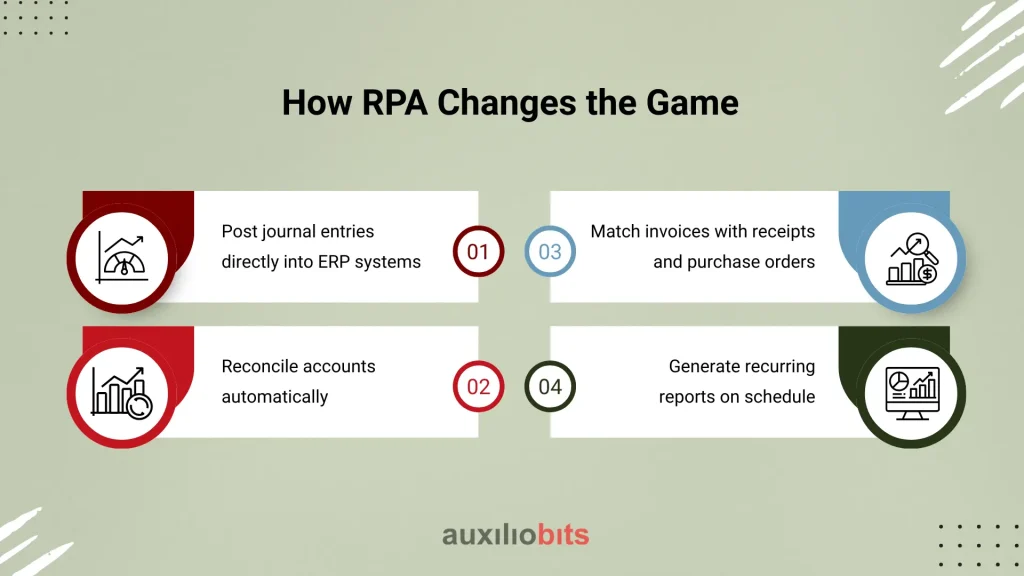
- Post journal entries directly into ERP systems
- Reconcile accounts automatically
- Match invoices with receipts and purchase orders.
- Generate recurring reports on schedule
They don’t get tired, they don’t need coffee breaks, and they don’t introduce “fatigue errors.”
One finance leader compared it to having an “army of interns” working around the clock—except these interns never leave, never get bored, and never misplace a decimal.
AI Agents: The Brains Behind the Bots
But RPA only handles the repetitive. To bring real intelligence into the process, finance teams are turning to AI agents.
Here’s the difference:
- RPA: Does what you tell it to every time.
- AI: Understands patterns and adapts when things look unusual.
AI agents can:
- Flag suspicious or irregular transactions before they snowball
- Forecast expenses and revenues using past patterns
- Double-check compliance with tax or accounting standards.
- Help finance leaders spot trends and advise management earlier
Picture this: your system flags that travel expenses doubled in one department last month. Instead of finding this weeks later in an audit, you get the alert immediately. That’s the kind of intelligence AI adds.
Real-World Use Cases
So, what does this look like when the rubber meets the road? Let me give you a few situations.
Take invoices and receipts. Normally, a staff accountant might spend hours lining these up manually, trying to figure out why one invoice doesn’t quite match the receipt. Now, bots can churn through thousands of them automatically, and AI quietly taps you on the shoulder when something looks odd. Maybe it’s just a timing issue. Maybe it’s a duplicate. Sometimes it’s a genuine problem. Either way, you know before the books close.
Or think about accruals. Every month, teams scramble to guess what’s left to accrue—utilities, vendor charges, you name it. AI can look at your historical spend and say, “Hey, based on the last 12 months, here’s what you’re probably missing.” It’s like having someone on the team with a photographic memory.
And then there’s variance analysis. If marketing spends double on travel compared to last month, AI notices. Not after the audit, not weeks later—right now. That gives you time to ask questions before the numbers get locked.
Industry Applications
Of course, how automation shows up depends on the industry.
- In banking, bots reconcile mountains of transactions every day. AI sits on top, making sure nothing slips through compliance cracks.
- In retail, imagine thousands of payments flying in from credit cards, PayPal, gift cards, and store apps. RPA matches them, while AI watches for fraud.
- In manufacturing, supplier reconciliations used to take weeks. Bots handle the grunt work, and AI even helps forecast raw material costs so you’re not caught off guard.
- And in healthcare, where billing and claims are endless, automation speeds things up while AI points out billing mistakes that could otherwise turn into compliance nightmares.
Different settings, same outcome: less manual slog, more accuracy, and more sanity for the team.
Why Finance Teams Are Jumping on Board
Honestly, the benefits are hard to ignore. Closing in five days instead of ten changes everything. Executives get faster answers, errors drop, and the team isn’t as fried by the end of the cycle.
But the part heard most from finance folks? Morale. Nobody studied accounting because they love keying in data or triple-checking spreadsheets at midnight. Bots take that drudgery away, and suddenly people get to focus on analysis, strategy, and even career development. That’s a big win.
Common Pitfalls to Watch Out For
That said, it’s not all smooth sailing. I’ve seen companies struggle when:
- They try to jam bots into ancient ERP systems.
- They expect AI to fix bad data (spoiler: it won’t).
- They don’t set clear ownership for processes.
- Or they don’t bring the team along, and people feel threatened instead of supported.
The truth is, bots aren’t here to steal jobs. They’re here to take the tasks nobody wants to do. The companies that make automation work are the ones that position it that way—from day one.
How to Start the Right Way
If you’re wondering where to begin, don’t overthink it. Pick one process that drives everyone nuts—like bank reconciliations. Prove it works, then expand.
Clean your data first (AI is smart, but it can’t magic away messy inputs). Bring IT and compliance in early so nothing breaks. And most importantly, keep your team in the loop. Show them what the bots are doing, why it helps, and how it frees them up.
Looking Ahead: The Future of Finance Automation
Where is all this headed? The phrase you’ll hear a lot is “continuous close.” Instead of the mad dash at the end of each month, the books will basically update in real time. That means CFOs won’t be waiting until day ten to know where things stand—they’ll know today.
On top of that, you’ll start seeing:
- AI copilots nudging accountants step by step through tricky processes
- Predictive accounting that anticipates shifts in expenses or revenues
- Finance professionals stepping fully into strategy roles rather than firefighting.
If closing the books today feels like running a marathon in a sprint’s timeframe, the future is more like a daily jog. Still important, but a lot less brutal.
Final Thoughts
RPA and AI aren’t shiny toys anymore. They’re becoming the backbone of modern finance teams. The ones who lean into it aren’t just faster—they’re calmer, more accurate, and more valuable to their business.
If your team still feels buried under spreadsheets, start small. Automate one process, build confidence, then expand. You’ll be surprised how quickly the dread of “close week” turns into something much more manageable.