






Key Takeaways
- Fragile automation is worse than no automation in Oracle ERP Cloud; design for change and scale from day one.
- Hybrid integration strategies-FBDI for volume, APIs for real-time, bots for exceptions, the backbone of scalable solutions.
- Treat error handling, monitoring, and governance as first-class design principles, not afterthoughts.
- Scalability is as much about people as technology design, with human roles in mind.
- Success stories come not from quick wins but from treating automation as enterprise infrastructure.
When organizations talk about automation in Oracle ERP Cloud, the conversation often gets stuck on surface-level benefits—faster processes, reduced errors, and fewer people needed for repetitive tasks. While those things are true, they are not the real challenge. The real test is scalability.
Anyone can build a bot or an integration to handle a single task. But how do you build an automation framework that won’t collapse when your transaction volume doubles next quarter? Or when Oracle pushes a quarterly update that quietly changes API behavior? That’s the hard part, and it’s where most automation initiatives either grow into real business enablers or fizzle out as fragile, patchwork scripts.
Also read: How to Build an End-to-End Automation Strategy for Enterprise Efficiency
The Problem: Fragile Automation in a Moving Landscape
Oracle ERP Cloud is not static. Every three months, Oracle rolls out new features, patches, and occasionally changes that break assumptions baked into existing automations. A bot that worked perfectly against the February release might suddenly fail come May.
On top of that, large enterprises run Oracle ERP as the backbone for critical processes:
- Procurement workflows with dozens of approval levels.
- Financial close cycles cannot afford a delay.
- Supply chain updates that ripple across multiple regions.
When automation here fails, it doesn’t just inconvenience a team—it blocks invoices worth millions, delays audits, or creates compliance risks. And yet, there are too many projects where the automation is little more than a quick fix written by a consulting team under pressure. Hard-coded credentials, brittle selectors, and SQL queries with zero retry logic. It works in UAT, sure. But under production load? Or when Oracle decides to tweak the UI? It crumbles.
So, the core problem is not just how to automate Oracle ERP Cloud. The challenge is how to build automation that can scale, survive change, and deliver value at an enterprise scale.
The Approach: Designing for Scalability from the Start
Scalable automation doesn’t happen by accident. It requires conscious architectural decisions, much like designing a core IT system. I usually break it down into four pillars:
1. Robust Integration Choices
Oracle ERP Cloud exposes multiple integration points: REST APIs, SOAP services, file-based loaders (FBDI), and UI-based automations. Teams often rush to whichever looks quickest.
But scalability means picking the right tool for the right job:
- REST APIs are lightweight and ideal for near-real-time integrations, but coverage is not always complete.
- SOAP services can be verbose but offer strong support for legacy modules.
- FBDI loaders handle massive batch data loads far better than APIs.
- UI automation should be a last resort—sometimes unavoidable, but never scalable on its own.
The mistake seen too often: teams default to RPA for everything because “it works.” Yes, it works, until your bot farm is processing a million records via the UI with 5% daily failure rate. A hybrid strategy, with FBDI and APIs doing the heavy lifting and bots handling exceptions, is far more sustainable
2. Error Handling as a First-Class Citizen
In ERP, failure is not the exception—it’s part of the normal workflow. Files arrive late. Approvals get stuck. APIs time out. Pretending otherwise is asking for trouble.
Scalable automations treat errors as data, not just disruptions. That means:
- Built-in retry logic with exponential backoff.
- Dead-letter queues for failed transactions.
- Clear error messages that a business user—not just a developer—can understand.
- Dashboards that show where in the pipeline things are stuck.
There have been financial close automations where failures were simply logged to a text file. No alerts, no retries. By the time anyone noticed, deadlines had been missed. Compare that with a setup where failures trigger immediate notifications in Microsoft Teams with context, and the difference is night and day.
3. Governance and Maintainability
Automation sprawl is real. What starts as a few scripts quickly becomes dozens of bots across Finance, Procurement, and HR. Without governance, you end up with shadow IT—different teams building their own solutions with no standardization.
A scalable program enforces:
- Centralized credential management (Azure Key Vault, CyberArk, etc.).
- Code repositories with version control.
- Documentation standards—because yes, someone will need to maintain that bot two years from now.
- Automated testing against Oracle’s quarterly updates, so breakages are caught early.
Some organizations now treat automations like microservices—deployable, versioned, and monitored with the same rigor as production code. It sounds heavy-handed, but when automation is running payroll, you want that level of discipline.
4. Human-in-the-Loop Design
Not every process can or should be 100% automated. Approvals, exceptions, and compliance checks all require judgment. Scalable automation doesn’t eliminate humans; it integrates them smartly.
That might mean:
- Building review queues where humans can quickly validate edge cases.
- Using RPA bots to gather and present all necessary context so the human can make a faster decision.
- Having fallback paths where, if automation fails, a clear handover to a business team occurs.
Ironically, automation programs that try hardest to remove humans often end up creating more work for them when things go wrong. A balanced design respects the human role instead of pretending it doesn’t exist.
Case Example: Scaling Invoice Processing
One global manufacturing company had a simple goal: automate supplier invoice processing in Oracle ERP Cloud. The first version was classic RPA-bots logging into Oracle and entering invoices via the UI.
It worked, at first. But as invoice volume grew past 30,000 per month, the cracks showed:
- Bots failed daily whenever Oracle UI lagged.
- Error logs were cryptic; business users couldn’t resolve them without IT.
- Quarterly Oracle updates broke selectors, leading to downtime every three months.
The shift to scalability involved re-architecting:
- Invoices moved to FBDI loaders, which could process thousands at once.
- REST APIs handled status checks and downstream updates.
- Bots were reserved for edge cases—invoices missing mandatory data, exceptions needing human review.
- Error dashboards in Power BI gave Finance clear visibility, without needing IT to decode logs.
The result? Processing capacity scaled fivefold, errors dropped by 70%, and Finance actually trusted the automation.
It wasn’t magic—it was a deliberate decision to move from “bots as a bandaid” to “automation as infrastructure.”
Subtler Challenges You Only Notice in the Field
A few points that don’t make it into glossy vendor presentations:
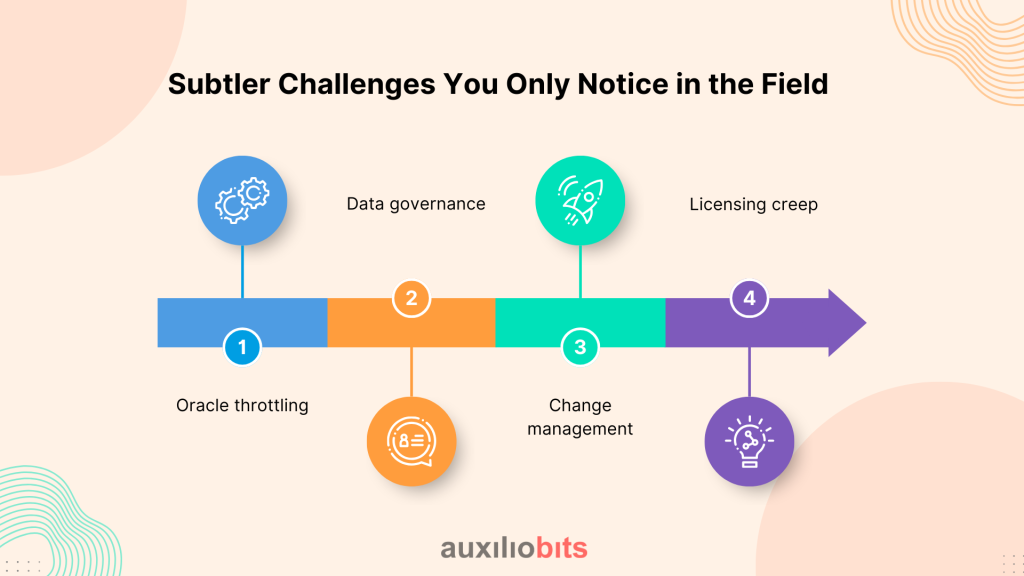
- Oracle throttling: REST APIs have rate limits. If you flood them with requests, you’ll get 429 errors. Scaling isn’t just about more bots; it’s about respecting API quotas.
- Data governance: Automating bad data just gets you faster bad outcomes. Organizations underestimate the cleanup needed before automation runs smoothly.
- Change management: Oracle Cloud users often resist “black box” automations. If they don’t trust what the bot is doing, they’ll create workarounds. Communication matters.
- Licensing creep: As bot volumes grow, RPA licensing can quietly balloon. Planning hybrid approaches saves cost.
Conclusion
Automation in Oracle ERP Cloud is no longer about quick wins or tactical fixes—it’s about designing for resilience, scalability, and enterprise-grade reliability. A bot that saves a few hours today but collapses under tomorrow’s transaction load is a liability, not an asset. The organizations that succeed treat automation as part of their IT backbone, not a side project. That means hybrid integration strategies, robust error handling, governance frameworks, and a thoughtful balance between human and machine roles.
Ultimately, scalable automation in Oracle ERP Cloud is not just about technology; it’s about building trust. Finance, procurement, and supply chain leaders must feel confident that when quarter-end arrives, automation won’t fail them. Success comes from treating automation like enterprise infrastructure—monitored, governed, and designed for change—so it can keep delivering value even as Oracle, processes, and volumes evolve.