





Key Takeaways
- Spreadsheet-based forecasting is slow, error-prone, and unscalable, leaving firms behind competitors using automation.
- Unlike static automation, agents reason, adapt, pull real-time data, and generate scenario-based forecasts.
- Automation frees finance professionals from data cleanup to focus on insights, risk advisory, and strategic planning.
- Beyond finance, supply chain, sales, and executives gain real-time, forward-looking signals for better decisions.
- Early adopters of agentic forecasting gain resilience, speed, and a decisive competitive advantage over spreadsheet-bound rivals.
Whether it’s deciding next quarter’s budget, evaluating capital, or aligning resources to support the long-term growth of a business, financial forecasting has always played a role in strategic decision-making. Financial forecasting defines the future direction. It enables companies to make the right decisions at the right time, armed with the best possible data. For decades, however, the forecasting process has relied on Excel spreadsheets, which, while flexible and familiar, ultimately only support some of the complexities inherent in modern business.
In today’s world, where the financial landscape can change overnight, driven by inflation, geopolitical developments, market volatility, and changes in consumer behavior, simply forecasting static numbers, updating Excel files, and focusing on cell data do not cut it any longer.Organizations need agentic automation. A powerful, continuous direction-setting, intelligent AI-powered agent that can monitor, adapt, and improve financial models.
Also read: What Are Agentic AI Agents? A Beginner’s Guide for Enterprises
The Problems with Traditional Financial Forecasting
There are many different forecasting models in use today. Conventional forecasting models are causing persistent problems that cost businesses time, money, and opportunities.
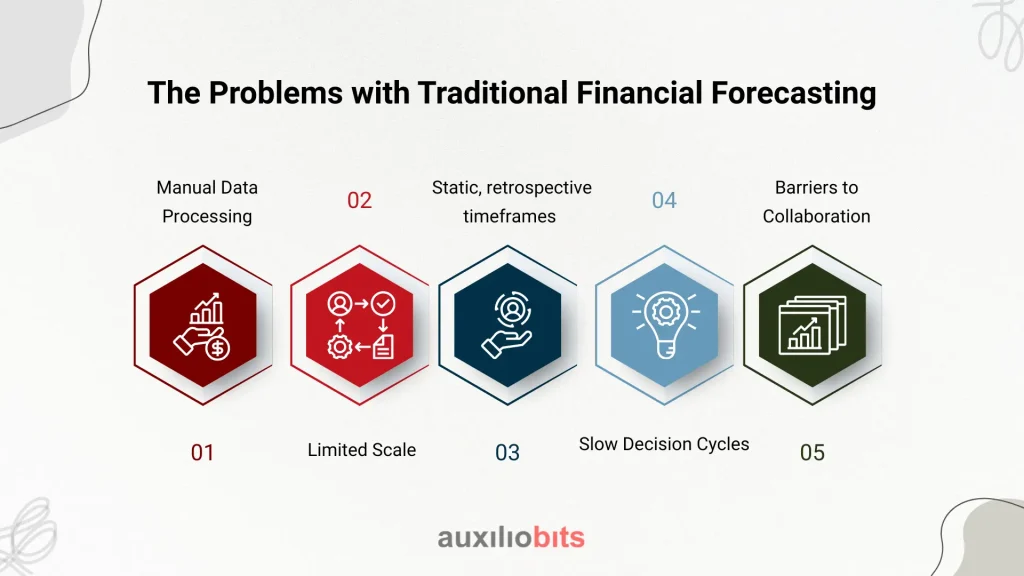
1. Manual Data Processing
Finance teams spend a large number of hours cleaning, merging, and validating data in Excel. Manual byte handling adds to the potential for human error. Incorrectly updated information leads to inaccurate predictions and missed opportunities.
2. Limited Scale
Excel was never designed to handle extensive data sets with multiple sources of data. As businesses grow into multiple geographies, currencies, and product lines, Excel simply cannot keep up.
3. Static, retrospective timeframes
Most forecasts produced in Excel are static snapshots of the past. All forecasts rely on historical data, but these forecasts do not account for real-time signals, e.g., change of market sentiment/global events/changing customer habits. They become dated very quickly.
4. Slow Decision Cycles
By the time finance completes its consolidation process among spreadsheets, the market has already shifted. There is a long time gap from data collection to insight to decision
5. Barriers to Collaboration
Spreadsheets simply do not scale in large teams. With many copies of the same spreadsheet floating around, it creates a range of issues: confusion, misalignment in version control, and confusion in decision-making.
The Function of Agentic Automation in Finance
This is where agentic automation comes in. Whereas traditional robotic process automation (RPA) follows scripted rules, agentic automation encompasses intelligent agents supported by artificial intelligence that can automate, reason, adapt, and improve.
This is how agentic automation fundamentally changes forecasting:
Continuous Data Ingestion
Agents connect to multiple sources in the form of ERP systems, CRM systems, market feeds, and even third-party APIs to allow forecasts to build off of dynamic, live data.
Contextual Decision-Making
Agents don’t just process data; they understand it. They can plot or frame macroeconomic indicators, interest rates, or supply chain disruptions, all the while taking into account internal financials.
Adaptive Forecasting Models
Models are dynamic and are adjusted automatically when new data is available. If sales volumes unexpectedly increase in one region, the forecast adjusts in real time.
Error Reduction
By facilitating the elimination of repetitive manual handling, agents significantly reduce errors previously made by human oversight of spreadsheet equations.
Increased Collaboration
Insights are provided through dashboards, visualizations, or natural language summaries accessible in real time for executives, managers, and analysts.
From Excel Spreadsheets to Dynamic Insights
Envision this transformation as becoming a journey represented by three stages:
- Excel-Dependent Forecasting
- Fully dependent on manual data entry.
- Heavy historical forecasts.
- Static and labor-intensive, with inevitable accidents.
- Agentic Forecasting (The New Era)
- AI agents ingest real-time data streams and analyze the data accordingly.
- Forecasts now continuously change – embedding new daily realities.
- Teams move from “data wrangling” to “insight generation.”
It is not simply an enhancement; it is a transformation. Organizations move from being more past-looking and spreadsheet-centric to being more insight-centric and forward-looking.
A Real-Life Example: Forecast Improvement
For example, a global retail company. The finance department typically spends weeks compiling sales data from multiple regions. By the time a forecast was delivered to senior management, promotions, variation in currency volatility, and back-to-school shopping patterns presented the outlook to be based on fantasy, not reality.
Through the use of agentic automation:
- Agents sourced data from sales systems, supplier databases, and economic indicators directly.
- Forecast models automatically adjusted when regional sales increased unexpectedly, so that they would give reliable predictions of sales. The finance team then provided probability-weighted discussion alternatives to executives in real-time instead of the “best guess” from past experiences.
The outcome? Forecast accuracy improved over 25%, and decisions to amend ordering inventories or shift marketing budgets were made faster and with confidence.
A Story of Success: Better Decisions, Better Results
A global manufacturing business was experiencing a familiar problem: its quarter forecasts were inaccurate, and executives were caught by surprise by cost overruns and revenue shortfalls.
The business decided to implement a financial planning agentic automation solution. Within months, measurable results were delivered:
- Reduced Forecast Cycle: Time to prepare a forecast was reduced from over three weeks to a few days.
- Increased Accuracy: Predictive accuracy increased by almost 30% due to real-time adjustments and adaptive learning.
- Improved agility: A sudden spike in the costs of raw materials occurred, and the system flagged this immediately, allowing finance to advise procurement sourcing alternatives before additional costs were incurred.
- Improved executive confidence: Board-level decision-making moved from ‘reacting to historical results’ to thinking ahead.
- The Chief Financial Officer subsequently summarized: “We used to think of forecasting as an administrative nuisance. Now, through agentic automation, it has become our most powerful strategic weapon.”
Conclusion
Still relying on static spreadsheets for the critical financial forecasts in your organization? It is time to leave Excel behind and adopt agentic automation.
By doing so, you will not only save time and reduce errors, but you will also gain more in-depth, more agile insights and truly position the finance function as a genuine strategic partner.