






Key Takeaways
- Agentic AI agents act autonomously, think proactively, and continuously learn, allowing them to handle complex workflows far beyond the capabilities of conventional rule-based systems.
- By making dynamic decisions using real-time data, Agentic AI streamlines operations, reduces errors, and helps businesses quickly adapt to changing demands and market conditions.
- Its modular design allows easy expansion across departments, while 24/7 intelligent operation reduces labor costs and enhances financial control through error-free execution.
- Agentic AI handles repetitive tasks, enabling employees to focus on innovation and strategy, boosting job satisfaction and enabling smarter, higher-impact human-AI collaboration.
- To fully utilize the benefits of Agentic AI, start with low-complexity, high-value use cases, choose suitable platforms, ensure clean data, and foster a collaborative culture.
Today, every company is seeking innovative ways to operate. From lessening costs to answering quickly and making their operations smooth, businesses are trying everything possible to solve challenges. One of the most valuable technologies that can help companies with such challenges is agentic AI. The AI agents function like employees in an organization. The only difference is that AI agents are not tired of performing monotonous tasks daily.
Agentic AI is so much more than conventional automation. Old systems follow fixed rules and scripts. They can only manage basic and repetitive tasks. If things go wrong, they stop functioning and need human intervention. For example, an agentic AI system can communicate with customers, understand their queries, find suitable solutions, and take immediate action during a customer care call.
Additionally, these agents help employees in the supply chain industry stay at ease. They handle everything and ensure all assigned tasks are completed. They can multitask, saving firms time and money.
Also read: Why Will AI Agents Replace Traditional Automation?
Key Characteristics of Agentic AI
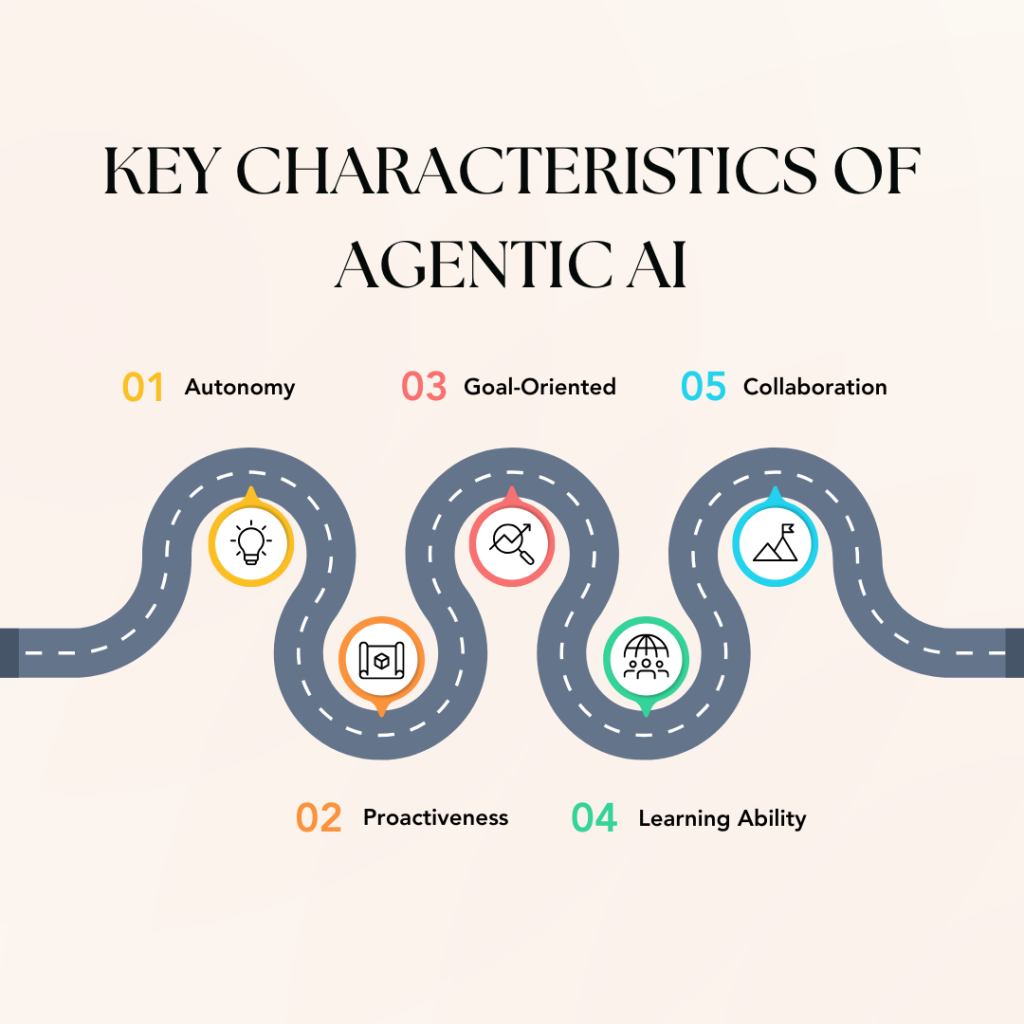
By introducing innovative agents, agentic AI works wonders for firms, allowing them to function differently. Its key characteristics are what make agentic AI more powerful. These characteristics will enable them to function better than conventional automation. We have listed the characteristics below:
1. Autonomy
One of the most essential features of Agentic AI is autonomy. This means the agent can perform tasks and make decisions without constant human input. Traditional automation tools depend on pre-defined rules and need people to monitor or adjust them regularly. In contrast, an autonomous agent can operate on its own. It can gather information, make decisions, and act like a skilled human worker. For example, an autonomous AI agent in IT support can detect system errors and resolve them without waiting for instructions.
2. Proactiveness
Agentic AI is also highly proactive. It doesn’t just wait for commands or problems to appear—it takes initiative. These agents are designed to anticipate future needs or issues and act in advance. For instance, an AI agent can monitor equipment performance in a manufacturing environment and schedule maintenance before a machine breaks down. This reduces downtime and saves money. Being proactive helps organizations stay ahead of challenges instead of reacting to them after the fact.
3. Goal-Oriented
Another key trait is being goal-oriented. Agentic AI agents are built with specific goals in mind. Whether it’s increasing customer satisfaction, reducing delivery times, or optimizing supply chains, these agents work with a clear purpose. They constantly evaluate their actions against the goal and adjust their behavior if needed. This focus ensures that the AI doesn’t just perform tasks—it contributes to meaningful business outcomes.
4. Learning Ability
Agentic AI systems have the power to learn and improve. They use data, feedback, and experience to get better over time. This is very different from traditional automation, which always works similarly. Learning agents can identify patterns, discover better ways of doing things, and avoid past mistakes. For example, a customer service agent can learn from previous interactions and provide faster, more accurate responses in future conversations. This makes the system more innovative and more effective with each use.
5. Collaboration
Finally, Agentic AI is designed for collaboration. It can work smoothly alongside human employees and other AI agents. These agents understand when to act independently, seek help, or pass on tasks. They can also communicate and coordinate with other agents to solve complex problems. This teamwork between AI and humans increases productivity and creates a more dynamic, responsive workplace.
Benefits of Agentic AI in Business Process Optimization
Agentic AI, characterized by its ability to function autonomously with a goal-oriented approach, transforms how businesses optimize their processes. By mimicking human decision-making and learning from data continuously, Agentic AI goes beyond traditional automation. It automates repetitive tasks and takes on complex, decision-intensive workflows, leading to significant business value. Below are the key benefits of incorporating Agentic AI in Business Process Optimization, elaborated in detail.
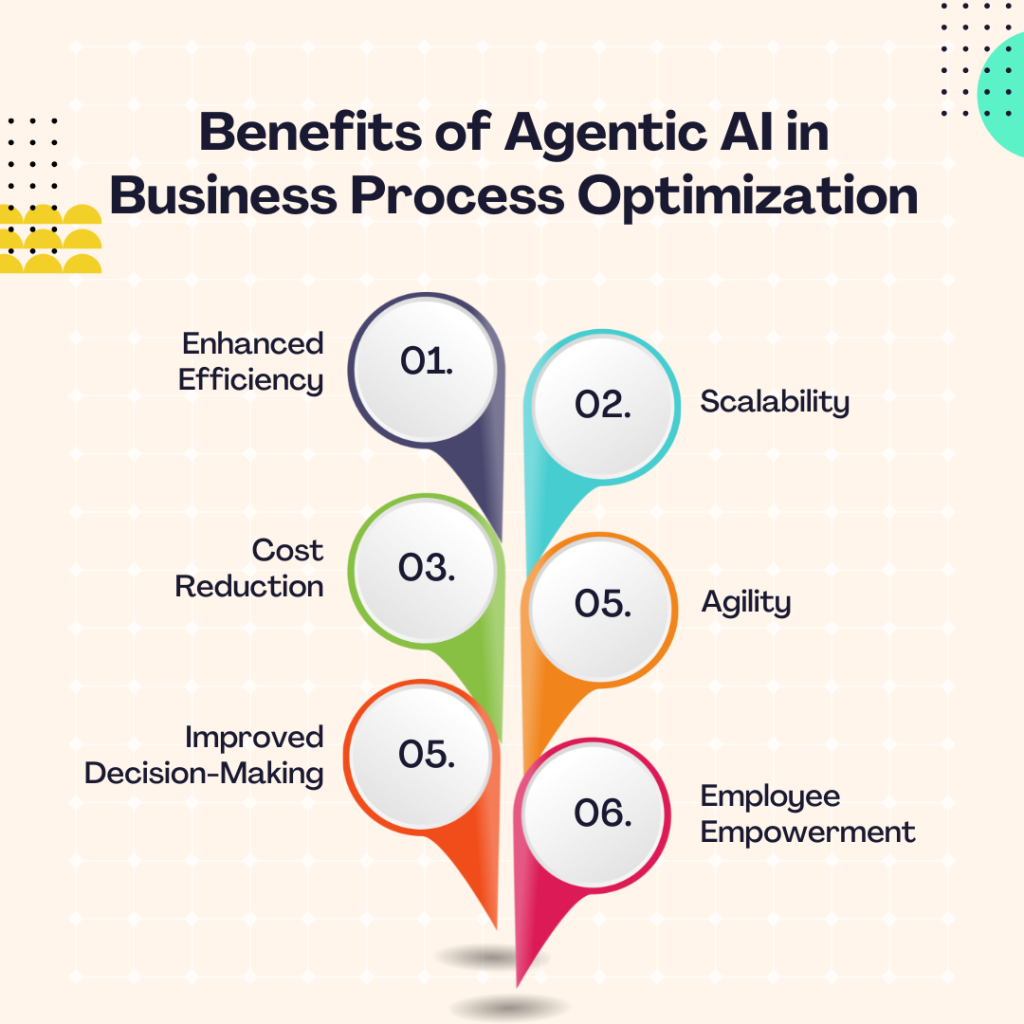
1. Enhanced Efficiency
Traditional automation focuses on rule-based, repetitive tasks. In contrast, Agentic AI enhances efficiency by automating tasks that require cognitive functions, such as understanding context, learning from past interactions, and making decisions dynamically. These intelligent agents can navigate multiple data sources, assess situations, and choose optimal actions in real time. For instance, in a customer service process, an AI agent can autonomously manage tickets, escalate cases, and personalize interactions without human intervention, significantly reducing turnaround time.
2. Scalability
Agentic AI is inherently designed to operate across various domains and systems. Unlike legacy automation systems that often require manual reconfiguration for each new use case or department, Agentic AI solutions can scale effortlessly. Their modular, cloud-native architectures and API-driven designs allow them to integrate with diverse business systems and expand operations across departments or global branches with minimal setup. This scalability ensures uniform optimization across the enterprise, regardless of geographic or functional boundaries.
3. Cost Reduction
By minimizing manual effort and reducing the likelihood of human errors, Agentic AI contributes directly to operational cost savings. Intelligent agents can work 24/7 without fatigue, handle high transaction volumes, and improve accuracy, which reduces rework and compliance risks. In financial operations, for example, Agentic AI can validate transactions, detect fraud patterns, and automate reconciliation tasks, drastically cutting labor costs and improving financial control.
4. Agility
In today’s business environment, agility is crucial. Agentic AI systems are built to adapt. They can modify their behavior based on new data, evolving rules, or changing objectives. This makes businesses more resilient and capable of responding quickly to market demands, regulatory changes, or customer preferences. For example, Agentic AI can reroute real-time deliveries based on disruptions in supply chain management, ensuring business continuity.
5. Improved Decision-Making
One of the most potent benefits of Agentic AI is its ability to make informed decisions based on real-time data and historical insights. These agents process vast amounts of structured and unstructured data, detect patterns, and generate insights that help guide business strategy. In areas like marketing, AI agents can analyze customer sentiment, predict trends, and recommend campaign adjustments on the fly—boosting effectiveness and ROI.
6. Employee Empowerment
By offloading routine and repetitive tasks, Agentic AI allows employees to focus on high-value, strategic work. This not only boosts productivity but also enhances job satisfaction and creativity. Teams can redirect their efforts toward innovation, problem-solving, and customer engagement, driving overall business growth. Moreover, with AI handling operational grunt work, employees can upskill and transition into more analytical or leadership roles.
Use Cases Across Industries
| Industry | Use Case | Outcome |
| Healthcare | AI agents scheduling appointments and managing patient flow | Reduced wait times, improved patient satisfaction |
| Finance | Intelligent agents for fraud detection and compliance | Real-time alerts, reduced financial risk |
| Manufacturing | Agents managing supply chain and predictive maintenance | Increased uptime, optimized inventory management |
| Retail | Personalized shopping agents for customer engagement | Enhanced CX and increased sales conversion |
| Logistics | Autonomous route planning and dispatch | Improved delivery efficiency and reduced fuel costs |
Integrating Agentic AI: Best Practices
Integrating Agentic AI into business operations is a strategic move that can drive transformation and long-term value. However, organizations must follow a thoughtful approach rooted in best practices to enjoy all the benefits. Agentic AI differs from traditional automation because it performs tasks and autonomously makes context-aware decisions. To ensure successful integration, businesses should focus on foundational elements such as pilot projects, platform selection, data readiness, performance monitoring, and promoting a collaborative culture. Here’s a detailed look at the best practices for integrating Agentic AI effectively.
1. Start Small: Begin with High-Impact, Low-Complexity Tasks
When introducing Agentic AI, it’s wise to begin with more minor, well-defined use cases that offer a clear business impact without requiring extensive change management. These “quick wins” help organizations demonstrate value early on, build internal confidence, and refine their AI deployment strategy. Common starting points include automating service desk queries, invoice processing, or internal ticket triaging. These processes are typically repetitive but benefit significantly from intelligent decision-making, such as prioritization based on urgency or customer history.
2. Choose the Right Platform: Use Tools like UiPath, Power Automate, Azure OpenAI, and DRUID AI
Selecting the proper technological foundation is critical. Platforms such as UiPath and Power Automate offer robust robotic process automation capabilities, while Azure OpenAI and DRUID AI enable intelligent conversational agents and decision automation. The ideal platform should align with your current infrastructure, support integration with existing systems, and offer scalability for future use cases. Additionally, opting for platforms that support agent orchestration and low-code development accelerates deployment and encourages broader adoption across the business.
3. Ensure Data Quality: Reliable Data is Essential for Intelligent Decision-Making
Agentic AI thrives on data. Clean, accurate, and timely data allows effective decision-making. Before deployment, organizations should invest in data governance practices—such as data cleansing, standardization, and validation—to ensure that AI agents can access trustworthy information. Inaccurate or fragmented data can lead to poor decisions, reduced trust in AI systems, and diminished outcomes. It’s also essential to establish pipelines for real-time data to enable dynamic responses from AI agents.
4. Monitor and Optimize: Continuously Track Agent Performance and Refine Models
Agentic AI systems are not “set-it-and-forget-it” solutions. Continuous monitoring is essential to ensure agents are performing as expected and delivering business value. Businesses should establish each agent’s key performance indicators (KPIs), track task outcomes, monitor decision accuracy, and assess user feedback. Over time, AI models should be refined using new data, updated rules, and advanced learning techniques to keep performance aligned with changing business needs. This ensures that the AI evolves alongside your organization.
5. Promote Collaboration: Encourage Synergy Between Human Employees and AI Agents
Successful integration of Agentic AI requires a cultural shift. Rather than viewing AI agents as replacements, they should be seen as collaborators that augment human capabilities. Encourage cross-functional teams to co-design AI workflows, involve employees in AI training sessions, and create open channels for feedback. When human employees trust and understand AI agents, adoption and productivity improve. Empowering teams to focus on strategic, creative, and customer-centric work—while AI handles the operational load—promotes a high-performance hybrid workforce.
Agentic AI Use Cases in Finance & Shared Services
Agentic AI can take finance automation beyond fixed workflows by allowing AI agents to understand context, make decisions within defined boundaries, execute multiple steps, and escalate exceptions when human judgment is required. This makes it particularly relevant to finance and shared services environments where processes span multiple systems, rules, approvals, and exceptions.
1. AP Automation With Agentic AI
Accounts payable is a strong use case for agentic AI because invoice processing involves more than simply extracting data. An AI agent can capture invoice information, identify the relevant purchase order, retrieve goods-receipt information, perform two-way or three-way matching, and determine whether the transaction meets predefined conditions.
When an invoice does not match, the agent can investigate the reason rather than simply stopping the workflow. It may check historical transactions, supplier information, purchase orders, or receiving records before deciding whether the issue can be resolved automatically. If the situation requires human judgment, the agent can escalate the exception with the relevant context.
This approach is a practical example of agentic process automation, where agents coordinate multiple actions toward a business outcome rather than executing one isolated task.
2. Reconciliation Automation
Reconciliation is another area where agentic AI can add capabilities beyond traditional automation. Agents can collect transactions from different systems, match records using predefined and learned patterns, investigate unmatched items, and identify potential reasons for variances.
For example, an agent could detect a mismatch between a bank transaction and a general ledger entry, investigate related records, identify a timing difference or missing transaction, and recommend or execute the next permitted action. Transactions that cannot be confidently resolved can be routed to finance professionals with supporting evidence.
These capabilities make AI agents in finance useful for finance teams dealing with high transaction volumes and complex exception patterns.
3. Financial Close Automation
The financial close process involves a sequence of interconnected activities, making it well suited to agent-based orchestration. Agents can execute close checklists, monitor task completion, retrieve supporting information, prepare or post journal entries within approved controls, identify missing activities, and generate reports.
Instead of simply triggering a predefined workflow, an agent can evaluate the status of multiple close activities and determine what action should happen next. For example, if a reconciliation is incomplete, the agent can identify the responsible team, send a follow-up, and update the close status.
5. Vendor Communication and Dispute Handling
Finance teams also spend significant time communicating with vendors about invoice status, payment dates, missing information, and disputes. Agents can handle routine status requests, retrieve information from ERP systems, communicate approved responses, and route complex disputes to the appropriate employee. This can reduce repetitive communication while maintaining human involvement when commercial judgment or negotiation is required.
Agentic AI vs. Traditional RPA in Finance
Traditional RPA generally follows predefined rules and sequences. If the input or situation changes significantly, the bot may require a new rule or workflow modification.
Agentic AI is more goal-driven. An agent can evaluate context, determine the next step, use multiple tools or systems, adapt its approach within defined boundaries, and escalate when it encounters an exception.
In simple terms:
- RPA: Rule-based and typically designed for specific tasks.
- Agentic AI: Goal-driven and capable of coordinating multiple steps.
- RPA: More static when process conditions change.
- Agentic AI: Can adapt its actions based on context.
- RPA: Usually follows a predefined sequence.
- Agentic AI: Can determine the next action within defined constraints.
The two technologies do not have to compete. In many finance environments, agentic AI and RPA can work together as part of intelligent enterprise automation. RPA can handle deterministic system interactions while agents provide reasoning, orchestration, and exception management.
For organizations building this model across AP, AR, record-to-report, procurement, and other functions, finance shared services provide a natural environment for scaling agent-based automation across standardized processes.
Ready to Transform Finance With Agentic AI?
Explore how agentic AI can transform your finance and shared services operations. Book a free discovery call.
Conclusion
In a world where speed, intelligence, and adaptability define success, Agentic AI offers a revolutionary leap forward. This approach allows businesses to achieve new performance levels, innovation, and customer satisfaction. The future of business process optimization is not just automated—it’s agentic.