








Global Business Services (GBS) organizations are evolving as businesses look for smarter ways to manage complex operations, improve efficiency, and respond to changing market demands. Traditional automation has helped organizations streamline repetitive tasks, but businesses now need systems that can do more than follow predefined instructions. This is where agentic AI in GBS is gaining attention. By combining artificial intelligence with autonomous decision-making and goal-oriented execution, agentic AI can help organizations coordinate workflows, resolve operational challenges, and support better business decisions. Understanding how this technology works can help business leaders prepare for the next phase of global business services.
What Is Agentic AI?
Agentic AI refers to artificial intelligence systems that can pursue defined goals by planning tasks, using available tools, analyzing information, and taking actions with varying degrees of autonomy. Unlike conventional AI applications that primarily generate responses or provide recommendations, AI agents can execute multiple steps toward a specific outcome.
For example, a traditional AI tool might identify an invoice discrepancy and explain why it occurred. An AI agent could potentially investigate the discrepancy, compare relevant records, request missing information, update an approved workflow, and escalate unresolved issues to a human employee.
These capabilities depend on the agent’s design, available data, system integrations, permissions, and oversight mechanisms.
Agentic AI does not mean removing people from business operations. Instead, it introduces a different approach to completing work, where AI systems can manage appropriate tasks independently while employees focus on judgment, strategy, and exceptions.
How Is Agentic AI Different From Traditional Automation?
Traditional automation has played an important role in business services for years. Robotic process automation (RPA), workflow tools, and rule-based systems help organizations complete repetitive activities consistently.
However, these technologies often struggle when processes involve incomplete information, changing circumstances, or decisions that fall outside predefined rules.
Agentic AI introduces greater flexibility by allowing systems to interpret context, determine next steps, and adapt their actions within established boundaries.
Consider a customer inquiry involving a delayed payment. A rule-based system might send a standard notification based on the payment status. An AI agent could potentially review the customer’s account, examine the payment history, identify the likely reason for the delay, and prepare an appropriate response or initiate an approved follow-up.
The main differences include:
- Decision-making: Traditional automation follows predefined rules, while agentic AI can evaluate context and select among permitted actions.
- Adaptability: AI agents can respond to changing inputs rather than relying entirely on fixed workflows.
- Multi-step execution: Agents can coordinate several related activities to achieve a defined objective.
- Human collaboration: Agents can involve employees when decisions require expertise, approval, or additional judgment.
These approaches are complementary rather than mutually exclusive. In many organizations, combining conventional automation with AI agents will be more practical than replacing existing systems entirely.
Why Is Agentic AI Becoming Relevant to Global Business Services?
GBS organizations typically coordinate multiple business functions across regions, teams, and technology platforms. These functions may include finance, human resources, procurement, customer support, and information technology.
Managing these operations can be challenging because information is distributed across different systems, processes depend on multiple stakeholders, and teams must balance efficiency with accuracy and compliance.
This is where agentic AI in GBS could make a meaningful difference. Instead of automating isolated activities, organizations can explore how AI agents might coordinate connected tasks across entire workflows.
For example, a procurement process may involve supplier onboarding, document verification, purchase approvals, contract checks, and payment coordination. An AI agent could help gather the necessary information, identify missing documents, route requests to the appropriate stakeholders, and track outstanding actions.
Such capabilities could reduce manual coordination and help employees spend less time chasing information. However, the benefits depend on process maturity, data quality, integration capabilities, and how well the organization defines the agent’s responsibilities.
Key Applications of Agentic AI in Global Business Services
The potential applications extend across several business functions. Organizations should evaluate them according to operational needs, risk exposure, and the feasibility of implementing appropriate controls.
1. Finance and Accounting
Finance operations involve recurring activities such as invoice processing, account reconciliation, expense management, and financial reporting. AI agents could support these workflows by gathering information from multiple systems, identifying inconsistencies, investigating exceptions, and coordinating follow-up activities.
For example, during account reconciliation, an agent might compare transactions across financial records, identify unmatched entries, retrieve supporting documentation, and recommend possible explanations.
Straightforward cases could proceed through approved workflows, while material discrepancies or unusual transactions could be escalated to finance professionals. This approach could help finance teams reduce manual investigation and focus more attention on complex exceptions and financial analysis.
2. Human Resources
HR teams manage employee inquiries, recruitment coordination, onboarding, benefits administration, and policy-related requests. Many of these activities require information from multiple systems and departments. AI agents could help employees navigate routine processes by retrieving relevant policy information, tracking onboarding requirements, coordinating documentation, and directing requests to the appropriate HR team.
For instance, during employee onboarding, an agent could monitor outstanding forms, coordinate approved account requests, and notify relevant stakeholders when an action is pending.
Sensitive decisions involving hiring, compensation, performance, or employee rights require additional safeguards and meaningful human oversight. AI should support these decisions without becoming an unchecked authority over employees.
3. Procurement and Supply Chain
Procurement teams frequently work with supplier records, purchase requests, contracts, delivery updates, and compliance documentation. Agentic systems could help monitor these activities, identify missing information, flag potential delays, and coordinate follow-ups with relevant stakeholders.
An AI agent might detect that a supplier’s compliance documentation is approaching its expiry date and initiate a reminder or route the issue to the responsible procurement professional.
This could improve visibility across procurement workflows and help teams respond to operational issues earlier.
4. Customer Service and Support
Customer service operations often involve repetitive inquiries, multiple communication channels, and complex handoffs between teams. AI agents could retrieve customer information, summarize previous interactions, investigate routine issues, and recommend or execute approved resolutions.
For example, an agent handling a billing inquiry might review the account history, compare relevant charges, and prepare an explanation based on verified records.
More complex complaints, sensitive situations, and cases involving financial adjustments outside the agent’s authority should be transferred to human representatives.
The objective is not simply to increase automation. It is to resolve appropriate requests more efficiently while maintaining customer trust and service quality.
5. IT Service Management
IT service teams handle incidents, access requests, troubleshooting, software issues, and routine maintenance activities. AI agents could help classify incoming tickets, gather diagnostic information, consult approved knowledge bases, and initiate authorized troubleshooting procedures.
For example, an agent might identify a recurring software issue, recommend a documented fix, and create a ticket for specialist review if the problem persists.
Actions involving privileged access, production systems, or significant infrastructure changes require strict authorization and monitoring.
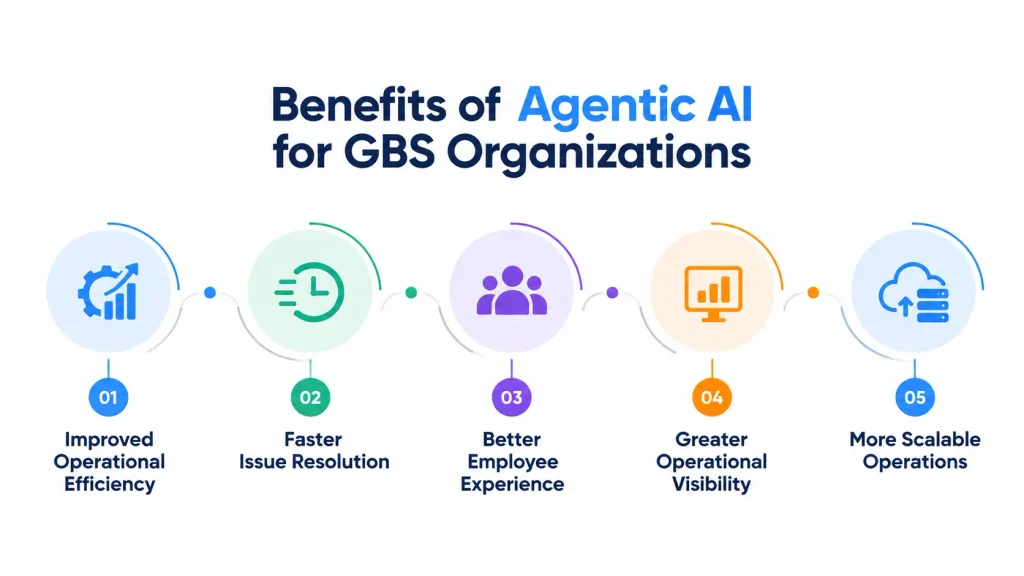
Benefits of Agentic AI for GBS Organizations
The potential value of agentic AI extends beyond completing individual tasks. Its broader impact may come from improving how work moves between systems, teams, and business functions.
1. Improved Operational Efficiency
AI agents can coordinate multiple activities without requiring employees to manage every step manually. This could reduce repetitive administrative work, shorten handoffs, and improve workflow consistency.
2. Faster Issue Resolution
Agents can gather information and investigate routine exceptions across connected systems. With the right access and reliable data, this capability may help teams identify problems sooner and resolve straightforward cases faster.
3. Better Employee Experience
When teams handle routine requests and administrative activities efficiently, employees can spend more time on analysis, collaboration, and problem-solving.
4. Greater Operational Visibility
AI agents can track workflow progress, identify recurring bottlenecks, and summarize unresolved issues. These insights may help GBS leaders see where processes are slowing down and where they need to improve.
5. More Scalable Operations
Organizations expanding into new markets or managing higher transaction volumes may use AI agents to support additional work without increasing manual coordination at the same rate. Actual scalability will depend on infrastructure, oversight requirements, and process complexity.
Importantly, these outcomes should be measured rather than assumed. Organizations need clear performance indicators to determine whether an implementation delivers meaningful improvements.
Challenges and Risks to Consider
Despite its potential, agentic AI introduces challenges that organizations must address before deploying it across critical business operations.
1. Data quality and integration: AI agents need access to accurate, relevant information. Inconsistent records and disconnected systems can produce unreliable outcomes.
2. Security and access control: Agents may interact with sensitive financial, employee, or customer information. Organizations must restrict access according to business requirements and the principle of least privilege.
3. Governance and accountability: Businesses need clear rules governing which actions agents can take independently, which require approval, and who remains accountable for the results.
4. Reliability and error management: AI agents can misunderstand instructions, select inappropriate actions, or produce incorrect outputs. Testing, monitoring, audit trails, and recovery procedures are essential.
5. Employee readiness: Teams need training to understand how agents work, how to review their outputs, and when to intervene. Clear communication can also help address concerns about changing responsibilities.
Successful adoption requires more than deploying an AI model. It involves redesigning workflows, establishing governance, and preparing people to work effectively alongside intelligent systems.
How Can Businesses Prepare for Agentic AI?
Organizations do not need to transform every business function at once. A measured approach can help leaders understand the technology’s practical value while limiting unnecessary risk.
Step 1: Identify the Right Use Cases
Start by identifying processes with high volumes of repetitive work, frequent handoffs, and clearly measurable outcomes. Avoid beginning with complex, high-risk decisions that require extensive human judgment.
Step 2: Evaluate Process Readiness
Review existing workflows, system integrations, data availability, and exception-handling procedures. Processes that are poorly documented or unnecessarily complicated may need improvement before introducing AI agents.
Step 3: Establish Clear Boundaries
Define the agent’s objectives, permissions, escalation rules, and approval requirements. Begin with limited responsibilities and expand autonomy only when evidence supports doing so.
Step 4: Run a Controlled Pilot
Test the selected use case in a limited environment. Compare results against the existing process and assess accuracy, completion time, error rates, employee experience, and operational costs.
Step 5: Measure and Improve
Use pilot results to identify weaknesses and refine the workflow. Expand deployment gradually when the system demonstrates reliable performance and appropriate controls.
This structured approach helps organizations move from experimentation toward practical adoption without treating autonomy as an end in itself.
The Future of Global Business Services
The future of GBS will likely involve a combination of human expertise, conventional automation, generative AI, and increasingly capable AI agents. As these technologies mature, organizations may move beyond automating individual tasks toward coordinating complete workflows across finance, HR, procurement, IT, and customer operations.
In this evolving environment, agentic AI in GBS could help shift the operating model from task execution toward outcome-oriented service delivery. Rather than measuring performance exclusively through transaction volumes or processing time, organizations may increasingly examine resolution quality, employee experience, process reliability, and business impact.
However, greater autonomy will not automatically produce better outcomes. Organizations that invest in sound processes, reliable data, employee capabilities, and strong governance will be better positioned to use these technologies responsibly.
The most effective GBS organizations will likely be those that combine AI capabilities with human judgment instead of treating them as competing approaches.
Conclusion
Agentic AI represents an important development in the evolution of global business services. By enabling AI systems to plan activities, coordinate workflows, and execute permitted actions, organizations can explore new ways to improve operational efficiency and service delivery.
From finance and HR to procurement, customer support, and IT, the technology offers opportunities to reduce manual coordination and help employees focus on higher-value work. To understand how this technology is transforming finance operations, explore our guide on From RPA to APA: Agentic AI for Finance Teams.
At the same time, adoption requires careful planning, clear accountability, strong security controls, and continuous evaluation.
For business leaders, the starting point is not to automate everything. It is to identify where intelligent agents can solve genuine operational problems and deliver measurable value. With a thoughtful implementation strategy, agentic AI in GBS can become a useful part of a broader transformation toward more connected, responsive, and outcome-driven business services.