





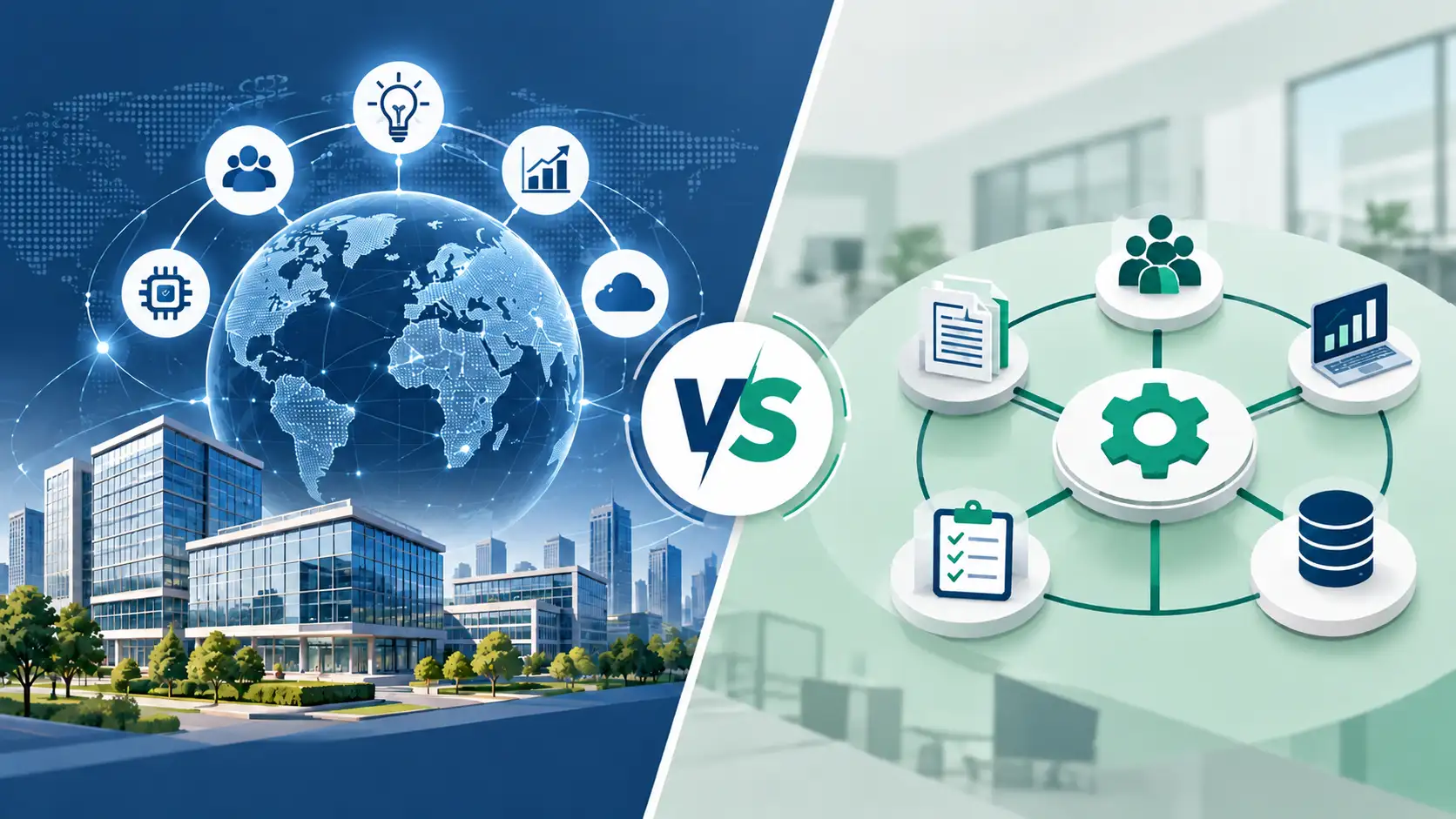


Businesses today are constantly investigating how to improve operational efficiency, reduce costs, and build capabilities that support long-term growth. As organizations expand across regions, two operating models often enter the conversation: Global Capability Centers (GCCs) and Shared Services Centers (SSCs). Understanding global capability center vs shared services is essential for businesses evaluating how to organize their operations, manage resources, and create greater value across departments.
Although both models consolidate business activities and improve efficiency, they differ in their strategic objectives, levels of ownership, and potential for innovation. Businesses looking to streamline centralized operations can explore shared services automation solutions to understand how automation can improve process efficiency, reduce manual workloads, and support consistent service delivery.
This guide explains the differences between GCCs and Shared Services Centers, explores their benefits and challenges, and helps businesses understand which approach may suit their needs.
What Is a Global Capability Center (GCC)?
A Global Capability Center is an offshore or nearshore operation established by a multinational organization to manage business functions, develop specialized expertise, and support strategic objectives across global markets.
Unlike a traditional back-office setup, a GCC can operate as an extension of the parent organization, with responsibility for innovation, technology development, analytics, research, and business transformation.
For example, a company headquartered in the United States might establish a GCC in India to manage software engineering, financial planning, cybersecurity, data analytics, and digital product development.
Over time, the center may evolve from supporting existing operations to developing new capabilities that benefit the entire enterprise.
Key Characteristics of a GCC
- Strategic ownership: Operates under the parent organization’s direction and long-term business priorities.
- Specialized expertise: Develops capabilities in areas such as technology, analytics, research, and digital transformation.
- Innovation and transformation: Supports new products, process improvements, and emerging business initiatives.
- Global collaboration: Works closely with teams across multiple regions and business units.
- Long-term capability building: Invests in talent, technology, and knowledge that strengthen organizational competitiveness.
GCCs are increasingly considered strategic business assets rather than simply lower-cost delivery locations.
What Is a Shared Services Center (SSC)?
A Shared Services Center consolidates similar business activities from different departments, business units, or geographical locations into one centralized operation.
The primary objective is to standardize processes, reduce duplication, improve service quality, and create economies of scale.
For example, an organization with multiple regional offices might establish an SSC to handle payroll, accounts payable, employee administration, procurement support, and other recurring activities.
Instead of each location maintaining separate teams for the same tasks, the organization centralizes these responsibilities under a common service structure.
Key Characteristics of an SSC
- Process standardization: Establishes consistent procedures across departments and locations.
- Cost efficiency: Reduces duplicated resources and improves economies of scale.
- Centralized service delivery: Brings similar operational activities under one management structure.
- Performance measurement: Uses service-level agreements (SLAs), turnaround times, accuracy, and productivity metrics to evaluate performance.
- Operational consistency: Improves governance, reporting, and compliance through common processes.
Shared Services Centers are particularly useful for organizations seeking greater control over routine business operations while improving efficiency and service reliability.
Global Capability Center vs Shared Services: Key Differences
While both models centralize activities, understanding global capability center vs shared services helps businesses identify their key differences and select an operating model that aligns with their objectives.
| Comparison Factor | Global Capability Center | Shared Services Center |
| Primary objective | Build strategic capabilities and support enterprise growth | Standardize operations and improve efficiency |
| Core focus | Innovation, expertise, transformation, and business outcomes | Process consolidation, consistency, and service delivery |
| Typical functions | Engineering, analytics, R&D, cybersecurity, finance transformation | Payroll, accounts payable, HR administration, procurement support |
| Performance measures | Business impact, innovation, capability development, productivity | Cost per transaction, accuracy, turnaround time, SLA compliance |
| Operating approach | Often evolves with strategic business priorities | Usually follows defined processes and service requirements |
| Talent strategy | Emphasizes specialized skills and capability development | Emphasizes process expertise, service delivery, and operational efficiency |
| Value creation | Strategic and operational value | Primarily operational value, with opportunities for broader improvement |
These distinctions are not absolute. An SSC can introduce automation and analytics, while a GCC can manage standardized processes. The difference lies in the center’s mandate, decision-making authority, and expected contribution to the enterprise.
Benefits of a Global Capability Center
Organizations exploring a GCC often want more than immediate cost savings. They want to establish capabilities that can support future business requirements.
1. Access to Specialized Talent
A GCC can help organizations access talent in software engineering, artificial intelligence, data science, financial analysis, and other specialized fields. This is especially valuable when local talent markets are expensive or competitive. By developing dedicated teams in strategic locations, businesses can expand their expertise while maintaining alignment with enterprise priorities.
2. Greater Innovation Potential
GCCs can provide dedicated resources for experimentation, product development, and process transformation. Teams can collaborate with headquarters to test new technologies, improve existing systems, and develop solutions for deployment across the organization.
3. Stronger Enterprise Integration
Because a GCC typically operates within the parent organization’s governance structure, it can align closely with corporate strategy, technology standards, and business objectives. This alignment can improve collaboration and reduce the disconnect that sometimes occurs between headquarters and external service providers.
4. Long-Term Capability Development
Organizations can invest in training, leadership development, specialized infrastructure, and institutional knowledge. Over time, these investments may help the center take on more complex responsibilities and deliver greater business value.
Benefits of a Shared Services Center
For organizations managing duplicated processes across departments or countries, an SSC offers a practical way to simplify operations.
1. Reduced Operational Costs
Consolidating similar activities can eliminate redundant teams, reduce administrative overhead, and improve resource utilization. Instead of maintaining separate accounts payable or payroll teams in every location, organizations can centralize those functions and use shared resources more efficiently.
2. Improved Process Consistency
A shared operating structure encourages common workflows, documentation, controls, and reporting standards. This consistency can reduce errors and make it easier to compare performance across business units.
3. Better Service Visibility
Shared Services Centers can introduce defined service-level agreements, standardized reporting, and performance dashboards. These measures help business leaders understand service quality, identify bottlenecks, and hold teams accountable.
4. Easier Automation Opportunities
High-volume, repetitive activities are often suitable for workflow automation, robotic process automation, and other digital tools. Centralizing these processes can make automation easier to implement, govern, and scale across multiple business units.
Global Capability Center vs Shared Services: Which Model Is More Cost-Effective?
Cost is an important consideration when evaluating these models, but the cheapest option is not necessarily the most effective.
An SSC may deliver faster operational savings when an organization has duplicated administrative processes, inconsistent workflows, and opportunities to consolidate transaction volumes.
A GCC may require a larger initial investment in specialized talent, technology, leadership, and infrastructure. However, it can create broader value when the business needs advanced expertise, product development, digital transformation, or long-term innovation.
When comparing the cost of a global capability center vs shared services, organizations should consider the total cost of ownership rather than salaries alone.
Relevant factors include:
- Recruitment, training, and employee retention costs.
- Technology platforms, infrastructure, and licensing.
- Management, governance, and compliance expenses.
- Process transition and change management costs.
- Productivity improvements and automation potential.
- Long-term business benefits and measurable outcomes.
The right approach depends on the business case. An SSC may be more appropriate for a cost-focused consolidation initiative, while a GCC may justify greater investment when strategic capabilities are central to future growth.
When Should a Business Choose a GCC?
A Global Capability Center may be suitable when an organization wants to build capabilities that directly contribute to competitive advantage.
Consider this model if your business:
- Needs specialized technology, engineering, analytics, or research capabilities.
- Wants to accelerate digital transformation and product innovation.
- Requires closer integration between global teams and corporate leadership.
- Plans to develop long-term expertise in a strategic market.
- Wants greater ownership of critical knowledge, intellectual property, and business capabilities.
For instance, a technology company building AI-powered products may establish a GCC to support engineering, model development, cybersecurity, and product research.
The center’s success would depend not only on operating costs but also on product quality, innovation, delivery speed, and business impact.
When Should a Business Choose an SSC?
A Shared Services Center may be the better choice when the immediate priority is operational simplification and service consistency.
Consider this model if your business:
- Has duplicated administrative functions across departments or regions.
- Wants to standardize finance, HR, procurement, or similar processes.
- Needs stronger cost control and service-level accountability.
- Wants to consolidate high-volume, repetitive transactions.
- The company is looking to improve process visibility before investing in a broader transformation.
For example, a multinational company with separate payroll teams across several countries might centralize eligible activities in an SSC. This can simplify management, reduce duplication, and create a foundation for further automation and process improvement.
Can a Business Combine GCC and Shared Services Models?
Yes. Organizations do not always need to choose one model exclusively. A hybrid structure can combine the operational discipline of Shared Services with the specialized capabilities of a GCC.
For example, a company might use an SSC for payroll processing, accounts payable, and routine employee administration while its GCC focuses on financial analytics, automation engineering, enterprise technology, and transformation initiatives.
This approach allows organizations to separate standardized service delivery from specialized capability development without creating unnecessary organizational silos.
However, a hybrid model requires clear accountability, defined service boundaries, shared data standards, and coordinated governance. Without these elements, teams may duplicate responsibilities or struggle to determine who owns particular outcomes.
The most effective structure is the one that supports business priorities while keeping operating complexity manageable.
How to Evaluate the Right Operating Model
Before deciding between the two models, business leaders should assess their current operations and future requirements.
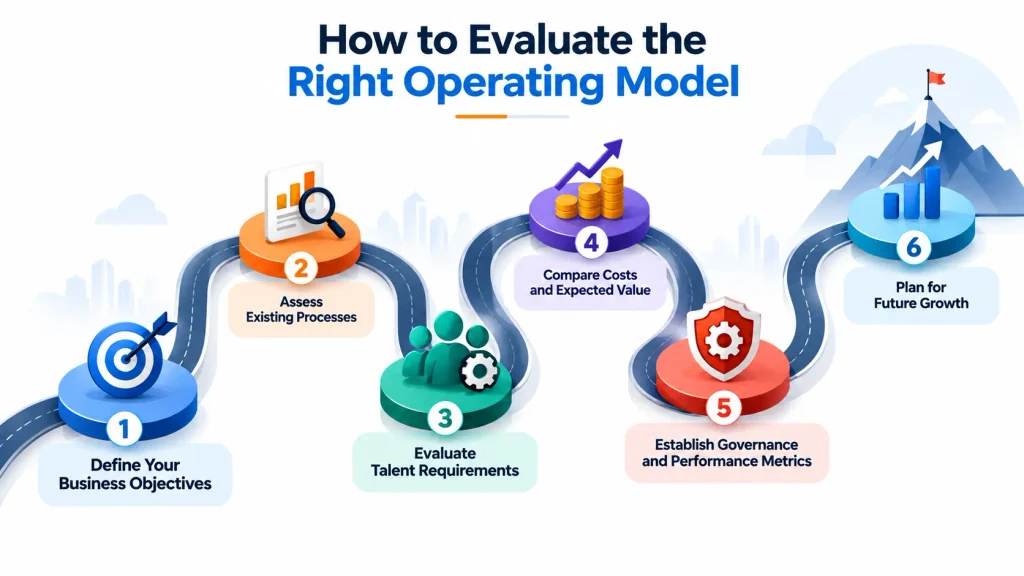
Step 1: Define Your Business Objectives
Determine whether the primary goal is reducing costs, improving service quality, accessing specialized talent, accelerating innovation, or supporting transformation.
Step 2: Assess Existing Processes
Identify duplicated activities, process inefficiencies, technology limitations, and areas where standardization could deliver immediate benefits.
Step 3: Evaluate Talent Requirements
Consider whether the work primarily requires process expertise or advanced capabilities such as engineering, analytics, research, and strategic problem-solving.
Step 4: Compare Costs and Expected Value
Estimate implementation costs, ongoing expenses, transition risks, and measurable benefits over an appropriate planning horizon.
Step 5: Establish Governance and Performance Metrics
Define ownership, decision-making authority, reporting structures, and success measures before implementation.
Step 6: Plan for Future Growth
Choose a model that can adapt to changing business needs without introducing unnecessary complexity or limiting future opportunities.
Conclusion
The decision between a Global Capability Center and a Shared Services Center is ultimately about the role an organization wants its centralized operations to play.
A GCC is generally better suited to building specialized expertise, enabling innovation, and supporting strategic business transformation. An SSC is typically more effective for consolidating routine activities, enhancing process consistency, and minimizing operational duplication.
When evaluating global capability center vs shared services, businesses should look beyond terminology and compare their strategic objectives, operating requirements, talent needs, costs, and long-term plans. They can also explore how Agentic AI is transforming GBS and shared services to understand how emerging technologies can improve operational efficiency and enable more intelligent business processes.
Neither model is universally superior. The right choice depends on the organization’s priorities, and a hybrid approach may offer the best balance for businesses that need both efficient service delivery and advanced capabilities.
By clearly defining the desired outcomes and establishing appropriate governance, organizations can build an operating model that improves performance today while preparing them for tomorrow’s challenges.