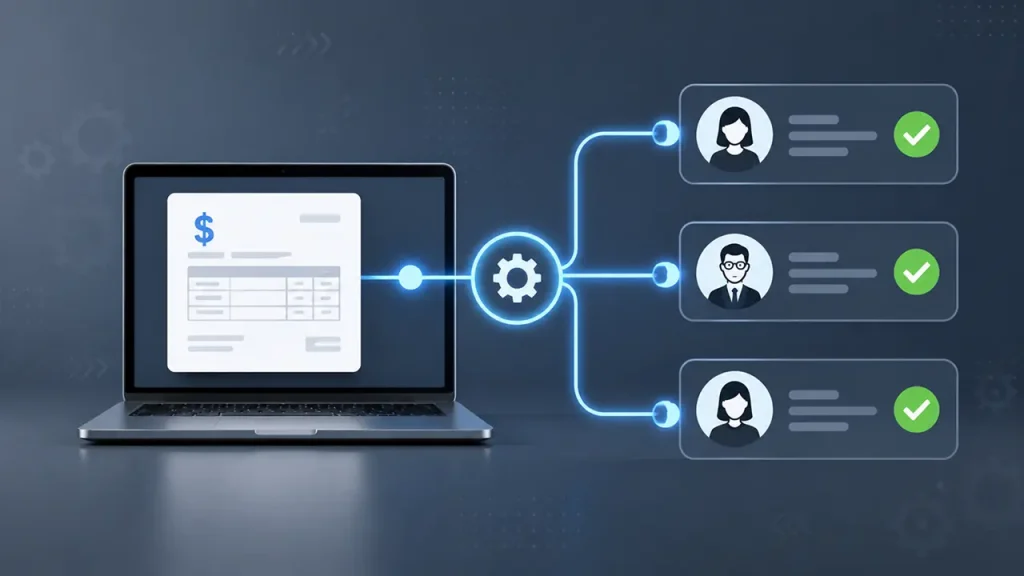









Finance leaders are under constant pressure to reduce operating costs, improve financial visibility, accelerate close, and support the business with fewer manual processes. Yet many transformation initiatives still begin with months of assessments, strategy presentations, and recommendations that leave finance teams with another roadmap to execute. Finance transformation consulting should be different. The objective should not be to tell finance leaders what to automate or which technology to consider. It should help them identify high-value opportunities, build the solution, deploy it into production, and measure the resulting business impact.
This practical guide explains what effective finance transformation consulting looks like, how it differs from traditional consulting, which finance processes should be prioritized, and what finance leaders should expect from a transformation partner. It also breaks down the finance transformation services a strong partner should provide, from process discovery to automation running in production.
What Is Finance Transformation Consulting?
Finance transformation consulting helps finance organizations redesign and modernize their operations through process optimization, automation, technology implementation, and operating-model improvements.
Rather than treating transformation as a technology purchase, a strong consulting engagement starts by understanding how work actually moves through the finance function. This includes mapping processes, identifying bottlenecks and manual handoffs, analyzing exceptions, establishing baseline performance metrics, and determining where automation can create measurable value.
A comprehensive engagement can include:
- Process assessment: Documenting current-state workflows, systems, handoffs, controls, and exceptions.
- Transformation strategy: Prioritizing processes based on business impact, complexity, feasibility, and expected ROI.
- Automation strategy: Determining where RPA, intelligent document processing, AI, workflow orchestration, or agentic automation can be applied.
- Technology selection: Evaluating technologies against the organization’s existing ERP, applications, data, security requirements, and operating model.
- Implementation: Building, integrating, testing, and deploying automated workflows.
- Change management: Preparing finance teams for new processes, roles, controls, and ways of working.
- Measurement: Tracking cost, cycle time, productivity, quality, exception rates, and other transformation KPIs.
This distinction matters because finance transformation consulting should not stop at recommendations. A strategy document does not reduce invoice-processing effort, shorten reconciliation cycles, or accelerate financial close by itself.
Traditional management consulting may diagnose problems and provide a roadmap. Transformation consulting should help finance teams move from diagnosis to execution, with working processes, measurable results, and a path to scale.
Finance Transformation Services: What a Typical Engagement Includes
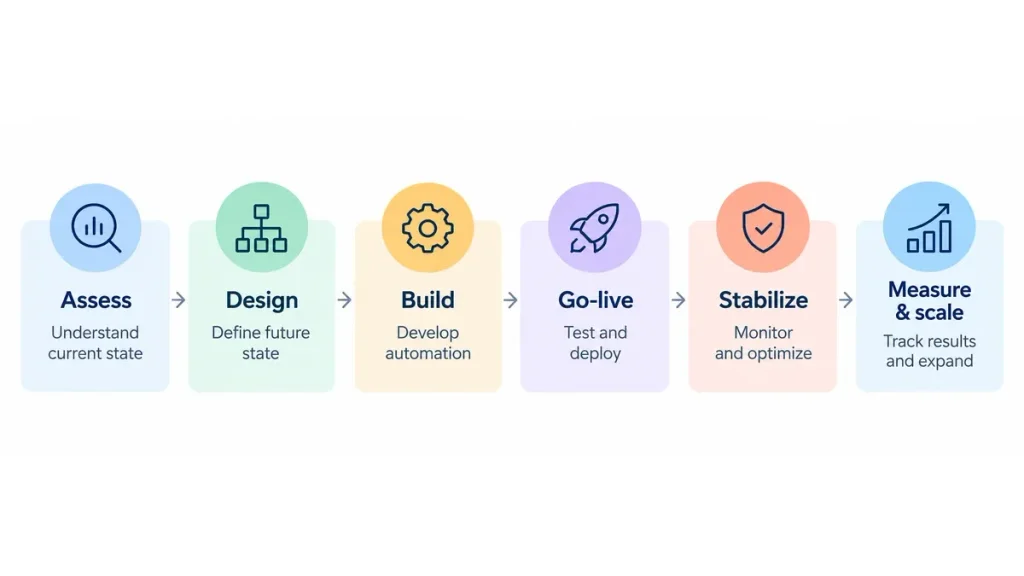
Finance transformation services are the hands-on work that turns a transformation plan into improved finance operations. Rather than delivering only a strategy document, an engagement covers discovery, design, build, deployment, and ongoing improvement. Each stage has a defined outcome, helping finance teams move from identifying inefficiencies to implementing measurable operational improvements.
| Service | What it includes | What you receive |
| Finance process assessment | Current-state mapping, volumes, exceptions, controls, and baseline metrics | Prioritized list of processes ranked by impact and effort |
| Finance operating model design | Roles, handoffs, shared services/GBS structure, and governance | Future-state process and operating model |
| Automation design and build | RPA, intelligent document processing, AI and agentic workflows, and ERP integration | Working automation in a test environment |
| Testing and go-live | Business-rule testing, exception scenarios, user validation, and production deployment | Automation running in production |
| Stabilization and hypercare | Monitoring, defect fixes, rule tuning, and exception analysis | Stable process with documented exception handling |
| Measurement and scale | KPI tracking against baseline, next-process roadmap, and center of excellence setup | Measured results and a plan for the next processes |
Finance process transformation vs. technology implementation
Buying software is not the same as finance process transformation. Process transformation changes how work flows through the organization before automation is built. This means removing unnecessary handoffs, standardizing approvals, clarifying ownership, and redesigning exception handling so that routine transactions move efficiently while unusual cases receive the right attention.
Technology implementation without this step often automates existing inefficiencies rather than eliminating them. Teams may end up processing the same unnecessary approvals faster or routing exceptions through the same fragmented workflows. The result is a new tool without the full operational improvement it was meant to deliver. A reliable finance process consulting partner should be able to show the redesigned process, not only the tool configuration.
Which finance transformation solutions fit which problems
Different operational challenges require different finance transformation solutions. The right approach depends on transaction volumes, process complexity, existing systems, and the amount of human judgment involved.
- High invoice volumes and manual data entry: Intelligent document processing + AP automation.
- Slow, spreadsheet-heavy reconciliations: Rules-based matching + reconciliation automation.
- Multi-entity, multi-ERP shared services: Standardized workflows + shared services automation.
- Judgment-heavy exceptions and multi-step decisions: Agentic process automation to coordinate decisions and actions across workflows.
- Unclear starting point: Begin with an assessment through consulting and advisory to identify the highest-impact opportunities.
Most finance transformation services engagements start with one high-volume process, such as AP or reconciliation, prove the results within 6–8 weeks, and then extend the same framework to the next process. This phased approach helps teams validate improvements, manage implementation risk, and build a repeatable model for scaling transformation.
Finance Transformation vs. Traditional Consulting: What’s Different?
The most significant difference is what happens after the recommendations are delivered.
Traditional consulting can be valuable when an organization needs an independent assessment, operating-model design, benchmarking, or strategic direction. But finance leaders looking for measurable operational improvement often need more than recommendations. They need a partner that can translate the recommendations into working technology and redesigned processes.
| Factor | Traditional Consulting | Finance Transformation Consulting |
| Deliverable | Strategy document and recommendations | Working automated processes |
| Engagement model | Advise and leave | Advise, build, and stabilize |
| Timeline | Often months of analysis | First results can be targeted within weeks |
| Cost model | Often hourly consulting fees | Can include defined implementation scopes |
| Outcome | Transformation roadmap | Automation running in production |
| Technology | Vendor-neutral recommendations | Hands-on implementation with specific technologies |
| Accountability | Primarily recommendations | Measurable operational results |
The distinction is not that traditional consulting has no implementation value. The distinction is where accountability sits. If the engagement ends when the roadmap is delivered, the finance team still has to translate recommendations into process changes, integrations, automation, testing, and adoption.
Effective finance transformation consulting closes that gap.
Traditional consulting tells you what to do. Transformation consulting helps you do it.
The strongest engagements combine strategic thinking with practical implementation: identify the right opportunity, build the solution, stabilize it, prove the value, and then determine where to go next.
The Process-First Approach to Finance Transformation

Technology can automate a process, but it cannot automatically fix a process that was poorly designed in the first place.
That is why a process-first approach is important. Before selecting a platform or building an automation, finance leaders need to understand what actually happens today: where data enters the process, who touches it, where approvals stall, which exceptions occur repeatedly, and where systems fail to communicate.
A practical four-phase model looks like this:
1. Discovery
The transformation starts with process discovery. Teams map the current workflow from beginning to end, identify manual activities and bottlenecks, review system dependencies, and establish baseline metrics.
For example, an AP assessment may examine invoice volumes, processing time, approval delays, exception rates, ERP integrations, and the amount of manual data entry involved.
2. Automate
The next step is to automate the highest-impact processes. This does not necessarily mean automating everything. The priority should be processes where automation can produce meaningful improvements in cost, speed, accuracy, capacity, or control.
This is where finance process automation can combine technologies such as RPA, intelligent document processing, workflow automation, AI, and orchestration.
3. Stabilize
Automation should not be considered complete at go-live. Teams need to monitor production performance, resolve defects, analyze exceptions, refine business rules, and ensure the process works across real-world scenarios.
Stabilization is particularly important in finance because exceptions often represent the most complex and valuable work in the process.
4. Scale
Once the first process is stable, organizations can expand automation to additional workflows and establish a center of excellence to govern automation development, standards, security, measurement, and continuous improvement.
For shared services organizations, this phased approach can be especially effective. Instead of attempting a large-scale transformation all at once, finance leaders can start with one high-volume process and expand from there through shared services automation.
The principle is simple: understand the process first, automate second, stabilize the result, and scale what works.
Key Areas of Finance Transformation
Finance transformation can span the entire finance operating model, but several processes typically offer strong opportunities for automation and redesign.
1. AP Automation
Accounts payable is often one of the best starting points because it combines high transaction volumes with repetitive manual activities.
Transformation opportunities include invoice capture, data extraction, validation, purchase-order matching, approval routing, exception handling, ERP posting, and payment preparation.
Organizations evaluating AP automation services should look beyond invoice capture. The real value comes from connecting the complete workflow and reducing the manual coordination required between systems and teams.
2. Reconciliation
Reconciliation processes frequently consume significant finance capacity because teams must compare transactions across bank accounts, subledgers, ERPs, intercompany records, and other data sources.
Automation can handle matching, identify variances, categorize exceptions, and route unresolved items for human review. This allows finance professionals to focus on investigation rather than repetitive comparison.
3. Financial Close
Financial close transformation can target close checklists, journal-entry preparation, account reconciliation, supporting documentation, variance analysis, and reporting.
The objective is not simply to make individual tasks faster. It is to create a more coordinated close process with fewer manual dependencies and better visibility into outstanding work
4. Reporting and Analytics
Finance teams often spend substantial time extracting, consolidating, cleaning, and formatting data before they analyze it.
Automation can streamline data collection and reporting, while dashboards provide more timely visibility into financial and operational performance. Initiatives such as spend analytics can help finance and procurement teams move from static reporting toward more actionable spend visibility.
5. Shared Services and GBS
Shared services and global business services organizations face an additional challenge: scale.
Processes may span multiple entities, regions, currencies, ERPs, approval structures, and service-level requirements. Standardizing workflows before automating them can therefore have a significant impact.
A broader GBS transformation can connect AP, reconciliation, reporting, close, procurement, and other finance processes under a common operating model. Organizations can also extend this approach through finance shared services.
The goal is not simply to centralize work. It is to create a finance operation that is standardized, measurable, automated, and scalable.
6. Procure-to-Pay
Procure-to-pay transformation extends automation beyond AP into the full purchasing lifecycle.
Instead of treating requisitions, purchase orders, receiving, invoice processing, matching, approvals, payment, and reconciliation as disconnected activities, organizations can connect them into an end-to-end workflow.
This is the objective of procure-to-pay automation, where the focus shifts from automating individual tasks to connecting the complete process.
For more advanced workflows, finance teams can also explore agentic process automation, particularly where processes require contextual decisions, exception handling, or multi-step orchestration.
How to Choose a Finance Transformation Consultant

Choosing a transformation partner requires looking beyond brand recognition or the quality of a strategy presentation. Finance leaders should evaluate whether the consultant can actually deliver the transformation.
1. Do they implement or just advise?
Ask what happens after the assessment. Search for a partner with the capability to design, build, integrate, test, deploy, and stabilize automation.
2. Do they have finance-specific experience?
Generic IT consulting experience is not enough. The partner should understand AP, reconciliation, financial close, reporting, controls, shared services, and finance KPIs.
3. Can they work with your ERP?
A transformation partner should be able to work with the technology already running your finance function, including SAP, Oracle, NetSuite, Microsoft Dynamics, and other enterprise systems. ERP replacement should not automatically be the starting point.
4. Do they offer a defined implementation model?
Ask how implementation is scoped, what is included, how change requests are handled, and whether the engagement can be structured around clear deliverables rather than indefinite consulting hours.
5. Can they show real results?
Ask for case studies with specific numbers. Cost reduction, hours recovered, processing speed, close-time improvement, and implementation timelines are more useful than generic claims about “digital transformation.”
6. Do they have relevant automation partnerships?
Depending on the use case, expertise across technologies such as UiPath, AI platforms, intelligent document processing, workflow orchestration, and agentic AI can expand implementation options.
7. What’s the implementation timeline?
A partner should be able to explain what they can realistically achieve in the first several weeks. The exact timeline will depend on process complexity, ERP integration, data quality, and governance requirements.
8. Can they help build internal capability?
Long-term transformation requires more than external delivery. A strong partner should be able to help establish governance, reusable automation standards, operating procedures, and a center of excellence.
For organizations looking for broader automation consulting, the evaluation should therefore focus on both strategic capability and implementation depth. Auxiliobits describes its consulting approach around assessing processes, identifying high-impact opportunities, and translating strategy into scalable automation outcomes.
Finance Transformation Case Studies
Finance transformation becomes easier to evaluate when the discussion moves from technology features to measurable outcomes.
Auxiliobits’ published case studies include a vendor invoice-processing engagement for a large marketing network that recovered 9,700+ hours and generated more than $200K in annual savings. Its finance shared services offering also reports 40–60% reductions in manual finance work, 2–3× faster processing, and a 6–8 week engagement timeline for moving from assessment to a working automation solution.
Another published finance case involving a luxury apparel manufacturer reports a 73% reduction in monthly close processing time, demonstrating how automation can extend beyond AP into financial close.
These examples illustrate an important point: finance transformation does not need to begin as a multi-year program. A focused process can become the starting point for measurable improvement, after which the same architecture, governance, and operating model can be extended to additional processes.
Finance leaders building the investment case can also use an AP automation business case to quantify potential savings and operational benefits.
See the full finance transformation case studies for examples of automation and digital transformation engagements.
Getting Started: What to Expect in the First 6–8 Weeks
A practical finance transformation program should create visible progress early rather than spending the entire engagement in analysis.
Weeks 1–2: Process Discovery and Mapping
The team documents the current process, identifies bottlenecks, reviews systems and integrations, analyzes exceptions, and establishes baseline metrics.
The output should be a clear view of where automation can create the most value and what needs to change before implementation.
Weeks 3–4: Automation Build and Configuration
The selected process is translated into an automated workflow. Integrations, business rules, document processing, approvals, exception paths, and system interactions are configured and developed.
This is where finance automation moves from a concept on a roadmap to an actual working solution.
Weeks 5–6: Testing and Stabilization
The automation is tested against normal transactions, edge cases, exceptions, and business rules. Finance users validate outputs and identify adjustments before production deployment.
The objective is to make the automation reliable enough to handle real operational workloads.
Weeks 7–8: Go-Live and Measurement
The process moves into production, performance is monitored, and the initial results are compared with the baseline.
By the end of the first 6–8 weeks, finance leaders should ideally have:
- At least one automated process running in production
- Baseline performance metrics
- Measured initial results
- Documented exception-handling procedures
- A clear roadmap for the next processes
- A foundation for scaling automation across finance
This does not mean every finance transformation can be completed in eight weeks. Complex multi-ERP programs, major operating-model changes, and enterprise-wide transformations require longer timelines. The principle is that the transformation should start producing evidence of value early.
Ready to Transform Your Finance Operations?
Finance transformation should not end with another strategy deck. The right approach connects process redesign, automation, implementation, and measurable outcomes. If your finance team is ready to identify a high-value process and move toward production quickly, book a discovery call to explore a process-first approach that can deliver initial results in 6–8 weeks.