







Key Takeaways
- Reverse logistics is no longer a side process—with return rates as high as 30% in some categories, mishandling this flow directly impacts profitability and customer loyalty.
- Agentic automation goes beyond physical sorting—it makes micro-decisions on routing, refurbishment, resale, or disposal based on SKU data, condition, seasonality, and confidence scores.
- Fulfillment centers are being forced into dual mode, handling outbound fulfillment and reverse intake simultaneously, demanding redesigned workflows and localized micro-fulfillment strategies.
- Automation fails when treated as one-size-fits-all—exception volume, cross-team misalignment, misclassified condition data, and seasonal surge planning remain the biggest pitfalls.
- Reverse automation drives value upstream, powering better sourcing, inventory updates, demand planning, ESG reporting, and secondary market recovery—often delivering more ROI than forward automation efforts.
For decades, the spotlight in supply chain conversations has been on getting goods out the door—faster, cheaper, and with better visibility. But the flow backward, the stream of returned goods, refurbishments, recalls, and restocking, is often messier than the forward supply chain ever was. Reverse logistics eats into operating margins quietly, and in many industries, unpredictably.
Now, automation has crept into this neglected corner. Not just industrial arms taking apart packaging or conveyors routing returns, but intelligent agents: systems capable of making micro-decisions without requiring human approval at every step. That’s the new reality—agentic automation managing whether returns head back to stock, get rerouted to refurbishment, or sent to disposal partners.
Handled poorly, returns break trust with both consumers and internal teams. Handled well, they recover not just dollars but loyalty. The trick is that the automation piece must be contextual, not one-size-fits-all.
Also read: Agent network for predictive load planning in transportation
The Immense and Intricate Nature of Reverse Flows
Every retailer knows the statistics, though few like to repeat them. E-commerce return rates average between 15–20%, with categories like apparel creeping closer to 30%. Compare that with brick-and-mortar return rates in the low single digits, and you see why execs start sweating.
But volume is only part of the challenge. Returns create complexity because:
- Items often come back in non-standard conditions—open boxes, missing tags, damaged packaging.
- The “time value” decays quickly, particularly in fashion, where a missed season can mean dead stock.
- Data quality is patchy; return reasons logged by customers are vague (“didn’t fit” could mean a tiny defect or simply the wrong size).
- Reverse transport legs rarely run at full capacity, raising per-unit costs.
What Agentic Automation Means in Practice
When people hear “automation,” they often picture robots lifting totes or scanners beeping items at conveyor junctions. Useful, yes, but that’s mechanical automation.
Agentic handling goes further—it’s about decision-making automation. Systems that ingest condition reports, shipping data, SKU attributes, and even images uploaded by customers, then decide:
- Redirect item to the nearest fulfillment node if it meets restockable criteria.
- Route directly to secondary market warehouses if seasonality or demand patterns suggest cannibalization risk for primary shelves.
- Initiate vendor return because the defect points to a manufacturing error.
- Flag for inspection by a human only when confidence scores fall below thresholds.
The difference might sound subtle, but for high-volume operations, it reshapes financial outcomes. Instead of every return defaulting to a central facility for manual processing (slow and expensive), items can branch dynamically across multiple destinations.
The Dual Role of Fulfillment Centers
It’s worth pausing on where this actually plays out. Fulfillment centers, already under strain pushing outbound goods, are now expected to double as return intake facilities. For mid-tier retailers, this duality is exhausting.
- Workers trained for outbound efficiency often find reverse handling interrupts flow. A returned toaster with missing screws doesn’t sit neatly next to 50 outbound parcels scheduled for same-day delivery.
- Automation helps here—sort-to-light systems, robotic binning, and AI-driven quality assessment stations. But these require reformatting workflows, not just bolting on new machines.
- Micro-fulfillment hubs are also experimenting with reverse capabilities embedded in them; localized intake minimizes return transit and accelerates restock for fast-moving SKUs.
Failure Modes: When Automation Trips Over Reality
Every successful automation story is matched by failures, some of them embarrassing. A few recurring pitfalls stand out.
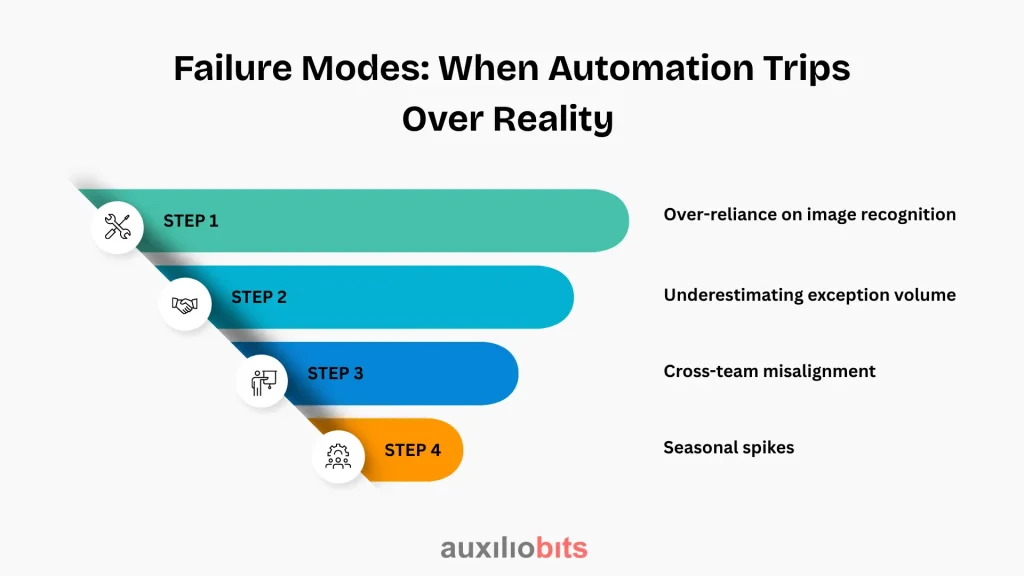
- Over-reliance on image recognition: Machine vision can misclassify product condition—declaring a used item “sellable” when subtle wear is hidden from camera view. Suddenly, you have complaints about receiving “used” goods sold as new.
- Underestimating exception volume: The myth is that most returns are routine. In reality, exceptions pile up—variant SKUs, discontinued models, customer fraud cases. Automation can choke unless exception handling routes are carefully designed.
- Cross-team misalignment: Merchandising views reverse flows as cost-control, while CX teams view them as service differentiators. When automation optimizes for warehouse throughput but forces stricter return rules, customer satisfaction can nosedive.
- Seasonal spikes: Holiday returns—up to 2x normal flow in January—aren’t easy for static automation systems. Dynamic scaling is still a weak point.
These failures highlight why agentic is not synonymous with autonomous. Automation agents coordinate, but human oversight still matters where complexity spikes.
Resale, Recycling, and the Secondary Market
A core reason reverse logistics can no longer be managed manually is that returned goods rarely travel a single path anymore. They disperse into multiple downstream loops.
- Resale channels: Platforms like BackMarket and thredUP absorb refurbished inventory at scale, sometimes offering better yield than traditional discounting.
- Recycling partners: Electronics manufacturers rely on certified e-waste recyclers to capture metals. The coordination requires automated compliance tracking, not just physical routing.
- Refurbishment lines: Brands like Apple or Dell run industrial-grade refurbishment; intake automation presorts devices into categories—repairable, cosmetic damages only, beyond recovery.
- Charity and liquidation: Lower-value SKUs funnel into donation channels or liquidators. Even this requires agentic tracking, because accounting rules demand proof of disposition.
The real nuance is making decisions fast enough to preserve value. A returned smartphone loses resale appeal for every week it sits idle. Automation compresses the decision cycle to hours, sometimes minutes.
Case Insights from the Field
- Amazon’s returns kiosks: Drop-offs at Kohl’s or UPS Stores are not just customer conveniences. They reduce consolidation lag. Behind the counter, items are scanned, classified, and tagged before they even return to a fulfillment node. This early labeling accelerates routing.
- IKEA’s furniture returns: Bulky goods are a different beast. Automation here doesn’t mean conveyor belts; it means software agents booking direct-to-outlet resale or routing components into recycling streams based on SKU-level material codes.
- Pharma industry recalls: Reverse logistics here isn’t about customer preference—it’s about compliance. Automation agents track the chain-of-custody down to lot and serial numbers, ensuring recalled items don’t slip back into inventory mistakenly.
Each example paints the same conclusion: the value is not just in speed, but in reducing missteps that can cost brand equity or trigger compliance penalties.
Integration with Upstream Systems
Another overlooked point: returns automation isn’t a silo. Done right, it pushes signals upstream.
- Planners get accurate defect data feeding back to sourcing decisions. Imagine automatically flagging a batch of yoga pants with stitching issues to the supplier contract team.
- Inventory systems gain near-real-time updates as “restockable” returns flow back into available-to-promise stock pools.
- Transportation divisions get dynamic rebalancing instructions when return volumes spike in certain zones.
For example, one CPG player admitted that most of their early “automation ROI” didn’t come from lower warehouse labor costs at all. The real benefit was supply planners adjusting purchase orders based on cleaner, faster defect-return feedback loops. Manufacturing quality errors were identified weeks earlier than before.
A Take on Sustainability
Sustainability is always paraded as part of the reverse logistics conversation, but truthfully, the economics often override environmental optimality. Agentic automation offers some reconciliation.
- By restocking closer to demand centers, fewer trucks run empty miles bringing items to distant hubs.
- Automated routing to resale and recycling reduces the chance of “lazy” default landfill outcomes.
- Data transparency helps brands back up public ESG claims with verifiable, audited return disposition pathways.
That said, recycling isn’t free of contradictions. Automated systems sometimes overclassify recycling as “safe,” when higher-value recovery could have been achieved via resale or refurbishment. A reminder: sustainability metrics shouldn’t blind operators to the actual financial calculus.
Toward a More Flexible Model
If there’s one common thread, it’s that reverse flows resist rigidity. Automation that mimics forward logistics—linear, predictable, standardized—will fail in the face of returns’ inherent variability.
Instead, leading practices frame automation as layered:
- Frontline scanning agents make initial pathway decisions at drop-off points.
- Mid-tier sorting systems, routing to regional hubs for restock or resale.
- Centralized intelligence layers, feeding insight back up to planning and sourcing.
This layered model protects the system from overconfidence in a single decision point. If the local kiosk mislabels an item, mid-tier inspection has another chance to redirect.
Closing Reflection
Reverse logistics isn’t glamorous. Most investors still prefer to hear about drones delivering same‑day groceries than about robots inspecting a pile of mismatched sweaters. Yet the bottom line impact of returns handling is enormous. Agentic automation—done with the right dose of humility—offers a pathway toward efficiency without stripping out the human judgment still needed at edge cases.
And perhaps the industry should stop underselling it. After all, more profit leaks through poor reverse handling than through last‑mile inefficiencies. If executives put half the strategic energy into agent-guided return flows as they put into outbound speed wars, margins might look different.
The question worth leaving open: will organizations treat reverse automation as a core competence, or keep treating it as janitorial cleanup for the glamorous front end of commerce? The answer, as always in logistics, will be obvious only in hindsight.