





key-takeways
- Integrating UiPath with chatbots automates repetitive tasks, reducing operational bottlenecks. Businesses benefit from faster task execution, minimized human error, and improved productivity, enhancing overall efficiency and cost savings.
- Chatbots powered by AI and UiPath provide real-time customer support, reducing wait times and offering 24/7 availability. Automated workflows ensure quick query resolution, delivering a seamless, personalized customer experience.
- UiPath bots handle complex backend tasks like data entry, invoice processing, and order management. Chatbots trigger these automated processes using API integration, ensuring smooth, error-free operations.
- UiPath’s automation capabilities allow businesses to scale operations effortlessly. With AI-driven chatbots managing customer interactions and UiPath bots executing backend tasks, companies can manage growing workloads without hiring additional resources.
- The integration provides actionable insights through UiPath Orchestrator’s analytics. Businesses can monitor bot performance, identify operational inefficiencies, and optimize workflows, leading to more intelligent decision-making and continuous process improvement.
Imagine a world where businesses run smoothly, with employees focused on high-priority tasks, responding to customer queries, and facing no operational lag. How do we achieve this? Well, there is nothing more beneficial than integrating UiPath with chatbots and virtual assistants. Hindrances like lower response rates impact traditional approaches when companies plan to grow. Nowadays, both employees and customers want access to personalized and real-time interactions. Companies can enjoy several perks if they integrate UiPath with AI chatbots and virtual assistants. By utilizing the capabilities of UiPath to automate tasks and virtual assistants and chatbots, companies can boost their productivity and efficiency to unparalleled levels.
This convergence is not an add-on but a requirement for any business that wants to achieve end-to-end hyper-automation, maximum workforce productivity, and lower costs. An end-to-end automated platform allows enterprises to deliver solutions that are not merely real-time but also intelligent and highly efficient. This acceleration greatly enhances customer experiences while enabling human employees to concentrate on other strategic tasks and high-value work that significantly contribute to the company’s overall success.
The Growing Need for AI-Powered Automation
AI automation integrates artificial intelligence with robotic process automation to create systems beyond traditional rules-based automation. It is like automation on steroids. These systems process large quantities of data, identify patterns, and make intelligent decisions based on the data, making them a step above traditional rules-based automation.
Labor shortages and the intricacy of the virtual world also drive the increasing need for AI-powered automation. Companies must implement intelligent automation to reduce costs, eliminate errors, and make quicker decisions. Moreover, AI-powered bots can operate 24/7. generating round-the-clock productivity and faster time-to-market. Also, the development of generative AI and agentic AI opened greater automation possibilities. Such innovations allow businesses to develop digital personal assistants that mimic human speech, produce text content, and automatically conduct multi-step, complex activities. Alongside sophisticated NLP and machine learning algorithms, automation powered by artificial intelligence is optimized in terms of operational efficiency and for boosting innovation and staying resilient.
Also, read The Role of UiPath Consultants in Streamlining Agentic Process Automation for Enterprises
The Power of UiPath in Automation
UiPath has emerged as the go-to automation tool for organizations seeking to optimize their business operations. As a leading Robotic Process Automation (RPA) platform, it surpasses traditional automation by using AI, machine learning (ML), and advanced analytics to enable HyperAutomation—the seamless automation of intelligent workflows.
What sets UiPath apart is its capability to provide end-to-end automation in complex business landscapes. In sectors ranging from healthcare to finance to manufacturing to communications, UiPath’s adaptive building blocks explode departmental bottlenecks, even impeding operations. Robots can process unstructured information, make precise decisions, adhere to complexity through automatic responses, enforce artificial capabilities (like document understanding and computer processing), and more.
UiPath’s no-code, low-code development platform is also beneficial because it gives the power of automation to everyone’s hands. Business users and developers can swiftly build automation workflows by dragging and dropping. UiPath encourages do-it-yourself development, making automation accessible to all. Its adaptive architecture supports attended and unattended bots for all front-office and back-office processes.
Benefits of UiPath Integration with Chatbots
If you are new to UiPath integration with chatbots and do not know its benefits, find some below.
| Advantages | Description |
| Productivity gets better | One can save a lot of time with the help of streamlined procedures. |
| Customers are satisfied. | RPA-integrated chatbots deliver real-time customer support. |
| Customer support 24/7 | Without the need for human intervention, chatbots can manage queries 24/7. |
| Scalability | Streamline your business operations and effortlessly scale automation. |
| Expense Minimization | Reduces operational costs by minimizing human labor. |
| Real-Time Insights | Maintains data-driven insights through RPA analytics. |
Steps to Follow When Integrating UiPath with Chatbots
As UiPath chatbots are integrated into business systems, there have been some substantial improvements in automation for business workflows, reduced operational costs, and higher customer experience ratings through automated and real-time feedback. If you are a company that would like to reap the benefits of the latest technologies arising from the integration of UiPath with chatbots and virtual assistants, now is the time to give it serious thought. Below are a few simple steps one may follow for the integration:
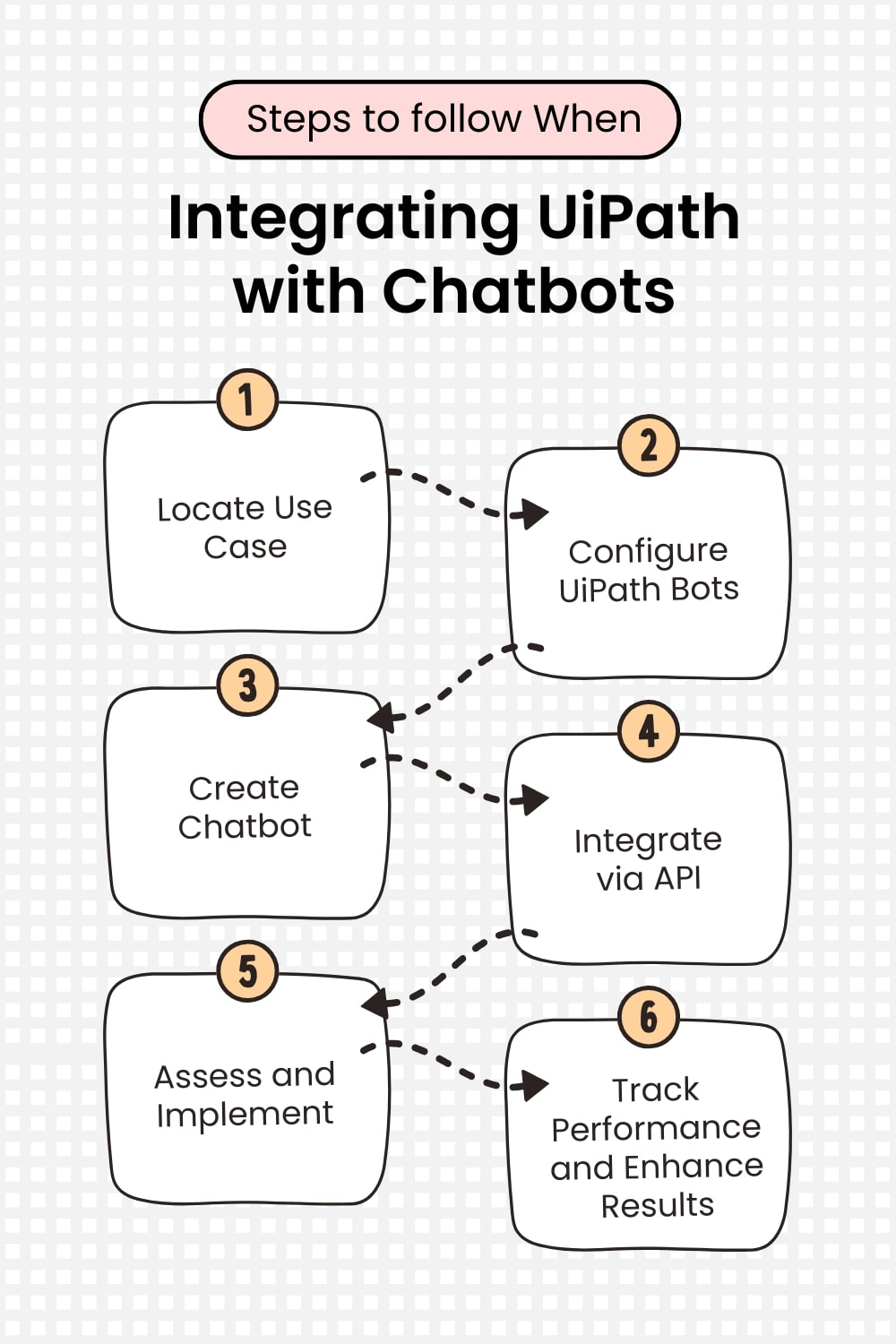
1. Locate Use Case
The first step you need to follow when getting started with the integration is to find a particular use case for the chatbot. Get going by identifying the tasks that are being conducted repeatedly. In addition, keep an eye on functions that take a lot of time and are error-prone. Some of the ideal candidates for automation consist of the following:
- Inquiries gathered from customers
- Order tracking and management.
- Appointment scheduling.
- Retrieving data from legacy systems.
- Invoice or claims processing.
2. Configure UiPath Bots
The next step is to use UiPath Studio to create the automation workflows required. UiPath robots can mimic human interaction with computer programs, gather information, check data, and perform back-end operations. Steps to install UiPath bots:
- Create the automation flow using drag-and-drop capability within UiPath Studio.
- Make the best use of AI capabilities when handling unstructured data.
- Ensure that data extraction, input, or system interactions are incorporated when and where required.
- Deploy the automation to UiPath Orchestrator for centralized management.
3. Create Chatbot
Applications for a conversation-driven chatbot include:
- Microsoft Bot Framework
- Google Dialogflow
- DRUID AI
The chatbot should be able to identify user intent and provide appropriate responses. It should also be capable of activating UiPath bots to manage back-end tasks as needed.
Core Components of Development:
- Natural Language Processing (NLP) for query understanding.
- Create conversation habits for common scenarios.
- UiPath API integration features for communication.
4. Integrate via API
Use UiPath’s REST APIs to establish a secure API connection between UiPath and the chatbot. These APIs allow external applications like chatbots to trigger automation workflows.
Connecting UiPath with Chatbots:
With chatbots, first obtain API access credentials from the UiPath Orchestrator. Next, define the API endpoints to trigger specific bots or retrieve results. Use API keys or OAuth for authentication and ensure bidirectional data flow for real-time updates. Some chatbot platforms may also offer pre-built UiPath connectors for easier integration.
5. Assess and Implement
Conduct thorough testing to determine seamless communication between the chatbot and UiPath bots. Conduct the following:
- Functional testing will ensure the chatbot selects the correct bot and receives the appropriate responses.
- Integration testing will examine API calls and data exchange between systems.
- User Acceptance Testing (UAT) will collect feedback from stakeholders to confirm the chatbot’s usability. The chatbot will be deployed to production to monitor its performance.
6. Track Performance and Enhance Results
After deployment, monitoring is required to maintain sustained operations and improve performance. UiPath Orchestrator provides a single platform for monitoring bot activities, detecting faults, and ascertaining system performance.
Recommendations for Effective Surveillance Procedures:
- Evaluate the precision and speed of responses.
- Assess error frequency and confirm appropriate exception management protocols.
- Employ analytical methodologies to discern patterns and areas necessitating enhancement.
- Conduct routine updates of chatbots and automated platforms to align with evolving organizational prerequisites.
The Final Verdict
Combining chatbot technologies with UiPath Robotic Process Automation (RPA) enhances customer interactions and operational efficiency. Chatbots handle initial customer inquiries, while RPA automates backend tasks like data retrieval and transaction processing. This integration minimizes errors, speeds up response times, boosts efficiency by reducing manual intervention, streamlines internal processes, and provides a consistent, personalized customer experience.
A simple methodology—from identifying areas of automation and deploying UiPath bots to designing chatbots, integrating through APIs, and measuring performance—can help one succeed in the long term. By monitoring real-time performance through UiPath Orchestrator, businesses can gain actionable insights to optimize processes, make better decisions, and fuel digital transformation.
Also, AI chatbots can be used with Natural Language Processing (NLP) to understand and answer customer inquiries sensibly. Combined with UiPath’s automation, they can undertake end-to-end processes without manual intervention, making it scalable and cost-effective.
Also, explore How to Optimize Business Processes with UiPath Agentic Automation.
Take the Next Step with Auxiliobits
Whether you need to optimize customer service, internalize processes, or accelerate digitalization, Auxiliobits will make your journey to automation easy and ROI-driven. Let us help you gain access to AI-driven automation.
We at Auxiliobits specialize in providing innovative automation solutions that maximize business value. Our experts offer comprehensive services, including identifying ideal use cases, designing dependable UiPath bots, and integrating them with advanced chatbots to achieve seamless automation.