





How a US healthcare eligibility API leader used RPA to return real-time eligibility results from various payer portals

Eliminating manual verification bottlenecks with intelligent automation — turning 4-minute workflows into sub-30-second responses at scale.

87%

Faster Eligibility Response Time

11.2K

Staff Hours Reclaimed Annually

95%+

Annual Cost
Reduction

$88K

Reduction in Data Entry Errors

20+ Portals

Payer portals fully automated

<30 Seconds

Average eligibility response time

99.4% Uptime

Bot availability across all portals

o FTE Added

Scale achieved without new hires

The Challenge

A Manual QC Process Buckling Under Enterprise Scale

Our client is a mid-market leader in US healthcare eligibility API services, acting as the connective tissue between 800+ downstream healthcare providers — clinics, hospitals, and billing companies — and America’s complex insurance payer ecosystem. Operating at scale with 20k+ eligibility checks processed daily, even marginal inefficiencies compound into significant revenue and operational risk.

The Problem

A critical subset of payer eligibility data was inaccessible via standard EDI 270/271 transactions or direct APIs. For these payers — covering roughly 60%-70% of the client’s total request volume — staff were required to manually log into each individual payer web portal, enter member demographics, navigate multi-screen flows, capture the eligibility response, and transcribe results back into the client’s proprietary API platform.

At peak, this manual process consumed 45 full-time equivalent staff hours per day across a dedicated operations team. Each check averaged 4–6 minutes. Errors from manual transcription caused downstream claim denials and delayed patient care — a reputational and financial liability the client could no longer accept as its payer network continued to grow. 

4-6 minutes per manual eligibility lookup across 40+ payer portals

8.3% average transcription error rate causing downstream claim denials

Inability to scale without proportionally growing headcount

No audit trail or structured logging for manual portal lookups

20k+
Daily manual Checks

Eligibility requests requiring manual portal verification at project start

45 hrs
Staff Hours Lost Daily

Dedicated FTE time consumed by repetitive portal navigation and data entry

$315k+
Annual cost of Manual OPS

Fully-loaded cost including labor, error remediation, and rework

We were adding headcount every quarter just to keep up with payer portal volume. It was unsustainable — and every manual step was a potential compliance or accuracy risk.
–  Chief Technology Officer

The Solution

An RPA-Powered Eligibility Engine Across Every Payer Portal

Auxiliobits deployed a fleet of UiPath RPA bots purpose-built for healthcare payer portal navigation – creating a scalable, intelligent middleware layer that mimics expert human workflows with speed, precision, and full auditability.
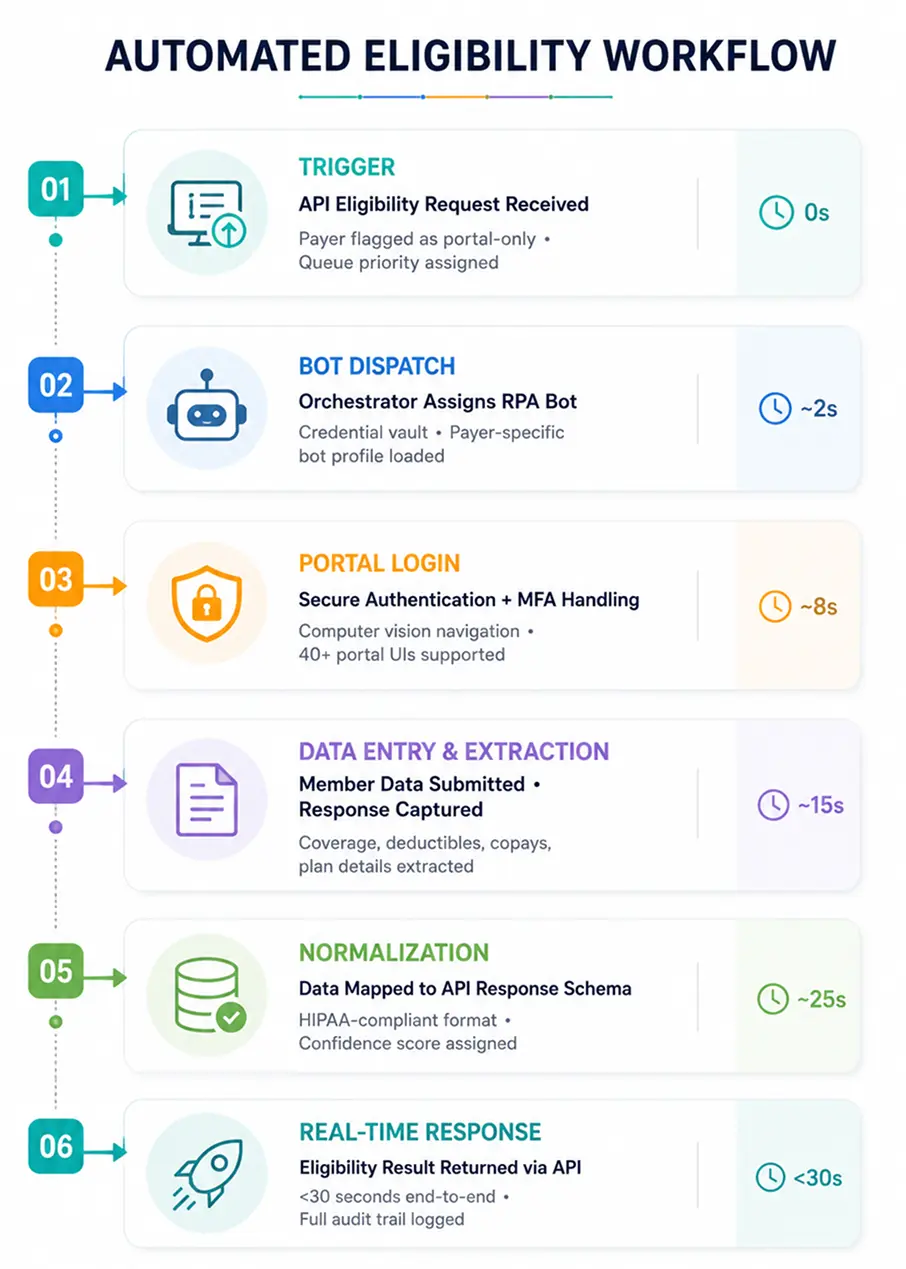
1. API Request Interception & Queue Management
Incoming eligibility API requests flagged for portal-only payers are routed to a prioritized UiPath Orchestrator queue with member demographics, payer ID, and request metadata.
2. Secure Portal Authentication
Bots retrieve payer-specific credentials from an encrypted vault; perform multi-step portal login, including MFA handling where required; and establish an authenticated session.
3. Intelligent Data Entry & Navigation
AI-assisted computer vision maps and navigates each payer portal’s unique UI, entering member data and navigating multi-page eligibility search flows reliably — even when portal layouts change.
4. Structured Data Extraction & Normalization
Eligibility response data is extracted, parsed, and normalized into the client’s standard API response schema — including coverage dates, copays, deductibles, and plan details.
5. Real-Time API Response & Audit Logging
Normalized results are posted back to the client’s API layer within seconds. All bot activity is logged to a HIPAA-compliant audit trail with timestamps, portal version, and result confidence score.

Technologies Deployed

Automation Platform

UiPath Studio for developing and managing scalable RPA workflows.

MCP HOST BUILD

Native FHIR R4 resource server + HL7 v2 bridge embedded at EMR data layer-zero middleware

AI-Powered UI Recognition

UiPath AI Computer Vision for intelligent payer portal navigation and dynamic UI handling.

Cloud Infrastructure

Microsoft Azure Virtual Machines for secure and scalable unattended bot hosting.

Secure Credential Management

Azure Key Vault for encrypted storage and secure access to payer credentials.

API Integration

REST APIs for real-time eligibility request processing and response delivery.
Implementation

Week 1–2
Discovery, portal mapping & bot architecture design.
Weeks 3–4
Development and UAT on the top 15 payers by volume.
Week 5–6
Full 20+ portal deployment, parallel-run testing, and live go-live on Azure infrastructure.

The Results

Measurable Impact Across Every Clinical Touchpoint
BEFORE AUTOMATION
AFTER AUTOMATION WITH AUXILIOBITS

87%

Faster response time

From 4-6 min <30 sec

11 , 200

Staff hours saved annually

45 hrs/day reclaimed

$315K

Annual cost reduction

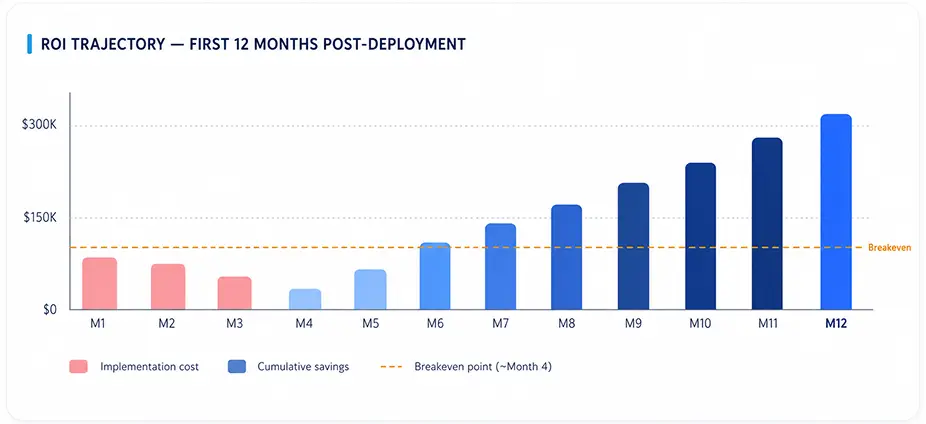
Full ROI in <4 months

92%

Reduction in data entry errors From 8.3% 0.7% error rate

40+

Payer portals automated
100% portal coverage achieved

99.4%

Bot uptime SLA achieved
 24/7 unattended operation

Operational Transformation

When Your EMR Drowns Clinicians, Instead of Empowering Them

The operations team now focuses exclusively on exception handling, payer relationship management, and continuous improvement, having previously spent 80% of their day on manual portal entry. Throughput capacity for portal-dependent payers increased by 6× without adding a single headcount. The client now confidently onboards new payers — including portal-only payers — within days rather than months.

Long-Term Strategic Value

Beyond cost savings, the automation foundation Auxiliobits delivered has unlocked new business capabilities: real-time SLA dashboards for downstream provider clients, predictive failure detection via bot monitoring, and the architectural groundwork for expanding into claims status and authorization workflows. The client is now positioned to grow transaction volume 3× without a material operational cost increase.

Key Takeaways

Portal-Dependent Payers Are a Solvable Bottleneck

In US healthcare, EDI coverage gaps mean a significant share of eligibility requests will always require portal interaction. Rather than treating the issue as a staffing problem, enterprises that deploy payer-specific RPA bots convert this liability into a scalable, auditable, competitive differentiator — without waiting for payers to build APIs.

AI Computer Vision Solves the Portal UI Fragmentation Problem

No two payer portals are identical — and portals change layouts without notice. Traditional selector-based RPA breaks under these conditions. By layering UiPath's AI computer vision capabilities into our bot architecture, Auxiliobits built bots resilient to layout changes, reducing portal maintenance overhead by over 70%-80% compared to standard RPA approaches.

Automation Velocity Becomes a Compounding Competitive Advantage

The client's ability to onboard new payer portals in days — rather than months of hiring and training — means every new payer relationship translates immediately into revenue. This structural advantage compounds over time: as competitors scale headcount, this client scales bots. Automation velocity is the new operational moat in healthcare data services.


Ready to Transform Your
Close?

Let’s assess your finance automation opportunity. Whether you’re running SAP, Oracle, or a hybrid ERP environment across multiple entities, our team will map your month-end close workflow and identify where intelligent automation delivers the fastest ROI.