





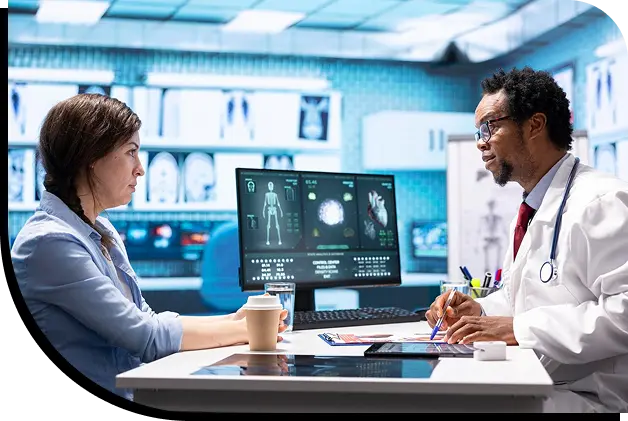
A healthcare EMR built an HL7 and FHIR native MCP Host to be the first AI-native application

A leading healthcare EMR platform partnered with Auxiliobits to architect an HL7 & FHIR-native MCP host, making it the world’s first AI-native electronic medical record application—where every clinical workflow is orchestrated by autonomous AI agents.

~6,000-7,000+
Clinician Hours

Reduced annually

~$1.2M-$1.6M+
Annual Cost Savings

Based on average fully loaded clinician rate

~80-90%+
Triage Automation

For routine & repeat inquiries

4x
Clinician Capacity

Reinvested into patient care & outcomes

The Challenge

When Your EMR Drowns Clinicians, Instead of Empowering Them

The client is a mid-market Electronic Medical Record (EMR) platform serving 50+ hospitals and 2,000+ clinicians across North America. Operating at the intersection of complex clinical data standards—HL7 v2, HL7 v3, and FHIR R4—the platform handles over 1 million patient records and 500000+ clinical transactions monthly.

Despite its scale, the platform’s AI capabilities were bolt-on and disconnected. Clinicians spent an average of 3.2 hours per shift navigating manual data entry, cross-referencing disparate lab systems, and reconciling HL7 message fragments—time stolen directly from patient care.

Every AI tool the EMR attempted to integrate operated in isolation: a transcription module here, a coding assistant there, and none of them contextually aware of the full patient record or capable of orchestrating multi-step clinical decisions autonomously.

Fragmented AI tooling
Period lock validation (MARV), previous/current period status checks (CKMLPP via SE16N), and price determination verification (CKMLO) with P2 incident creation on failure.
HL7/FHIR translation bottlenecks
SM37 batch job monitoring for SAPRCM23 completion across all EMEA plants and SE16N-KEKO costing version completeness validation before MLC execution.
No agentic orchestration
Clinicians managed multi-step workflows (admit → assess → prescribe → discharge) entirely manually, with zero AI-driven decision support across the continuum.
Compliance exposure
Inconsistent data formatting across HL7 segments created audit vulnerabilities and HIPAA documentation gaps.

We had incredible AI modules sitting in silos. What we needed was a nervous system—something that could connect every data source, every workflow, and every clinical decision into one coherent, AI-orchestrated experience. That’s exactly what Auxiliobits built.
– Chief Medical Information Officer, EMR Client

PAIN BY THE NUMBERS - BEFORE MCP

3.2 hrs

avg. admin hours per clinician/shift

40 min

lab result delay due to HL7 transform

6 +

disconnected Al modules in the EMR

40-50 %+

documentation error rate in audit reviews

The Problem

SSC Inefficiency Was Blocking GBS Evolution

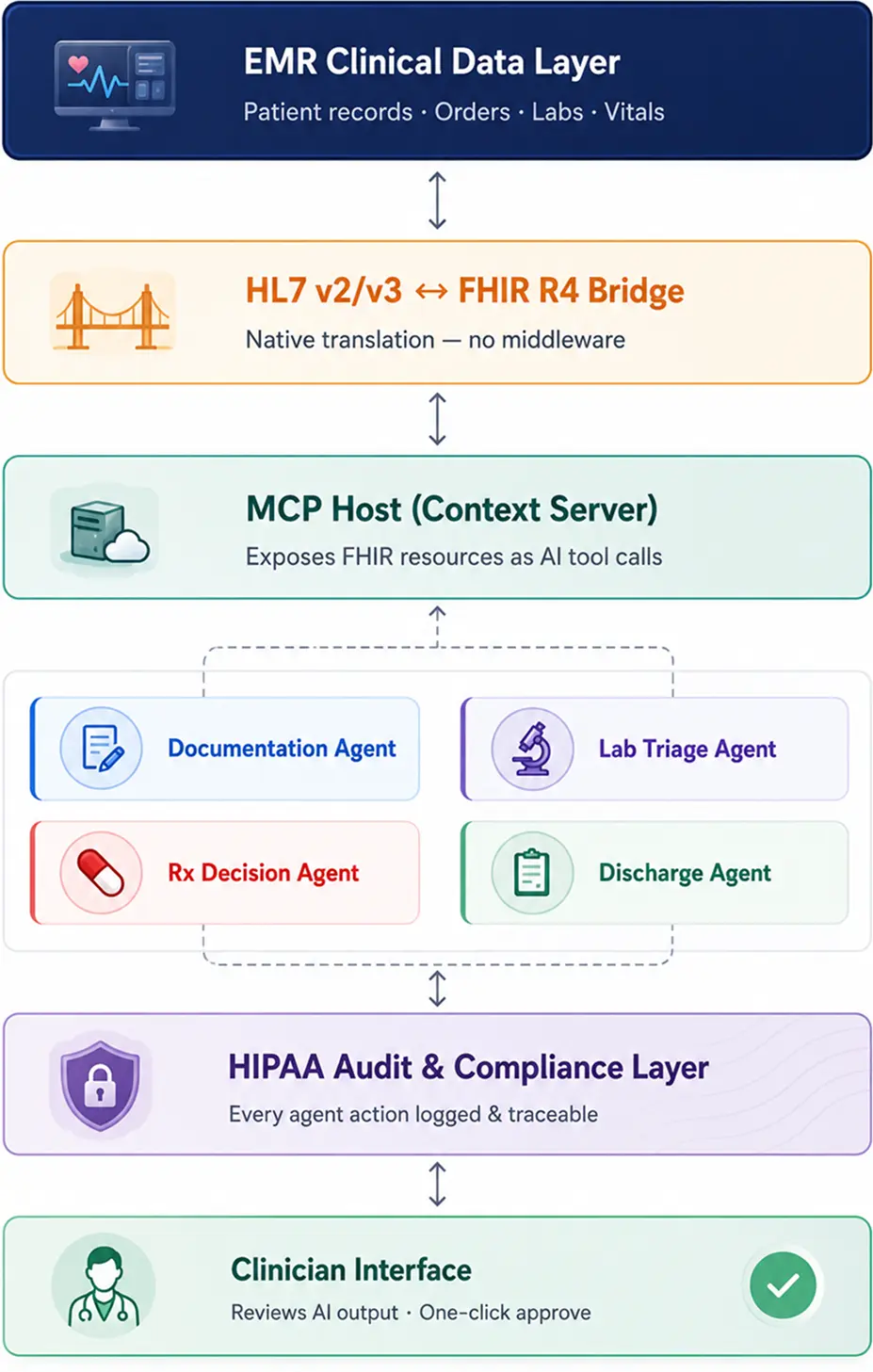
Auxiliobits designed and deployed an MCP (Model Context Protocol) Host that is natively fluent in both HL7 v2/v3 and FHIR R4—making it the first EMR in the industry capable of exposing its entire clinical data graph to AI agents as first-class, structured context without middleware translation layers.

Rather than wrapping existing APIs, the MCP Host was embedded at the data layer of the EMR, enabling AI agents to query FHIR resources, receive HL7 ADT event feeds, and orchestrate multi-step clinical workflows autonomously—all within a HIPAA-compliant, audited execution environment powered by Auxiliobits’ AuxiBot™ platform.

Implementation followed a phased 14-week roadmap: MCP core architecture (weeks 1–3), FHIR R4 resource mapping & HL7 bridge (weeks 4–8), agentic workflow deployment (weeks 9–12), and clinician rollout & change management (weeks 13–14).

Technologies Deployed

MCP Host (Anthropic Protocol)
FHIR R4 HL7 v2/v3
Azure Healthcare APIs
LLM Orchestration Layer
Intelligent Document Processing
AuxiBotTM Agentic Engine
UiPath RPA
HIPAA Audit Trail Engine

Key Workflows Automated

1. AI-native patient context assembly

Core automation engine executing all SAP bot interactions and orchestrating the end- to-end MLC workflow

2. Real-time HL7 ADT event processing
Primary ERP system – transaction codes CRMF, CKMIQ, CKMLCP, MMRV, SE16N, SM37 automated end-to-end
3. Ambient clinical documentation
Attended and unattended robot fleet for cross-system data entry, process routing, and field population in MediaOcean Prisma and Maconomy ERP
4. Autonomous lab result triage
Pre-requisite check source for costing data validation and cross-team status coordination
5. Discharge summary generation
Batch job monitoring for SAPRCM23 costing release jobs across all EMEA plants prior to MLC execution

MCP Architecture — Data Flow

Implementation

14-WEEK IMPLEMENTATION ROADMAP

Week 1–4
MCP Core Architecture
Weeks 5-8
FHIR R4 + HL7 Bridge
Week 9-12
Agentic Workflows Live
Week 13-14
Clinician Rollout

The organization’s long-term goal was to evolve its SSC into a Global Business Services (GBS) model — a centralized, standardized, and scalable operational engine.
But without automation:

From Legacy EMR to Al-Native Platform - How It Happened

DISCOVERY & AUDIT

HL7 message mapping, FHIR gap analysis, agentic opportunity scoring across 40 clinical workflows

MCP HOST BUILD

Native FHIR R4 resource server + HL7 v2 bridge embedded at EMR data layer-zero middleware

AGENT DEPLOYMENT

5 clinical Al agents deployed: documentation, triage, coding, prescribing support, discharge

GO-LIVE & SCALE

Phased rollout across 6 pilot hospitals→ full 50-hospital network within 90 days

The Results

Measurable Impact Across Every Clinical Touchpoint

73%

Reduction in clinician documentation time - from 3.2h to under 52 min per shift

$340 K

Annual cost reduction from eliminated manual processes and reduced re- admission admin

90Sec

Average critical lab result routing time - down from 40+ minutes

98.6%

FHIR/HL7 data accuracy rate at ingestion - audit vulnerabilities eliminated

4.1X

Audit trail completeness - every step logged, every exception ticketed, every notification timestamped automatically

fd

fd

Operational & Strategic Outcomes

When Your EMR Drowns Clinicians, Instead of Empowering Them

With 5 autonomous AI agents now orchestrated through the MCP Host, clinicians at all 50+ partner hospitals have shifted from data entry operators to care decision-makers. The documentation agent alone recaptured 6000-7000+ clinician hours annually—hours redirected to direct patient care.

The FHIR-native architecture enabled the EMR to pass NCQA and ONC certification audits with zero remediation items—a first for the platform. Regulatory confidence unlocked three new health system contracts worth $2.1M in ARR within the first six months post-launch.

Scalability was built in by design: the MCP Host’s tool-call interface allows any new AI capability—imaging AI, genomics agents, or population health models—to be connected without re-engineering the EMR data layer, future-proofing the platform for the next decade of clinical AI. 

The moment our MCP Host went live, every AI tool we had—and every AI tool we’ll ever build—suddenly had full, real-time access to the entire patient context. Auxiliobits didn’t just integrate AI into our EMR. They made our EMR the first truly AI-native clinical platform in our space.
– -VP of Product, Leading Healthcare EMR

Key Takeaways

Healthcare AI cannot be an add-on. For AI agents to deliver clinical value, they must be native to the data model—which means the EMR itself must become an MCP. Host that speaks HL7 and FHIR as first-class languages, not translated afterthoughts.

The Model Context Protocol (MCP) is the missing interoperability layer for healthcare AI. By exposing FHIR resources as agent tool calls, a single architecture unifies documentation, triage, coding, and prescribing—eliminating the integration tax that kills most clinical AI deployments.

AI-nativeness is a competitive moat. EMR platforms that become MCP Hosts can onboard any future AI model—clinical, genomic, imaging—without re-engineering their data layer, creating a platform advantage that compounds with every new AI capability the industry produces.

Ready to Transform Your
Close?

Let’s assess your finance automation opportunity. Whether you’re running SAP, Oracle, or a hybrid ERP environment across multiple entities, our team will map your month-end close workflow and identify where intelligent automation delivers the fastest ROI.