







Key Takeaways
- Lean Six Sigma projects often stall due to slow data collection, static analysis, and resistance on the ground.
- Agentic AI streamlines these pain points with continuous monitoring, automated measurement, and decision support.
- DMAIC still applies, but looks different—especially in Measure, Analyze, and Control.
- Culture, governance, and data quality matter just as much as algorithms.
- The role of process leaders is evolving into a hybrid of Six Sigma rigor, AI literacy, and change leadership.
Lean Six Sigma (LSS) has been the corporate workhorse of process improvement for decades. It promised precision, data-backed decisions, and efficiency gains that could be measured down to the decimal. But anyone who has actually run these projects knows the gap between theory and practice. Whiteboards get filled, workshops drag on, teams wrestle with half-clean data, and the “analysis” stage often turns into an endless reconciliation exercise.
Meanwhile, businesses don’t stand still. Customer expectations shift daily, supply chains bend under pressure, and service operations constantly deal with exceptions. Traditional Six Sigma tools were never designed for such fluid environments. That’s where Agentic AI is starting to change the game—not just another shiny dashboard, but intelligent agents that gather data, surface anomalies, and sometimes take small corrective actions on their own.
The obvious question is: Does this strengthen Lean Six Sigma or undermine it? We’d argue it does both, depending on how it’s used.
Also read: Comparing VoiceFlow, Twilio, and Custom GPT Architectures for Voice Agents
Where Lean Six Sigma Breaks Down in Practice
On paper, the DMAIC cycle is flawless. In the real world, it gets messy.
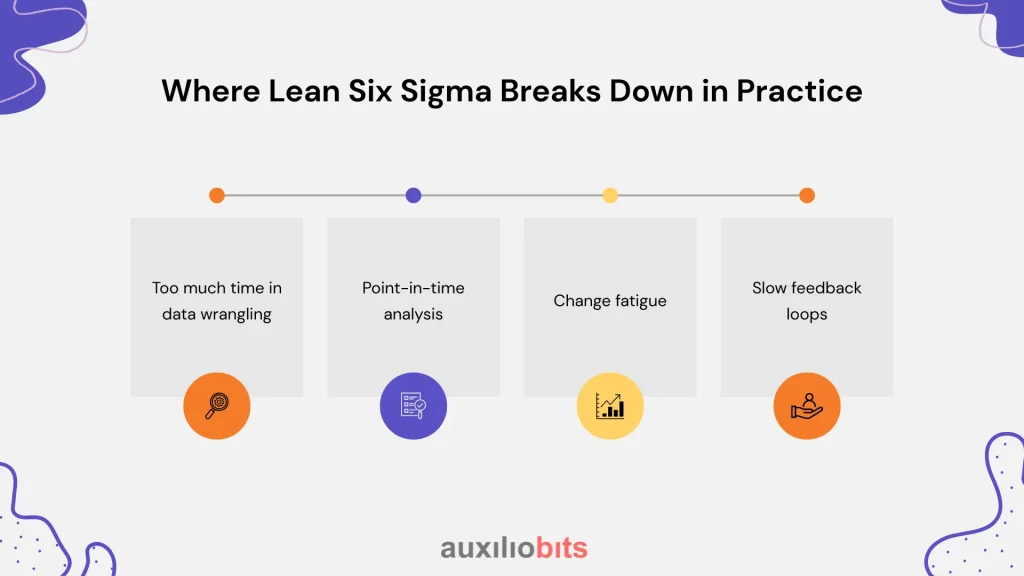
Too much time in data wrangling
Teams spend weeks (sometimes months) pulling data from ERPs, CRMs, and Excel dumps just to get to a baseline. By the time charts are ready, the process has already shifted.
Point-in-time analysis
Control charts and Pareto diagrams are still valuable, but they freeze a process in time. Businesses rarely behave so politely.
Change fatigue
Frontline workers often feel these initiatives are “done to them,” which explains why gains frequently fade after the initial project.
Slow feedback loops
Sustaining improvements requires vigilance. Manual audits are too infrequent to catch deviations quickly.
LSS still works well in controlled environments like manufacturing lines. But in areas like banking operations, logistics, or digital service flows—where inputs and conditions are in constant flux—it can feel like running after a moving train.
What Agentic AI Brings to the Table
Agentic AI isn’t a dashboard or a static bot. Think of it as a tireless junior engineer: monitoring, nudging, and escalating when things drift out of tolerance.
- Data without the drudgery—Instead of people stitching together logs from multiple systems, AI agents continuously capture and structure data in the background.
- Early warnings—Rather than waiting for the next project review, supervisors can be alerted in real time if a metric starts drifting.
- Safe-to-fail experiments—In call centers, for instance, agents can quietly test new routing rules on a subset of calls and report back results without disrupting operations.
- Decision framing—Not everyone wants more data. Good agents present options ranked by impact, complete with confidence levels, so leaders can act quickly.
This doesn’t replace Six Sigma methodology—it shortens the cycle and removes friction. A project that used to take six months might now deliver meaningful results in six weeks.
Two Illustrations from the Field
1. Automotive Supplier
An auto parts manufacturer wanted to cut scrap rates. The old way involved engineers spending nights pulling MES data, running regressions, and holding reviews every quarter. With an agent layer added, machine settings, operator logs, and defect patterns were continuously tracked. The system even adjusted non-critical parameters like feeder speed within safe boundaries. Engineers still set the rules, but monitoring no longer depended on human vigilance. Scrap rates dropped 18% in four months—a pace the traditional DMAIC cycle never achieved
2. Banking Operations
A commercial bank ran endless Kaizen sessions to tackle loan processing delays. Everyone had theories, but the data was fragmented. Once agents began tracking workflow timestamps across systems, the culprit became obvious: “pending document reviews” piled up every Thursday afternoon because senior officers batch-approved only once a week. Instead of another six-week workshop, leaders simply changed review schedules. The “analysis paralysis” phase was replaced with one simple fix.
Why Agentic AI Won’t Save the Day on Its Own
There’s a danger in swinging the pendulum too far.
- Bad data = bad outcomes. Agents can’t compensate for sloppy system inputs. They’ll just scale the mistakes.
- Automation bias. Teams may start believing every AI recommendation is gospel, overlooking contextual nuances.
- Cultural inertia. Insights are useless if people refuse to change how they work.
- Compliance risks. In regulated industries, agents that take action without oversight could create serious headaches.
Lean Six Sigma always insisted on discipline. Without it, AI risks turning processes into isolated optimizations that look great locally but undermine end-to-end performance.
How DMAIC Morphs with AI in the Loop
DMAIC isn’t going away. But it doesn’t look the same when intelligent agents are watching every metric.
- Define—Instead of brainstorming problems in workshops, agents surface patterns and anomalies worth tackling. Humans still decide which ones matter strategically.
- Measure—Sampling is no longer an issue. Measurement is continuous and automated.
- Analyze—AI can crunch models faster than any Black Belt, but interpreting them requires human skepticism and contextual knowledge.
- Improve—Micro-experiments can be automated, but adoption still relies on change management.
- Control—Continuous monitoring is now the default, with automated nudges replacing quarterly audits
So yes, DMAIC holds. But it’s leaner, faster, and slightly more unpredictable.
When AI Helps and When It Doesn’t
It’s tempting to apply AI everywhere. That’s a mistake.
High-value use cases
- Cross-system workflows (e.g., supply chain, loan approvals).
- High-variability processes where conditions shift daily.
- Customer-facing environments where fast deviation response matters.
Low-value or risky cases
- Highly standardized, repetitive tasks are already automated with RPA.
- Small-scale processes where human observation suffices.
- Scenarios with heavy compliance restrictions.
Not every nail needs the AI hammer. The best leaders choose where complexity and scale justify the extra intelligence.
The Evolving Role of the Black Belt
Here’s where some Six Sigma traditionalists might bristle: the skillset is shifting.
- Statistics still matter, but less for running regressions and more for validating AI outputs.
- Change management is now central—technology adoption outpaces cultural adoption.
- AI literacy is non-negotiable. Future leaders will need to understand APIs, model drift, and even ethics.
The next generation of “Black Belts” may look more like “Agentic Process Leaders”—bridging technical, analytical, and cultural fluency.
Rethinking Process Excellence
Lean Six Sigma built its reputation on standardization: eliminate variation, lock in stability. But in a world of adaptive AI, variation can sometimes be useful.
Take a contact center. Traditionally, you’d want one routing rule for all. With sentiment analysis, agents can adapt call routing in real time—something impossible with static playbooks. Variation, in this context, isn’t waste. It’s responsiveness.
The challenge is ensuring that all these micro-adjustments add up to enterprise goals. Hyper-optimized silos without coordination only create new inefficiencies. Governance becomes as important as algorithms.
The Final Verdict
Agentic AI doesn’t erase Lean Six Sigma—it exposes where it struggles. It shows us that static charts and workshop-heavy projects aren’t fast enough for today’s complexity. At the same time, it also shows us why the LSS mindset—discipline, critical thinking, structured improvement—remains indispensable.
The organizations that win won’t abandon Six Sigma. They’ll use AI agents as accelerators, not replacements. The real danger isn’t that AI will make LSS obsolete, but that practitioners cling so tightly to rituals that they miss the augmentation staring them in the face.