





- Know your current maturity stage before investing in AI. Evaluating supplier risk management tools is only effective when you understand your organization’s existing capabilities and the gaps you need to close.
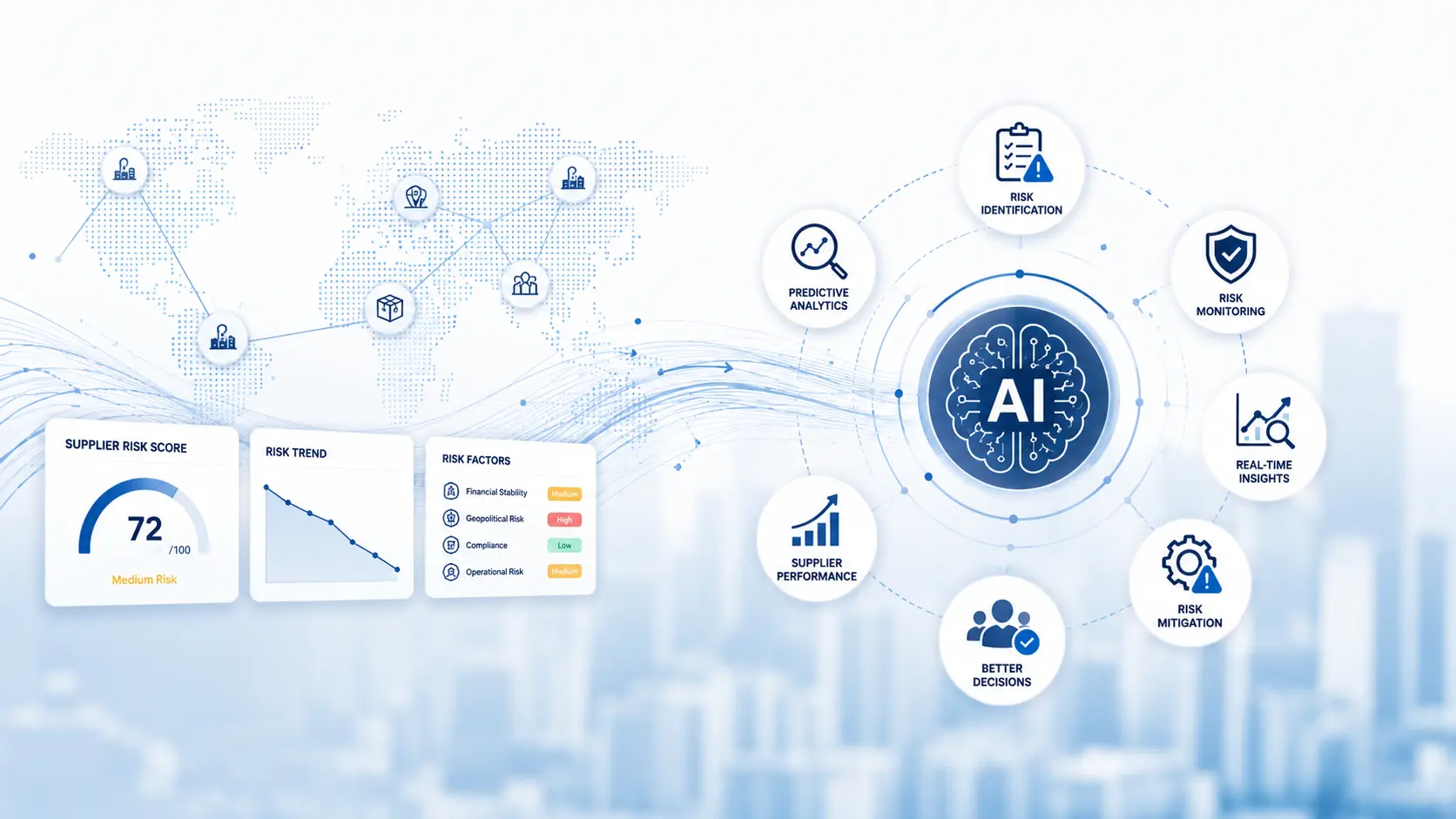
- Continuous monitoring delivers more value than periodic assessments. Annual supplier reviews leave businesses exposed to emerging risks, while AI-powered monitoring provides earlier visibility into potential disruptions.
- Explainable, category-based risk insights improve decision-making. Breaking supplier risk into financial, operational, compliance, cyber, and geopolitical factors enables faster and more informed responses.
- Technology alone doesn’t improve supplier risk management. Clear ownership, cross-functional collaboration, and well-defined supplier criticality tiers are essential for successful AI adoption.
- The business case for AI changes with your maturity level. Early-stage organizations benefit from disruption avoidance, while mature organizations gain value through faster response times, stronger governance, and audit-ready decision-making.
Every supplier risk AI vendor demo shows you the same thing: the most mature version of the process, running cleanly, on someone else’s data. That’s a reasonable thing for a demo to show. It’s a bad way to figure out where your organization actually stands and an even worse way to figure out what moving forward will ultimately require.
Most teams don’t lack ambition about supplier risk monitoring — they lack an honest read on their current stage, which means they evaluate tools against a destination instead of against the gap between where they are and where they’re trying to get. This piece is built to close that gap: four stages, what each one costs you when it’s stress-tested, and what changes operationally — not just technologically — at each transition.
The Four Stages of Supplier Risk Maturity
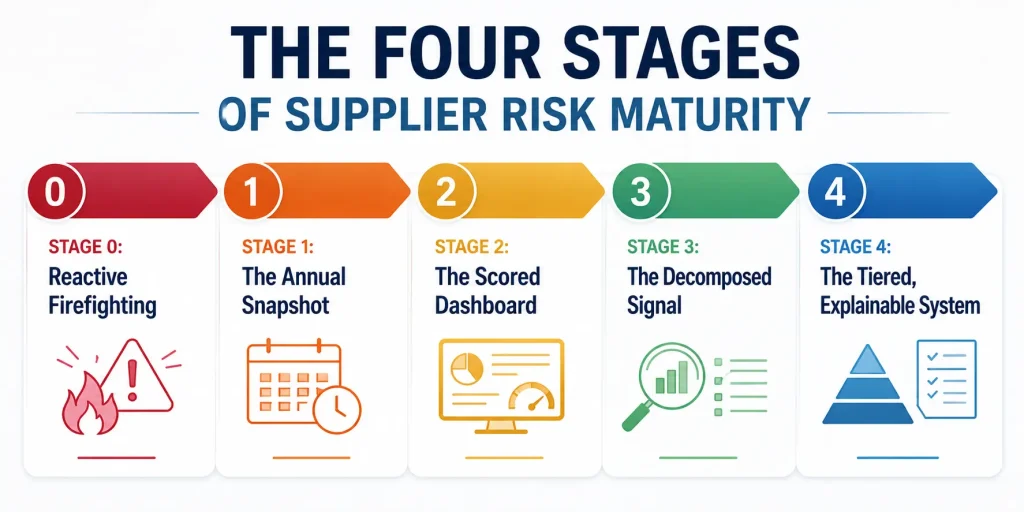
1. Stage 0: Reactive Firefighting
Reactive Firefighting There’s no formal monitoring. Supplier risk is discovered the way most things get discovered in this stage — after it’s already a problem, usually via a missed delivery, a frantic call from a plant manager, or a news headline someone happens to see. The organizing belief here is usually “our suppliers are stable enough that this issue hasn’t bitten us yet,” which is true right up until it isn’t. When stress-tested by an actual disruption, this stage has zero lead time — the first signal of risk is the disruption itself.
2. Stage 1: The Annual Snapshot
Risk gets assessed properly — financial checks, compliance review, sometimes a site visit — but only at onboarding and renewal. The belief here is that a thorough point-in-time review is “due diligence” and nothing more. It is due diligence; it’s just due diligence with an expiration date no one tracks. Stress-tested by a mid-cycle event (a credit downgrade, a labor dispute, or a regulatory action), this stage finds out about the change at the next scheduled review — which might be eleven months too late.
3. Stage 2: The Scored Dashboard
Now there’s automated, continuous monitoring — usually the first AI tool purchase in this space. A blended score updates regularly. The belief shifts to “we have AI monitoring now, this is solved.” It mostly isn’t, because the score is a single number compressing several different risk types, and the team using it often can’t tell a credit-risk-driven score change from a geopolitical one without manual digging. Stress-tested by an actual event, this stage gets the alert — often correctly — but burns hours figuring out what it means and what to do, because the system told them that something changed without explaining what.
4. Stage 3: The Decomposed Signal
The score breaks down into categories — financial, compliance, geopolitical, cyber, operational — and alerts are prioritized rather than dumped in bulk. The team can act on a signal without an investigation step first. The limiting belief here is usually “we’ve solved the noise problem”, which is true for alert volume but doesn’t address whether monitoring intensity matches supplier criticality. A sole-source component supplier and a backup office-supplies vendor are still getting watched at a similar depth. Stress-tested by a disruption at a critical supplier specifically, this stage performs well — the gap shows up in resourcing, where attention gets spread evenly across a supplier base that isn’t uniformly risky.
5. Stage 4: The Tiered, Explainable System
Monitoring depth scales with criticality and switching cost. Every score is explainable — the specific drivers and weightings behind it can be reconstructed after the fact, which matters as much for internal trust as for surviving an audit or board risk review. Risk ownership is assigned by category (compliance risk escalates to compliance, operational risk to sourcing) rather than generically landing on “procurement”. This step is the stage most vendor demos are implicitly selling you, but very few organizations are actually running it end to end — and getting there isn’t primarily a software purchase.
Where Are You, Honestly?
Skip the scoring grid. Answer these about your single highest-criticality supplier:
- If that supplier’s risk status changed today, would you know within a day — or only find out at the next scheduled review?
- If their score moved, could you say why in under five minutes, without pulling someone in for an investigation?
- Is that supplier monitored more closely than your lowest-risk vendor — or about the same?
- If you had to justify a sourcing decision to an auditor based on that supplier’s risk rating, could you show the underlying drivers, or just the number?
Four “no”s puts you at Stage 0–1. Two or three “yes”s, mostly around question 2, puts you at Stage 2. Strong on 1–3 but weak on 4 is classic Stage 3. All four “yes” is genuinely Stage 4 — and worth knowing, because the evaluation criteria that matter change completely from here.
What Moving Forward Actually Costs You to Skip
The financial case for AI supplier risk monitoring isn’t one number — it changes shape depending on which transition you’re making.
- Moving from Stage 0 or 1 to Stage 2 is fundamentally a disruption-cost-avoidance argument: continuous monitoring catches deterioration months before an annual review would, and the value is the cost of disruptions caught early enough to mitigate. This is the easiest case to build and the one most vendor ROI claims are implicitly making – but it depends on a counterfactual (what would have happened without the tool), so treat any specific percentage here with appropriate skepticism.
- Moving from Stage 2 to Stage 3 is mostly a labor and decision-quality argument, not a disruption-avoidance one. The value shows up as analyst hours no longer spent manually deciphering what drove a score change and as faster, more confident responses because the team trusts the signal instead of second-guessing it. If your current ROI pitch for “more AI” is still framed around disruption avoidance at this stage, it’s reusing the Stage 0→2 argument for a transition that doesn’t actually deliver that kind of value anymore – the disruption-catching capability already exists; what’s improving is response speed and team trust in the tool.
- Moving from Stage 3 to Stage 4 is primarily a risk-defensibility argument: the value is being able to show, after the fact, exactly why a sourcing decision was made — which matters disproportionately in regulated industries, during M&A due diligence, or after a disruption when leadership asks “did we know about this?” It’s harder to put a clean dollar figure on, but it’s often the difference between a defensible decision and an expensive after-the-fact reconstruction project.
Knowing which transition you’re actually financing changes what you should ask a vendor to prove in a business case — and should make you suspicious of any single ROI number applied uniformly regardless of your starting stage.
What Has to Change Beyond the Software
Tooling alone won’t move you to the next stage. Each transition has a non-software requirement that gets skipped more often than it should:
- 0→1 or 1→2 requires someone to own ongoing monitoring as a job function, not just a one-time onboarding task — otherwise the new tool’s alerts go to the same inbox the annual review used to and get treated with the same urgency (low).
- 2→3 requires risk categories to actually be assigned to the teams positioned to act on them. A decomposed score is only useful if compliance risk routes to compliance and operational risk routes to sourcing—if everything still lands on one generalist procurement inbox, decomposition doesn’t change response times.
- 3→4 requires monitoring intensity to be explicitly tied to a supplier criticality tier that’s been deliberately defined and agreed on — usually requiring sourcing, finance, and risk/compliance to align on what “critical” means, which is a cross-functional exercise, not a configuration setting.
What to Ask a Vendor, Based on Your Stage
If you’re at stages 0–1, the priority question is monitoring frequency and breadth: how often does data refresh, and across how many suppliers can it run without requiring manual setup per vendor?
If you’re at Stage 2, the priority is decomposability: can you see the category breakdown behind any score, and how is that broken down for an alert your team receives mid-incident – not just in a sales demo?
If you’re at Stage 3, the priority is tiering and explainability: can monitoring intensity be configured per supplier tier, and can every score’s specific drivers be reconstructed after the fact for an audit?
If you’re genuinely at Stage 4 already, most off-the-shelf platforms won’t move you further — the gap is more likely in cross-functional risk ownership than in the tool itself, and the right next conversation may not be with a vendor at all.
Where This Leaves You
The honest version of “should we invest in supplier risk management AI?” isn’t yes or no — it’s “what stage are we at, and what does the next one require?” Run the four questions above against your highest-criticality supplier before your next vendor call, and bring the transition you’re trying to make – not a generic feature checklist – into that conversation.