







Key Takeaways
- Whisper AI minimizes manual data entry, enabling efficient EHR documentation and improving clinical workflows with hands-free automation.
- The model ensures precise speech-to-text conversion, recognizing medical terminologies and maintaining session context for personalized interactions.
- Whisper AI integrates with Azure AI, Assistant APIs, and LLMs, allowing quick and effective medical data retrieval, prescription generation, and scheduling.
- By reducing screen time and administrative workload, physicians can focus more on patient interactions, leading to better healthcare outcomes.
- Parallel execution, function calling, and AI-driven thread management accelerate workflow processing, reducing delays and ensuring real-time data access and decision-making.
Whisper AI, an open-source automatic speech recognition and speech-to-text model developed by OpenAI, is a reliable solution for the hands-free automation of EHR procedures. Released in 2022, it provides multilingual transcription and live voice-to-text translation, making it the ideal solution for healthcare practitioners. Released under the MIT license, Whisper AI is a cost-effective alternative to commercial APIs that automates patient documentation, data entry, and scheduling with seamless voice commands.
Key Features of Whisper AI
Below are the points highlighting some of the key features of the whisper model:
- Employs a transformer-based encoder-decoder framework to process 30-second audio clips.
- Translates over 100 languages, including direct English translation from other languages.
- It was trained on a dataset of 680k hours of diverse audio and is robust to noise, accents, and domain-specific terminology.
- Provides various model sizes (Tiny to Large) to distinguish between performance and accuracy.
Implementation Steps for Voice-Driven Automation Using Whisper AI
Hands-free automation using Whisper AI is an innovative and voice-enabled solution to EHR workflow optimization. Using the power of automatic speech recognition (ASR) and contextual awareness, Whisper AI improves documentation accuracy and decreases administrative burden.
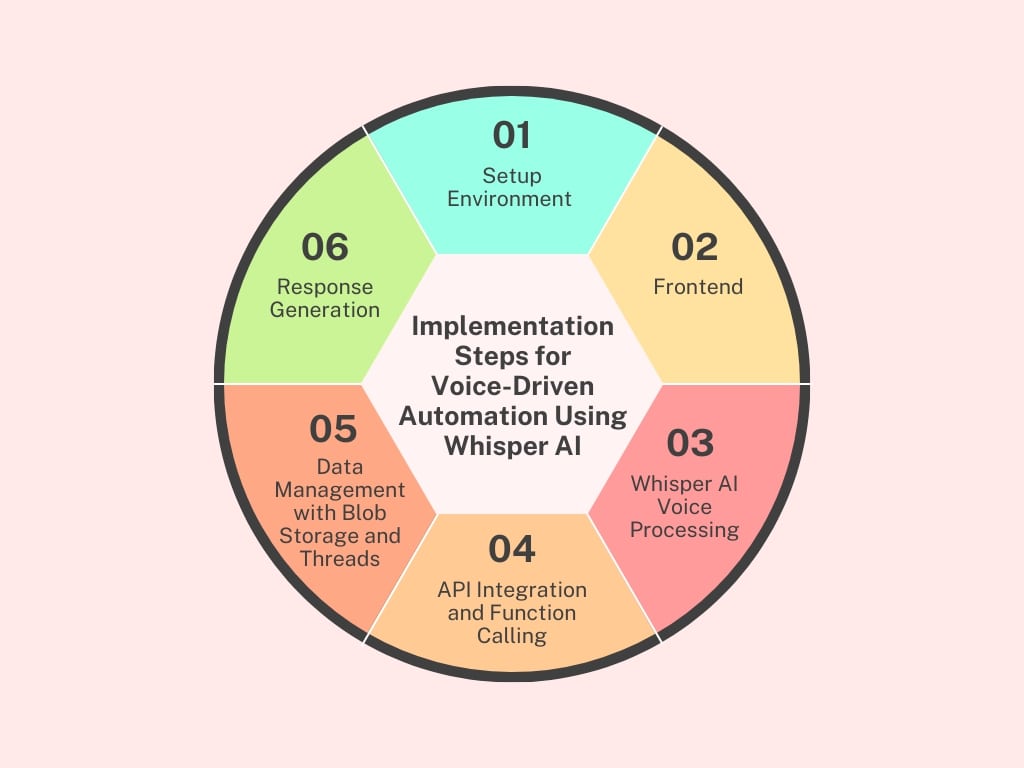
1. Setup Environment
Develop a cloud setup using the Azure AI Layer.
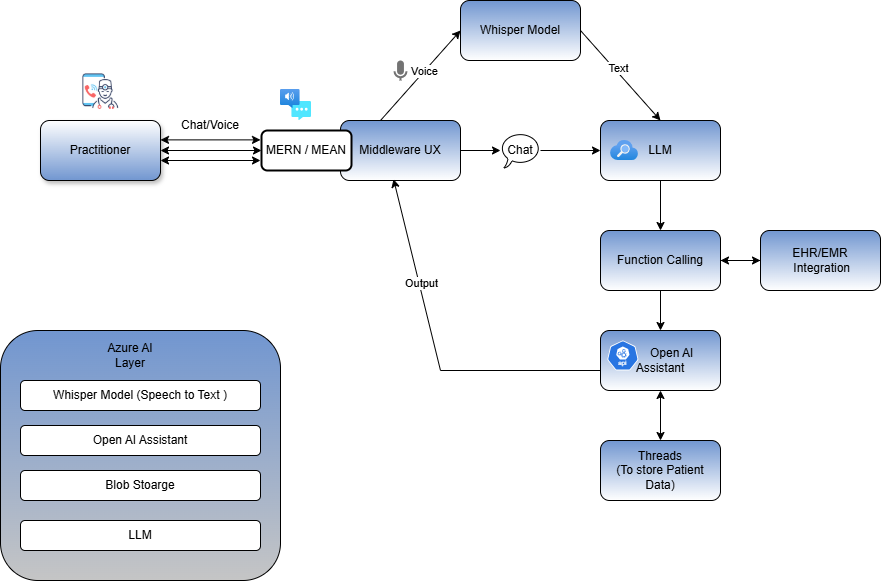
The required services used :
- Whisper Model (for Speech-to-Text)
- Assistant APIs
- Blob Storage
- LLM (Large Language Model)
2. Frontend
- Apply the Middleware UX (MERN/MEAN) layer to process Voice and Chat interactions.
- An effortless interaction is enabled between the practitioner and the system.
3. Whisper AI Voice Processing
- Record the Voice Input from the practitioner through the front end.
- Route the voice data through the Azure AI Layer to the Whisper Model.
- Convert Speech to Text with Whisper.
4. API Integration and Function Calling
- Set up the LLM to identify intents that necessitate calls to external APIs.
- Perform suitable operations using the Assistant API.
- APIs include medical records retrieval, diagnostic recommendations, protocol addition, and prescription generation.
5. Data Management with Blob Storage and Threads
- Store voice data or transcripts in Azure Blob Storage.
- Ensure data privacy and compliance (e.g., HIPAA for health information).
- Use Threads to process patient-specific information, maintaining session context to show accurate and personalized interaction.
6. Response Generation
- Assistant API automatically generates a complete summary of all the changes made during the session.
- The response is fed back to the Middleware UX through webhooks.
- The result is presented to the practitioner through the front-end interface.
- Service Worker Background Execution: Supports asynchronous execution in which backgrounding long-running tasks can be executed in the background while the front end is kept open for servicing new requests.
Assistant API & Thread Management
Whisper AI, Assistant API, and Thread Management simplify EHR workflows by automating scheduling and reminders using a single API call. Thread Management contextualizes outputs with patient context, and Function Calling interprets users’ intent. Parallel Execution further optimizes it by executing tasks in parallel, eliminating wait times, and enhancing the EHR experience.
Single Run Start in OpenAI Assistant API
This feature of the API provides the serial execution of automated tasks in a single API call. It does away with multiple sequential API calls:
- Automatically initiates a conversation thread when invoked.
- Maintains context and metadata during a session.
- Associates metadata (e.g., PatientID) for efficient data retrieval.
- It supports function calling and parallel execution for quicker processing.
- Offers inherent error handling and logging
Benefits
Following are some of the benefits of using Whisper AI:
- Hands-Free Functionality: It allows physicians and clinical personnel to view records, schedule appointments, and access information through voice commands, thus minimizing manual labor.
- Time Efficiency: It also accelerates office and data entry processes, freeing the end-users to spend more time on patient care.
- Improved Accuracy: Whisper AI’s advanced speech-to-text facility ensures accurate medical terminology and instructions.
- Increased Patient Interaction: It decreases screen time, allowing patients and physicians to have more effective interactions.
- Context Awareness: With call-to-function and thread control, it can access session context and provide accurate, personalized responses.
Common Use Cases
Considering the usefulness of this model, it has many other applications as well, including:
- Transcribing meetings, podcasts, or audio recordings.
- Creating captions for videos or translating foreign content
- Voice assistants development and NLP research investment.
Conclusion
Whisper AI voice automation automates accurate documentation hands-free to maximize EHR workflow. Whisper AI unites speech-to-text, more intelligent processing, and context understanding to reduce administrative burdens, improve information management speed, and provide instant decisions. An embedded solution maximizes operational efficiency and patient care quality.