






Key Takeaways
- Smart Portals are redefining healthcare efficiency by integrating RPA, LLMs, and EMR access into a unified, intelligent provider interface that automates workflows and improves care delivery.
- Robotic Process Automation (RPA) significantly reduces administrative overhead by automating repetitive tasks, such as data entry, claims submission, and appointment management, thereby freeing up clinical staff to focus on patient care.
- Large Language Models (LLMs) transform how providers interact with data, summarizing patient records, generating communications, and supporting clinical decisions through intelligent data synthesis.
- API integration is the backbone of Smart Portals, enabling seamless data exchange across EMRs, billing systems, and telehealth tools, solving the interoperability challenge that has long plagued healthcare IT.
- The adoption of Smart Portals leads to measurable outcomes: improved care quality, reduced errors, increased staff satisfaction, operational cost savings, and a better experience for both providers and patients.
The healthcare industry is rapidly evolving, with providers continually seeking innovative ways to enhance efficiency, reduce administrative burdens, and ultimately improve patient care. Enter “Smart Portals”—a “game-changer” explicitly designed for healthcare providers. These aren’t just your average patient portals; they’re intelligent hubs that seamlessly integrate cutting-edge technologies, such as Robotic Process Automation (RPA), Large Language Models (LLMs), and crucial Electronic Medical Record (EMR) access, all powered by robust API Integration.
Also read: The Role of Large Language Models (LLMs) in Agentic Process Automation
The Challenge: A Mountain of Manual Tasks and Disjointed Systems
Imagine a typical day for a healthcare provider. It often involves a daunting workload of repetitive, administrative tasks. From manually updating patient demographics in multiple systems and painstakingly scheduling appointments to meticulously managing insurance claims and retrieving fragmented patient histories from various sources, these manual processes devour valuable time that could be spent directly on patient care.
This not only contributes to physician burnout and staff fatigue but also significantly increases the risk of human error, leading to costly mistakes and slowing down critical workflows. Furthermore, the fragmented nature of healthcare IT, with different departments often using disparate software systems that don’t communicate effectively, creates silos of information and a constant need for manual data reconciliation. This lack of seamless connectivity hinders efficiency and impacts the overall quality of care.
The Solution: Smart Portals at Your Fingertips—A Unified, Intelligent Hub
Innovative Portals addresses these pervasive challenges head-on by creating a centralized, intuitive, and intelligent platform for providers. They act as a single pane of glass, bringing together diverse functionalities and information into one cohesive interface. Here’s how the key technologies work in concert to achieve this transformation:
1. API Integration: The Seamless Connector and Foundation of Interoperability
At the very core of any truly effective Smart Portal is powerful API Integration. APIs (Application Programming Interfaces) are digital bridges that enable different software applications and systems to communicate and exchange data seamlessly and securely. In the complex world of healthcare, this means:
Connecting EMRs Across Vendors:
Securely accessing and sharing vital patient data from various Electronic Medical Record (EMR) systems, regardless of the vendor or specific platform. This is a monumental step toward true interoperability, ensuring providers have a comprehensive and holistic view of a patient’s history—from past diagnoses and lab results to current medications, allergies, and previous treatment plans—all without having to log into multiple systems.
Integrating with External Healthcare Systems:
Linking with other critical external platforms and services, such as specialized billing systems, sophisticated e-prescribing services, advanced scheduling and resource management tools, remote patient monitoring devices, and even telehealth platforms. This eliminates the need for redundant manual data entry across disparate systems, significantly saving time, reducing administrative overhead, and minimizing the potential for transcription errors.
Facilitating instant updates and bidirectional communication between all connected systems. This ensures that providers always have access to the most current and accurate patient information, enabling quicker, more informed decision-making and a higher quality of care. For example, a new lab result is instantly available to the physician, or a medication change is immediately reflected across all relevant systems.
Why is API Integration the linchpin? It’s the foundational technology that unlocks the full potential of Smart Portals. Without robust API integration, other powerful technologies, such as RPA and LLMs, would operate in isolation, unable to access the critical data they need to function effectively. It ensures that all the disparate pieces of a healthcare organization’s digital ecosystem can work together harmoniously, creating a unified, efficient, and intelligent workflow that was previously unattainable.
2. Robotic Process Automation (RPA): Your Dedicated Digital Assistant
RPA utilizes “software robots” or “bots” to automate repetitive, high-volume, rule-based tasks that healthcare staff typically handle manually. In the context of a Smart Portal, RPA becomes an invaluable digital assistant, significantly boosting operational efficiency:
RPA bots can swiftly and accurately transfer patient information from various intake forms, online registrations, or external referrals directly into EMRs. They can also seamlessly update insurance details, demographic changes, or contact information across all relevant systems, virtually eliminating manual transcription errors.
RPA can automatically check provider availability across multiple calendars, send personalized appointment reminders via preferred channels (such as SMS or email), confirm appointments, and even manage complex rescheduling requests, thereby drastically reducing no-show rates and optimizing clinic schedules.
Bots can automate the submission of insurance claims, track their status, reconcile payments, and identify discrepancies, thereby significantly reducing administrative time for billing departments and enhancing cash flow for the practice. They can also assist with prior authorization processes, a notoriously time-consuming task.
RPA can compile data from diverse sources within the EMR and other integrated systems to create comprehensive reports for administrative purposes, compliance audits, quality improvement initiatives, or even financial analysis, all at a fraction of the time it would take manually.
By intelligently offloading these monotonous, time-consuming, and error-prone tasks to RPA bots, healthcare providers and their support staff are freed to focus on higher-value activities, such as direct patient interaction, complex problem-solving, and providing compassionate care. This leads to significantly increased productivity, reduced operational costs, and a substantial decrease in staff burnout.
3. Large Language Models (LLMs): Intelligent Insights and Enhanced Communication
Large Language Models, like the advanced AI technologies powering sophisticated chatbots and content generation tools, bring an unprecedented level of intelligence and efficiency to Smart Portals:
LLMs possess the remarkable ability to rapidly process and sift through vast amounts of unstructured EMR data, including lengthy clinical notes, discharge summaries, pathology reports, and historical treatment plans. They can then synthesize this information, summarizing complex patient histories, identifying key diagnostic findings, and highlighting critical details into concise, easy-to-understand formats. This saves providers a significant amount of time during chart review, enabling them to grasp the patient’s complete clinical picture quickly.
Drafting and Personalizing Communications:
LLMs can significantly assist with drafting routine patient communications, follow-up instructions, referral letters to specialists, or even personalized discharge instructions. They ensure clarity, accuracy, and adherence to established medical guidelines while also tailoring their approach to meet the specific needs and preferences of each patient. This streamlines communication workflows and enhances patient understanding.
Intelligent chatbots powered by LLMs can effectively handle frequently asked patient questions, routing them to relevant information within the portal or the EMR, or escalating more complex queries to human staff when necessary. For providers, LLMs can act as intelligent search engines, quickly retrieving specific medical guidelines, drug interactions, or research articles based on natural language queries.
While still evolving and always requiring human oversight, LLMs hold immense promise in aiding clinical decision-making. By analyzing vast medical literature, clinical guidelines, and specific patient data, they could offer insights into possible diagnoses, suggest relevant treatment options, flag potential drug interactions, or even predict patient risks, all as a supportive tool for the human provider. This transforms the portal into an intelligent assistant that enhances clinical acumen.
The Transformative Benefits for Healthcare Providers
The holistic integration of API Integration, RPA, and LLMs within Smart Portals offers a profound and multifaceted transformation for healthcare providers:
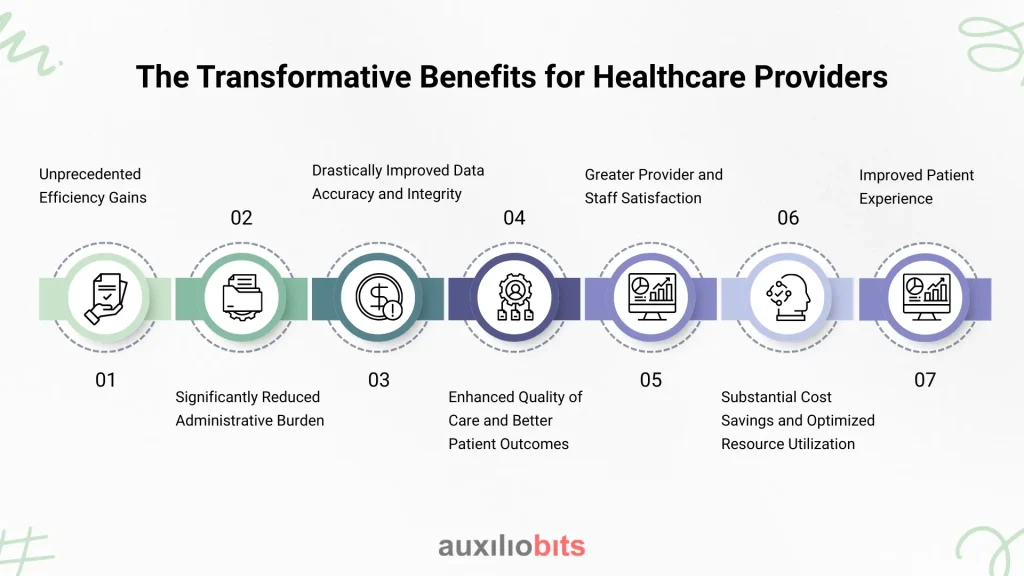
Unprecedented Efficiency Gains:
Automating manual tasks, providing instant access to comprehensive information, and intelligent data processing drastically improve operational workflows across the entire practice or hospital system.
Significantly Reduced Administrative Burden:
Freeing up invaluable time for providers and their staff, allowing them to shift their focus from laborious paperwork and data entry to direct, compassionate, and patient-centric care.
Drastically Improved Data Accuracy and Integrity:
Minimizing the risk of human error through automated data transfer, intelligent validation, and consistent information across all integrated systems.
Enhanced Quality of Care and Better Patient Outcomes:
Enabling providers to make more informed, timely, and precise decisions with access to comprehensive, real-time patient data and intelligent insights.
Reducing the daily grind of repetitive tasks and allowing healthcare professionals to engage in more stimulating and fulfilling aspects of their work, leading to decreased burnout and improved morale.
Substantial Cost Savings and Optimized Resource Utilization:
Streamlining processes, reducing the need for extensive manual labor, minimizing errors, and optimizing resource allocation all contribute to significant operational cost reductions.
While primarily provider-focused, the efficiencies gained indirectly benefit patients through faster appointments, more accurate billing, and more personalized care.
The Future of Healthcare is Smart and Connected
Smart Portals, with their potent blend of API Integration, RPA, and LLMs, are not merely a technological advancement; they represent a fundamental paradigm shift in how healthcare is delivered and managed. By empowering providers with intelligent, interconnected tools that simplify complex tasks, provide instant access to critical information, and automate mundane processes, these portals are paving the way for a more efficient, accurate, accessible, and ultimately, more human-centered healthcare system. The future of healthcare is becoming increasingly intelligent, interconnected, and focused on what truly matters: the patient.