





Key Takeaways
- Shared services transformation requires process, technology, and governance to evolve together.
- Choose the operating model that best fits your scale, risk, and business goals.
- Standardize processes before automating to maximize long-term value.
- Measure success with business outcomes, not just centralization metrics.
- Strong governance and change management are essential for sustained transformation success.
Most finance leaders don’t need convincing that shared services transformation belongs on the roadmap. What’s harder to find is a clear-eyed account of why some programs land a 15% cost saving and quietly plateau, while others use the same starting point to cut close time by a third and reshape the finance function’s role in the business. The difference rarely comes down to budget or technology choice. The key factors are sequencing, governance, and a handful of decisions made in the first 90 days.
This piece is built around the operating model choices, the proprietary maturity framework we use to diagnose readiness, and a composite case study drawn from patterns we’ve seen across multi-entity finance transformations — so you can benchmark your plan against what actually separates the two outcomes above.
What “Transformation” Actually Means Here
It’s worth being precise, because the term gets used loosely. A shared services transformation is different from a shared services setup. Setup is about consolidating headcount and standardizing a few workflows. Transformation is a structural redesign of how finance work gets done — spanning process, technology, governance, and talent — with the explicit goal of shifting the function from a cost center that processes transactions to a value center that enables decisions.
In practice, that means three things are usually happening at once:
- Process redesign, not just relocation. Moving a broken process to a shared services hub just makes the broken process cheaper to run — it doesn’t fix it.
- Technology-led automation, where RPA, intelligent workflow, and AI-assisted reconciliation absorb the repetitive volume that used to justify large headcount.
- Governance and service design, including SLAs, escalation paths, and a genuine customer-service mindset toward the business units the center supports.
Organizations that treat these as three separate workstreams tend to underdeliver. The ones that succeed treat them as one integrated program.
Why This Is Accelerating Now
A few forces are converging that make this the right window to evaluate a shared services transformation:
- Talent economics have shifted. Retaining skilled finance talent for manual, repetitive work is increasingly difficult and expensive. Automating the routine work frees people for higher-value analysis — which also helps retention.
- AI has matured past the pilot stage for finance-specific use cases like invoice matching, journal entry validation, and anomaly detection in close processes – making automation-heavy shared services models far more achievable than they were three or four years ago.
- Boards are asking for faster, cleaner data. A fragmented finance operating model makes real-time reporting nearly impossible. Consolidation through shared services is often the fastest route to a single source of truth.
- M&A and multi-entity complexity keep growing. Every additional entity, ERP instance, or regional finance team multiplies the cost of not having a shared, standardized operating model.
The Three Models You’re Likely Choosing Between
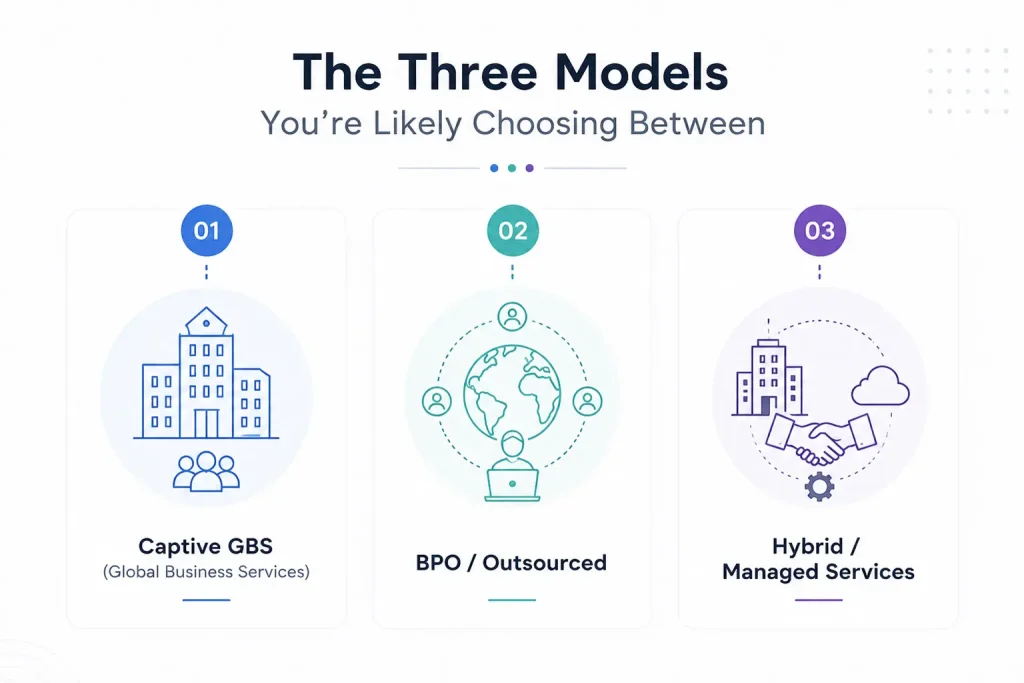
Most finance leaders end up evaluating some version of these three approaches. None is inherently the “best” — the right fit depends on your scale, geographic footprint, and risk appetite.
| Model | What It Looks Like | Best Fit When | Watch-Outs |
| Captive GBS (Global Business Services) | Company-owned center, often multi-function (finance, HR, IT), built and staffed internally | You have scale, want full control over IP and process, and plan to keep evolving the model long-term | High upfront investment; slower to stand up; requires internal change management muscle |
| BPO / Outsourced | Third-party provider runs defined finance processes under contract | You need speed, want to convert fixed cost to variable cost, or lack internal bandwidth to run a transformation | Less control over process evolution; vendor lock-in risk; SLA quality varies significantly by provider |
| Hybrid / Managed Services | Mix of retained strategic work in-house with select processes outsourced or co-sourced, often layered with automation platforms | You want to move faster than a captive build but retain control of judgment-heavy or sensitive processes | Requires clear governance to avoid duplicated effort or unclear ownership between internal and external teams |
A useful framing for your evaluation: which processes are truly transactional (accounts payable, expense processing, and basic reconciliations) versus which require institutional judgment (technical accounting positions, complex forecasting, and board reporting)? The former is almost always a strong candidate for centralization and automation. The latter usually stays close to the business, even in a mature shared services model.
The Maturity Framework: Five Levers That Separate Stalled Programs From Compounding Ones
Five levers consistently appear across the programs that continue to deliver value years after go-live, rather than plateauing after the initial wave of headcount savings. We use this as a diagnostic framework with finance leaders early in their evaluation, scoring each lever from ‘Ad Hoc to Optimized before a model decision is made.
1. Lever 1: Process standardization before automation
Automating an inconsistent process at scale just multiplies the inconsistency. The highest-return sequencing is: standardize, simplify, then automate. Skipping straight to automation is one of the most common reasons transformation timelines slip — in programs we’ve reviewed post-mortem, it’s the single most frequently cited root cause of missed year-one savings targets.
Lever 2: A technology stack built for orchestration, not just execution
Point-solution automation (a bot here, a script there) creates a maintenance burden that eventually offsets the labor savings. Mature shared services operating models invest in an orchestration layer — a system that routes, tracks, and reports on work across humans and bots — so the center scales without linearly scaling headcount.
Lever 3: Governance with real teeth
SLAs, KPIs, and escalation paths only work if someone owns them. The centers that sustain performance have a named service owner accountable for both cost and business-unit satisfaction — not just a transactional throughput metric.
Lever 4: A deliberate talent strategy
Shared services transformation changes what “success” looks like for the people inside the function. Roles shift from processing to exception-handling, analysis, and continuous improvement. Programs that ignore these factors — and simply expect existing staff to absorb new responsibilities without reskilling — see attrition spike exactly when stability matters most.
Lever 5: Change management sized to the disruption
This is consistently the most underfunded lever. Business units that lose direct control over “their” finance resources will resist unless they see, early and often, that service quality is improving — not just that costs are dropping.
How the two outcomes diverge: programs that score “Optimized” on at least four of these five levers before go-live are the ones that tend to keep compounding value in years two and three — extending automation to adjacent processes, absorbing new entities without re-inflating headcount, and shifting a growing share of the team into analysis roles. Programs that go live with only one or two levers in place typically capture their year-one labor arbitrage savings and then flatten out, because the underlying process and governance debt catch up with them.
Common Pitfalls Worth Planning Around
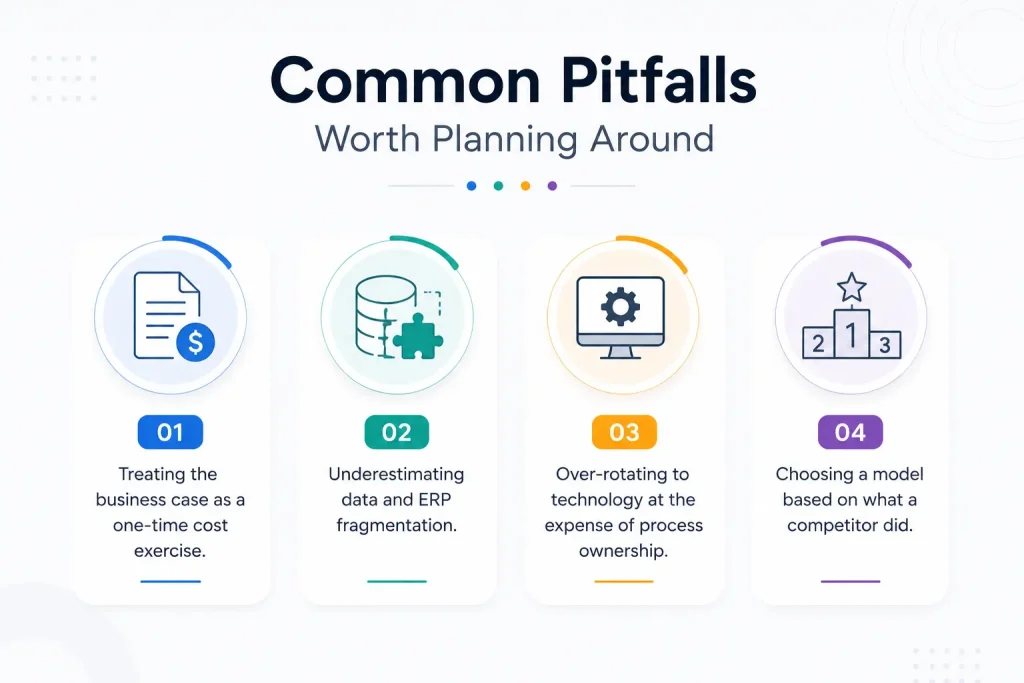
- Treating the business case as a one-time cost exercise. The most defensible business cases model both tangible cost savings and the value of faster close cycles, better forecasting accuracy, and reduced compliance risk.
- Underestimating data and ERP fragmentation. If you’re running multiple ERP instances, transformation often needs a data harmonization phase before centralization delivers its full value.
- Over-rotating to technology at the expense of process ownership. Automation without a clear process owner tends to degrade quietly over 12–18 months as exceptions pile up unmanaged.
- Choosing a model based on what a competitor did, rather than your entity structure, regulatory footprint, and talent market.
How to Know If the Model Is Working: Metrics That Matter
Vanity metrics like “number of processes centralized” tell you activity, not value. The metrics worth tracking against your transformation business case typically include:
- Days to close (monthly and quarterly)
- Cost per transaction, tracked over time — not just at go-live
- First-time-right rate for automated processes
- Business unit satisfaction / SLA adherence
- Percentage of finance headcount in analysis vs. transaction processing roles
- Error and rework rates in close and reconciliation processes
If you’re currently evaluating vendors, technology partners, or an internal build, these are also the metrics worth asking any potential partner to benchmark against—vague promises of “efficiency gains” without a measurement framework are a warning sign.
Where to Go From Here
Shared services transformation is one of the most impactful steps a finance organization can take, but the difference between programs that create lasting value and those that stall after the first wave of savings is almost always due to sequencing, governance, and change management — not the technology choice itself.
If you’re actively comparing models, providers, or technology platforms for your own transformation, it’s worth scoring your plan against the five-lever maturity framework above before you finalize a model decision.
Want to go deeper? Reach out to walk through a maturity scoring session for your finance operating model, or ask us any questions you might have.