






Key Takeaways
- Start with controlled, high-value pilots, but design them with enterprise scale in mind.
- Establish governance, audit, and exception-handling frameworks before expanding scope.
- Invest in infrastructure and orchestration to support distributed, adaptive agents.
- Embrace continuous learning—both for agents and human operators.
- Engage employees early to foster adoption and reduce change resistance.
Enterprise adoption of agentic solutions is no longer a question of “if” but “how fast and effectively.” Organizations have moved past experimentation and are now grappling with the challenge of scaling autonomous AI agents across workflows, departments, and geographies. The transition from a controlled pilot to a full-scale rollout is anything but trivial—technical robustness, governance, organizational readiness, and culture all collide in complex ways. While the promise of agentic automation is enormous—autonomous process execution, dynamic decision-making, and adaptive learning—the path to scale exposes the subtleties often overlooked in proof-of-concept stages.
Also read: Autonomous route‑planning agents using NVIDIA mapping and Azure Maps
From Pilot to Enterprise: Understanding the Chasm
Pilots in agentic deployments are often small, contained, and high-impact experiments. Teams select processes that are well-defined, repetitive, and low-risk. A single intelligent agent might autonomously handle document verification, route approvals, or analyze customer support tickets. Success metrics are clear: speed gains, error reduction, cost savings, and occasionally, user satisfaction scores.
But once you decide to expand beyond the pilot, the simplicity vanishes. Suddenly, interdependencies with legacy systems, cross-department coordination, and governance structures become non-negotiable. Scaling isn’t just a technical exercise—it’s organizational orchestration at a level most IT or automation teams haven’t encountered.
Several patterns emerge from enterprise adoption efforts:
- Unanticipated friction points: Processes that seem trivial in isolation often encounter bottlenecks once integrated with existing ERP, CRM, or ticketing systems. For example, an agent designed to handle invoice approvals may stall when invoice formats vary across geographies—a nuance invisible during pilot trials.
- Governance gaps: Many organizations underestimate the need for agentic oversight. Agents acting autonomously require well-defined guardrails; without them, you risk inconsistent decisions or regulatory non-compliance.
- Change fatigue: Human users who initially welcomed pilot agents can become frustrated when processes scale faster than adoption support, particularly if agents introduce slight behavioral inconsistencies.
- Data readiness issues: Agents rely on accurate, high-quality data. Scaling exposes deficiencies in enterprise data pipelines, from missing attributes to inconsistent formatting across business units.
A crucial takeaway: scaling challenges are as much about human and organizational factors as they are about technology. Failing to acknowledge either guarantees friction.
Strategic Approaches to Enterprise Rollout
Scaling requires deliberate planning. A few proven strategies can smooth the transition from a controlled pilot to a live, enterprise-grade deployment:
1. Phased Expansion Over “Big Bang”
Attempting an enterprise-wide rollout in one sweep rarely succeeds. A phased approach—incrementally adding agents, processes, or business units—allows teams to learn and adjust.
- Vertical scaling: Expand the agent’s scope within a single department before moving laterally. This approach allows tight feedback loops and reduces organizational risk.
- Horizontal scaling: Once confidence grows, deploy across multiple business units or geographies. Consider regulatory variations, local policies, and linguistic differences.
- Parallel monitoring: Maintain oversight on both new and legacy processes to detect integration anomalies.
A cautionary note: some teams misinterpret phased rollout as slow adoption. In reality, speed without stability undermines credibility and ROI.
2. Governance and Oversight as a Core Pillar
Autonomy is seductive but dangerous without guardrails. Enterprise-grade agentic solutions require governance frameworks that are proactive rather than reactive.
- Decision validation: Establish thresholds where agent decisions must be reviewed. Over time, these thresholds can adjust dynamically as trust grows.
- Audit trails: Maintain transparent logs of agent activity, particularly for compliance-sensitive domains like finance, healthcare, or supply chain management.
- Exception management: Design clear escalation paths for edge cases. For instance, if an agent flags a high-value transaction as suspicious, the human override process must be intuitive and swift.
Neglecting governance in the scaling phase often leads to reputational or operational risks that could have been mitigated at the pilot stage.
3. Continuous Learning and Feedback Loops
Agentic solutions thrive on iteration. They are not static programs; they evolve based on feedback, environmental changes, and new data.
- Human-in-the-loop: Ensure humans can guide learning cycles, correcting errors and refining models.
- Metrics-driven adjustments: Track process KPIs such as error rates, processing speed, and user intervention frequency. These metrics should directly inform agent behavior tuning.
- Cross-department insights: Data or behavioral patterns observed in one unit can inform deployment strategies elsewhere, fostering faster adaptation.
Interestingly, some enterprises try to “lock in” agent behavior too early, fearing unpredictability. The paradox: rigid agents scale poorly because they cannot handle the nuances of real-world processes.
4. Infrastructure and Orchestration Considerations
Scaling agentic systems often exposes infrastructure limitations. Unlike traditional RPA bots, intelligent agents may require:
- Distributed processing capabilities: Some agents need real-time access to multiple data streams, which demands robust integration layers.
- Cloud-native deployment: Elastic compute and storage allow scaling without overburdening local systems.
- Orchestration platforms: Centralized orchestration ensures agents across processes can communicate, share context, and avoid conflicts or redundancies.
A practical example comes from a multinational insurance company. Their pilot agent automated claims triage successfully in one region. Scaling globally required re-architecting workflows to support 50+ parallel agents, including a centralized orchestration layer and AI model versioning controls—an investment they hadn’t anticipated during the pilot.
5. Organizational Alignment and Change Management
Agents touch human workflows, so scaling isn’t purely technical. Neglecting organizational readiness invites resistance.
- Communication and expectation setting: Teams need clarity on agent capabilities, limits, and how success will be measured.
- Training programs: Employees must know how to interact with agents, resolve exceptions, and report anomalies.
- Cultural considerations: In some environments, fear of replacement can inhibit adoption. Position agents as augmentation rather than substitution.
Case in point: a global manufacturing firm struggled when its procurement automation agents were rolled out without proper employee engagement. Initial resistance slowed adoption, despite clear efficiency gains. A midstream change management initiative—clarifying roles, providing hands-on agent simulations, and highlighting productivity wins—dramatically improved engagement.
6. Risk Management and Compliance
Scaling agents amplifies risk exposure. Autonomous decision-making can collide with regulatory or internal compliance requirements.
- Privacy safeguards: Ensure sensitive data handled by agents aligns with GDPR, HIPAA, or equivalent standards.
- Operational risk assessment: Model worst-case scenarios, including agent errors, downtime, or unintended decision loops.
- Regular audits: Conduct periodic audits to verify that agents continue to act within defined parameters.
Interestingly, risk-conscious enterprises often over-engineer controls, slowing agent effectiveness. The sweet spot balances compliance and agility.
Practical Considerations: Lessons from Real Deployments
A few recurring insights surface from organizations that have successfully scaled agentic solutions
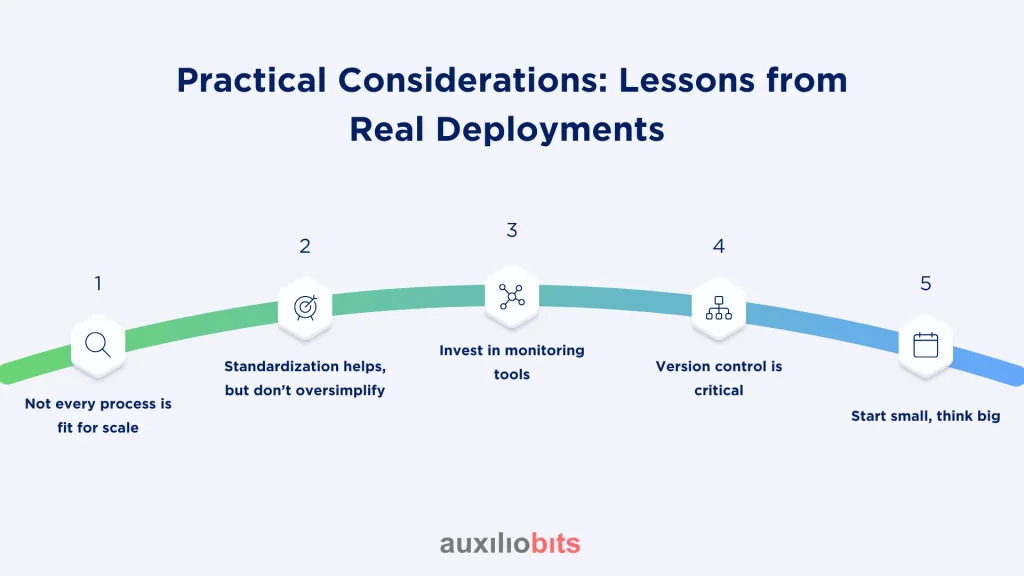
- Not every process is fit for scale: Agents excel where decision parameters are clear but can falter in processes requiring deep tacit judgment.
- Standardization helps, but don’t oversimplify: Uniform process templates accelerate rollout, but ignoring local variations can create operational bottlenecks.
- Invest in monitoring tools: Dashboards, anomaly alerts, and KPI trackers become indispensable once agents operate at scale.
- Version control is critical: Enterprise agents continuously evolve. Ensuring that model and policy versions align across locations prevents inconsistent behavior.
- Start small, think big: Initial pilots should have enterprise expansion in mind—architecture, governance, and infrastructure should not be temporary fixes.
Common Pitfalls in Scaling Agentic Solutions
Scaling isn’t just about doing more of what worked in the pilot. Some traps are worth highlighting:
- Assuming a “set-and-forget” mentality: Autonomous agents need ongoing tuning. Neglecting this leads to drift, errors, and lost trust.
- Underestimating integration complexity: Agents rarely exist in isolation; connecting them to ERPs, CRM systems, or analytics platforms can expose hidden dependencies.
- Ignoring human factors: Agents that alienate employees or disrupt workflows are eventually bypassed.
- Overlooking latency and performance: What works with 50 transactions per day may fail under 5,000 daily transactions.
- Neglecting cross-agent orchestration: Multiple agents operating independently may duplicate work or produce conflicting decisions without proper coordination.
Conclusion
Scaling agentic solutions from a controlled pilot to an enterprise-wide deployment is a multidimensional challenge. Success hinges not just on sophisticated algorithms or robust infrastructure, but equally on governance, organizational readiness, and human engagement. Enterprises that treat scaling as a deliberate, phased, and metrics-driven process—rather than a “big bang” rollout—are far more likely to realize the transformative potential of autonomous agents.
Key lessons emerge from real-world deployments: invest in oversight frameworks, maintain continuous learning loops, ensure infrastructure can handle distributed and high-volume operations, and foster cultural acceptance through clear communication and training. Ignoring any of these dimensions invites friction, operational risk, and diminished ROI.
Ultimately, agentic solutions thrive where technology and organization evolve together. Enterprises that plan for scale from the outset, align processes and people, and embrace iterative learning are positioned not just to expand automation but to unlock the full promise of adaptive, intelligent, and enterprise-grade autonomy. Scaling isn’t the end—it’s the beginning of a smarter, more resilient, and highly responsive enterprise.