







Key Takeaways
- Automation curbs compliance failures, strengthens audit trails, and prevents many low-level errors.
- New risks arise: systemic errors, outdated scripts, and over-reliance on digital logs.
- Strong governance—immutability of records, rapid change management, and exception handling—is non-negotiable.
- Framing automation as employee protection, not cost-cutting, reduces resistance and cultural risk.
- The ultimate value isn’t zero risk, but risk that regulators find acceptable and organizations can correct quickly.
If you’ve ever spent time inside a bank, a hospital, or a pharmaceutical plant, you know that the word “risk” isn’t just a line item on a dashboard. It’s a daily preoccupation. The compliance officer worries about tomorrow’s audit. The operations manager worries about a missed step that might halt production. And leadership? They’re quietly calculating the reputational damage if a regulator finds fault.
In these settings, automation is often misunderstood. It’s not only about speed or headcount savings. When applied carefully, it’s about lowering exposure—reducing the odds of a compliance slip, a regulatory fine, or a preventable error that could snowball. But let’s be clear: automation doesn’t make risk disappear. It shifts it, sometimes in ways that surprise even experienced teams.
Also read: How to Prioritize Processes for Automation: A Value-to-Effort Model
The Shape of Risk in Heavily Regulated Domains
Industries like finance, healthcare, and energy don’t operate on trust alone. They operate under rulebooks enforced by regulators who are not known for their patience.
- In finance, a small oversight in anti-money laundering (AML) monitoring can result in fines measured not in thousands but in hundreds of millions.
- In healthcare, a single incorrect code on a claim can be interpreted as fraud. Even if it was human error, the liability stands.
- In pharma manufacturing, a skipped entry in a batch record could trigger a product recall, costing more than the entire production run.
In less regulated markets, mistakes are annoyances. In these industries, mistakes can become scandals. That’s why precision and auditability matter as much as speed.
Where Automation Creates Real Risk Relief
Automation, when set up well, reduces three categories of risk that regulators watch most closely:
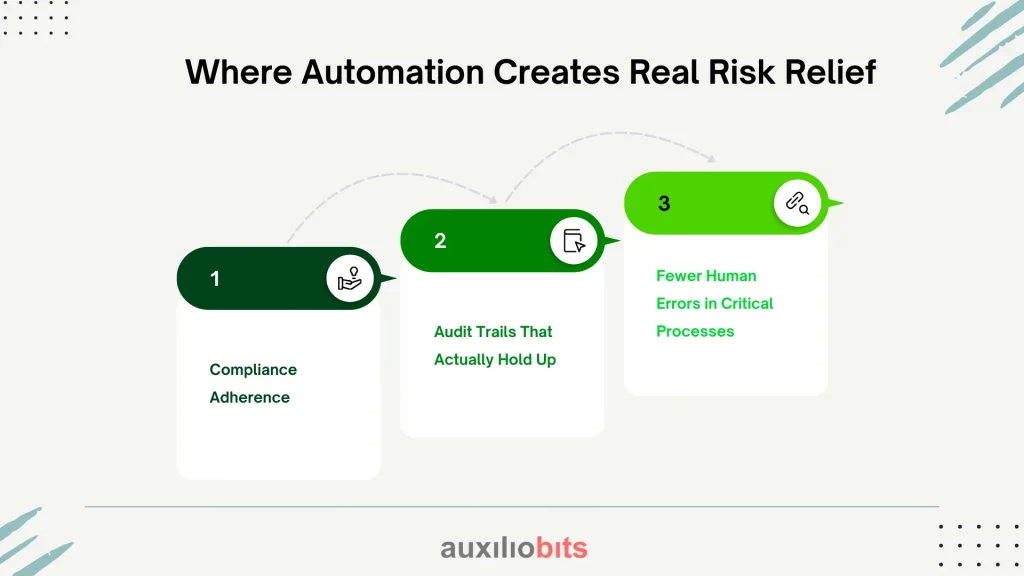
1. Compliance Adherence
The first risk is simple non-compliance—rules ignored or missed. Automated workflows force standardization. They don’t let a step get skipped because “the team was busy.”
- In healthcare claims, automation can check every submission against payer rules before it leaves the system, dramatically cutting rejections.
- In pharmaceutical labs, automation captures every test result with timestamps and operator IDs, making “missing documentation” nearly impossible.
Human discretion is valuable in decision-making, but a liability in repetitive checks. Automation narrows that variance.
2. Audit Trails That Actually Hold Up
Regulators rarely take a company’s word for it. They want records. Automated systems naturally generate those records, often with more detail than a human could keep.
A bank’s RPA program for client onboarding didn’t win praise because it sped up onboarding. It won praise because every sanction-screening check was logged with precision—who (or which bot) ran it, when, and against which database. When regulators asked, the bank produced evidence without delay.
3. Fewer Human Errors in Critical Processes
People mistype. They misread. They get tired. Automation removes many of these low-level risks.
- Pharma GMP environments: automation enforces the sequence of steps. You can’t accidentally sign step 7 before step 6.
- Insurance underwriting: automated consistency checks prevent policies from being issued without required documents.
t’s not that bots are perfect; it’s that their mistakes are predictable and fixable in ways human lapses aren’t.
The Trade-Offs Automation Brings
Here’s the contradiction: the very thing that reduces risk can create new exposure.
- Mass replication of errors: If a bot’s rule is wrong, it won’t make one mistake—it will make ten thousand, identically.
- Over-reliance on logs: Digital audit trails are great, but regulators sometimes doubt their integrity. If logs can be altered, they’re worse than paper.
- Slow adaptation: Regulations evolve constantly. If automation scripts aren’t updated in lockstep, compliance drifts quietly out of date.
This is why automation cannot be a “set it and forget it” exercise. The risk profile shifts—from human fallibility to governance and oversight gaps.
Case Example: Pharmaceutical Manufacturing
One mid-sized pharma company illustrates both the benefit and the trade-off. Before automation, operators recorded batch steps on paper, and quality teams checked them afterward. Deviations were often discovered too late, forcing entire production lots to be scrapped.
After moving to digital automation:
- Every step was captured in real time.
- Deviations triggered instant alerts.
- Inspectors could review clean, searchable logs rather than boxes of paper.
The result? FDA inspection findings dropped by nearly half. But a new issue emerged: when recipes needed mid-batch adjustments, the system couldn’t accommodate them quickly. Production stopped while IT reconfigured workflows. Risk shifted—from hidden compliance lapses to operational rigidity. The trade-off still favored automation, because regulators valued transparency over flexibility, but the lesson was clear: design matters.
Risk Profiles by Sector
Each regulated industry faces its own flavor of risk. Automation interacts with those risks differently:
- Financial services → Primary risk: missing a fraud or AML flag. Automation helps by enforcing checks, but models must avoid bias. Regulators now demand proof that automated screening doesn’t discriminate.
- Healthcare → Risk centers on patient safety and privacy. Automation of claims and eligibility cuts errors, but clinicians remain cautious about relying on opaque systems for patient care.
- Energy/utilities → Safety logs and inspections are prime candidates for automation. But the more automated the control systems, the more attractive they become to cyber attackers.
What reduces one risk category can heighten another. Practitioners must decide which risk they’re more comfortable holding.
Field Lessons: What Seasoned Teams Get Right
Veterans of automation in these industries share a few hard-won lessons:
- Don’t automate judgment calls. Regulators can accept a human being “wrong but documented.” They distrust a black-box algorithm making opaque decisions.
- Logs must be immutable. If an audit trail can be altered, it’s a liability. Immutable storage—blockchain, WORM drives—adds credibility.
- Change management is part of compliance. Every time a regulation shifts, automation logic must change too. Lag creates silent exposure.
- Always design for exceptions. Bots fail. Networks go down. Without a manual fallback, you risk trading one failure mode for another.
The Role of Framing Inside Organizations
How automation is positioned internally makes a difference. If staff believe automation is just about cutting jobs, resistance rises, and “shadow processes” appear—unofficial workarounds that create hidden compliance risks.
When leaders present automation as protection, adoption is smoother. Analysts and operators appreciate that automation reduces the chance they’ll personally be blamed for a miss. In one bank, KYC teams actively requested more automation because it relieved them of responsibility for screening errors. Framing shifted automation from a threat to a shield.
Control Versus Flexibility
Regulators prize consistency; businesses need adaptability. Automation hardens processes, which makes compliance teams happy but frustrates operators when exceptions occur. The art lies in designing layers:
- Rigid automation: For tasks with zero tolerance—sanction screening, digital signature validation, and mandatory documentation.
- Configurable automation: For rules that shift frequently—new healthcare codes, financial reporting templates. Here, giving business users the ability to update logic directly reduces lag.
A one-size-fits-all automation approach never works. The balance must be calibrated process by process.
A Less Obvious Payoff
There’s a form of risk often overlooked in boardroom charts: cultural fragility. In tightly regulated industries, employees live under pressure. A single slip can bring career-ending blame. Automation reduces that burden.
A compliance officer in a pharmaceutical firm once remarked, “Before automation, my team lived in fear of missing a line in a logbook. Now they can focus on analysis instead of obsessing over handwriting.” The cultural relief was as valuable as the regulatory benefit. Less fear, less attrition, fewer whistleblower headaches.
Automation as Risk Shaping, Not Risk Erasing
It’s tempting to believe automation builds a zero-risk environment. It doesn’t. Risk doesn’t vanish; it changes form. Regulators tend to prefer predictable, systemic errors with clear trails over unpredictable human lapses. Why? Systemic issues can be fixed at once, while human inconsistency has no universal remedy.
So, automation does reduce risk—but more precisely, it reshapes it into something auditable and manageable. For most industries under regulatory scrutiny, that’s a trade worth making.
Closing Thoughts
Risk in regulated industries has always been a moving target. Automation doesn’t magically solve that problem—it reshapes it into something more predictable, auditable, and in many cases, easier to defend. A misconfigured bot can cause havoc, yes, but regulators generally prefer a transparent, systemic error that can be corrected across the board to the messy, inconsistent mistakes humans make under pressure.
What separates successful organizations from the rest isn’t the tools they buy, but how seriously they treat governance, exception handling, and cultural framing. Automation positioned as a compliance safety net is embraced; automation pitched as a headcount reducer is quietly undermined. The difference matters.
In the end, the companies that get this right don’t reduce risk to zero—that’s impossible—but they transform risk into a form they can live with, one regulators can trust, and one that employees can work under without fear. And in industries where a single error can snowball into regulatory scrutiny, reputational damage, or even public harm, that shift is not just valuable—it’s essential.