





Key Takeaways
- Cycle time improves not because tasks are faster, but because waiting and rework shrink. Agentic AI removes silent delays, not just manual steps.
- Cost leakage drops when intervention happens before decisions—not during audits. Timing matters more than control strength.
- Compliance improves most when systems explain risk instead of enforcing rules blindly. Guidance beats rejection in real procurement environments.
- The biggest KPI gains often come from reduced variability, not better averages. Fewer extremes matter more than marginal speed-ups.
- Agentic AI works best where judgment is frequent, not where processes are already rigid. It’s a decision amplifier, not a transaction engine.
Procurement KPIs have a funny way of behaving. Everyone tracks them. Few people trust them. And even fewer believe automation will improve the ones that matter without creating new problems elsewhere.
That skepticism is earned.
For years, procurement teams automated tasks—PO creation, vendor onboarding steps, three-way matching—and then wondered why cycle times still drifted, leakage persisted, and compliance audits continued to be painful. The dashboards looked better. The lived experience didn’t.
Agentic AI changes that dynamic—but not because it’s “smarter.” It changes things because it alters how work gets coordinated, decisions get revisited, and exceptions get handled without waiting for humans to notice them first.
This isn’t about replacing buyers or category managers. It’s about changing the mechanics behind the KPIs they’re held accountable for.Let’s talk about the three procurement metrics that consistently move when agentic systems are introduced—and just as importantly, why they move, where they don’t, and where teams sometimes fool themselves.
Also read: Agent-Driven RFP Analysis and Proposal Generation in Procurement
Cycle Time: From Linear Waiting to Continuous Motion
Why procurement cycle time is stubborn
Procurement cycle time isn’t slow because people are slow. It’s slow because work queues are invisible.
A requisition doesn’t wait because no one wants to approve it. It waits because:
- The approver didn’t know it was urgent.
- The data was incomplete, but nobody flagged it.
- A policy exception was needed, and no one wanted to be wrong.
- A supplier clarification email went unanswered for three days.
Traditional automation shaves minutes off steps. It doesn’t compress the waiting between them.
Agentic AI does something more subtle: it collapses decision latency.
What changes with agentic systems
In environments where agentic AI is deployed, cycle time improvements usually show up in unexpected places—not at the front end, but mid-process.
Examples seen repeatedly:
- Requisitions don’t stall silently. An agent notices inactivity patterns and escalates contextually, not mechanically.
- Approval routing adapts. If a manager is out, the system doesn’t just wait; it reasons about alternates within policy.
- Data gaps get resolved earlier. Instead of rejecting a requisition at approval, an agent prompts the requester upstream—sometimes before submission.
KPIs that actually move
You’ll see improvements in:
- PR-to-PO cycle time
- Exception resolution time
- Requisition rework rate
You won’t always see:
- Perfect straight-line reductions month over month
- Immediate gains in heavily regulated categories (those lag)
That’s normal. Cycle time improves unevenly because agentic systems learn where friction lives. Early gains often come from mundane categories first—MRO, indirect spend, tail suppliers.
A nuance most dashboards miss
Cycle time compression sometimes increases workload perception initially.
Why? Because delays become visible. Bottlenecks surface. People feel busier even as throughput improves. Teams that mistake this for failure often roll back the very behaviors driving improvement.
Cost Leakage: The KPI Everyone Talks About, Few Control
Cost leakage is procurement’s most uncomfortable metric. It’s rarely owned outright, yet everyone is blamed for it.
And it hides everywhere:
- Contracted prices not applied
- Volume tiers missed
- Maverick spend rationalized as “urgent”
- Discounts lost because timing slipped
Traditional controls rely on after-the-fact detection. By the time leakage is reported, it’s already baked into financials.
Agentic AI works differently—by intervening during decisions, not after transactions.
How agentic AI reduces leakage in practice
Agentic systems continuously reconcile intent with execution.
That sounds abstract. It’s not.
Concrete examples:
- An agent compares a requisition against active contracts in real time—not just matching SKUs, but reasoning about functional equivalence.
- When volume commitments are at risk, agents surface warnings early, not at quarter close.
- Off-contract purchases trigger contextual nudges: “This supplier is 7% higher than contracted alternatives. Is there a justification?”
Importantly, these aren’t hard stops. Hard stops create workarounds. Soft, reasoned interventions change behavior.
KPIs that show meaningful movement
Organizations typically see:
- Off-contract spend reduction
- Price variance shrinkage
- Captured vs. negotiated savings gap narrowing
One global manufacturer reduced tail-spend leakage by ~18% without introducing new approval layers. The difference wasn’t enforcement. It was timing.
The agent intervened before the buyer clicked submit, not during audit.
Where cost leakage doesn’t improve
Agentic AI won’t magically fix:
- Poorly negotiated contracts
- Unrealistic volume commitments
- Supplier markets with extreme volatility
In those cases, leakage is structural, not operational. Automation can highlight it, but not eliminate it.
Teams sometimes blame the system when the real issue is commercial strategy.
When leakage KPIs improve, procurement often gets more scrutiny, not less.
Why? Because finance starts trusting the numbers.
Be careful what you wish for.
Compliance: Fewer Violations, Better Behavior
Compliance metrics are deceptive. Low violation counts don’t always mean good compliance. They often mean low detection.
Traditional procurement compliance relies on:
- Static rules
- Retrospective audits
- Training refreshers no one remembers
Agentic AI shifts compliance from policing to guidance.
What actually changes
Instead of enforcing policy through rejection, agentic systems:
- Interpret policy contextually
- Apply nuance based on category, supplier, and risk
- Adapt guidance based on past outcomes
For example:
- A deviation from preferred supplier might be acceptable in one geography but risky in another.
- A contract clause exception might be tolerable under $10K but not above.
- A missing document may be benign in one workflow, critical in another.
Agents reason about this continuously. Humans don’t have the cognitive bandwidth to.
Compliance KPIs that improve
You’ll typically see movement in:
- Policy deviation rate
- Audit findings per cycle
- Time to remediate non-compliance
Interestingly, compliance cost sometimes drops even as scrutiny increases. Fewer escalations. Fewer emergency approvals. Less legal back-and-forth.
Where compliance automation backfires
When agentic systems are configured as rigid enforcers, adoption suffers.
Buyers learn to game inputs. Exceptions explode. Shadow processes reappear.
Compliance improves only when the system explains why something is risky, not just that it violates policy.
That’s a design choice, not a technology limitation.
Why These KPIs Improve Together
Cycle time, cost leakage, and compliance are usually treated as trade-offs.
- Faster cycles risk compliance.
- Tighter controls slow everything down.
- Cost focus irritates suppliers and users.
Agentic AI doesn’t eliminate these tensions. It manages them dynamically.
By reasoning across signals—urgency, risk, value—the system can:
- Allow speed where risk is low
- Apply friction where impact is high
- Escalate only when human judgment adds value
That’s why these KPIs often improve together instead of cannibalizing each other.
But it only works when procurement leaders accept a hard truth: you can’t pre-define every rule upfront. Some control has to be adaptive.
Practical Signals That Your KPIs Are Ready for Agentic AI
Not every procurement function benefits equally at the same time. The following conditions tend to predict success:
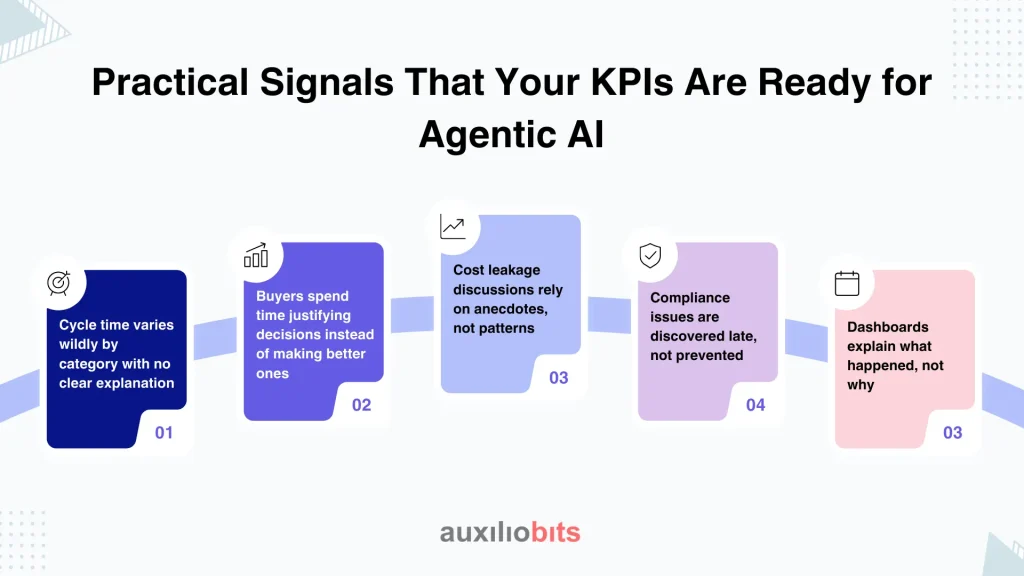
- Cycle time varies wildly by category with no clear explanation
- Cost leakage discussions rely on anecdotes, not patterns
- Compliance issues are discovered late, not prevented
- Buyers spend time justifying decisions instead of making better ones
- Dashboards explain what happened, not why
If those sound familiar, agentic systems usually move the needle.
If your problems are purely transactional—missing fields, manual uploads—basic automation may still be enough.
A Note on Measurement
When agentic AI is introduced, many teams rush to prove ROI within 90 days. They focus narrowly on averages.
That’s a mistake.
The real signal lies in:
- Variance reduction
- Fewer extreme outliers
- More predictable throughput
- Earlier detection of problems that used to surface late
Procurement doesn’t need perfect speed. It needs reliable flow.
Agentic systems excel at that, even if the headline KPI improvements look modest at first.
Closing Thought
Procurement KPIs don’t improve because AI is intelligent. They improve because attention shifts—from monitoring transactions to shaping decisions.
Agentic AI doesn’t replace procurement judgment. It redistributes it—away from firefighting and toward intent.
And once that happens, cycle time shrinks, leakage tightens, and compliance becomes less adversarial.
Not overnight. Not magically. But measurably.
And for most procurement leaders, that’s the difference between another automation initiative—and one that actually changes how the function operates.