





Key Takeaways
- Procurement automation in shared services is often limited by inconsistent processes and governance rather than technology. Consolidating procurement activities without standardizing workflows simply centralizes inefficiencies.
- Shared services centers commonly encounter four automation failure modes—Ticket Multiplication, Local Override Syndrome, Single-Instance Illusion, and SLA Theater—which prevent organizations from realizing the full value of automation.
- Selecting the right operating model is critical. While centralized and federated approaches have advantages, a well-governed hybrid model typically delivers the best balance between standardization, flexibility, and scalability.
- Successful procurement automation depends on strong governance, including standardized approval workflows, centralized vendor master management, automated exception handling, and consistent system configuration across business units.
- Organizations achieve the greatest return on investment when they standardize procurement processes before automating them. Automation built on inconsistent workflows accelerates existing inefficiencies instead of eliminating them.
Most shared services centers (SSCs) didn’t get a procurement automation problem — they got a procurement consolidation problem, then mistook it for automation. Business units were folded into a single center, transactions were routed through one queue, and a dashboard somewhere started reporting a lower headcount-to-invoice ratio. On paper, that looks like progress.
In practice, many SSC leaders running procurement automation initiatives find that ticket volume didn’t shrink — it just moved. Approval delays didn’t disappear — they got renamed as “pending business unit response”. The center got bigger, busier, and pricier to run, while the thing automation was supposed to deliver — fewer manual touches per transaction — never showed up in the numbers that matter.
This isn’t a tooling failure. It’s a structural one. Shared services environments carry a layer of complexity that single-entity procurement automation never has to deal with: multiple business units, multiple chart-of-accounts structures, multiple approval hierarchies, and sometimes multiple ERPs bolted together under one “global” label. Automating procurement in that environment requires a different diagnostic lens than the standard P2P automation playbook — and that’s what this post is built around.
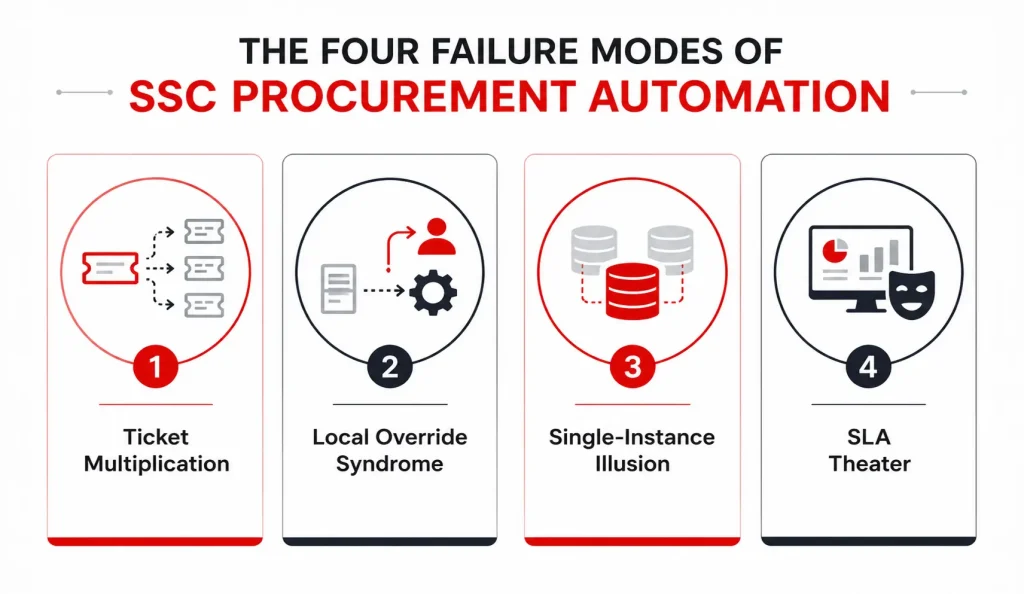
The Four Failure Modes of SSC Procurement Automation
Before evaluating any automation initiative, it helps to know what failure actually looks like from the inside. In our work with shared services teams, the same four patterns show up again and again.
1. Ticket Multiplication
The SSC centralizes intake, but every business unit keeps its own exceptions, approval quirks, and “special handling” rules. Instead of one standardized procurement automation flow, the center ends up maintaining a dozen near-identical variants — each requiring a human to remember which BU does what. Volume looks centralized; effort isn’t.
2. Local Override Syndrome
Business units route around the automated process whenever it’s inconvenient—emailing a regional buyer directly, approving a PO outside the system, or maintaining a shadow spreadsheet for “urgent” purchases. The automation exists, but it only governs the transactions that choose to use it. Maverick spend doesn’t go away in a shared services model; it just becomes harder to see, because everyone assumes centralization already solved it.
3. Single-Instance Illusion
Leadership points to “one ERP instance” as proof of standardization. But a single instance with twelve sets of custom approval workflows, fifteen vendor master conventions, and inconsistent catalog taxonomies isn’t standardized — it’s centrally hosted chaos. Procurement automation built on top of that inherited variance automates the inconsistency, not the process.
4. SLA Theater
The SSC hits its service-level targets, but only because the SLA was defined narrowly enough to hit. “Invoice processed within 24 hours of receipt” looks great until you notice the clock doesn’t start until the invoice clears a three-day exception queue first. The metric improves; the business experience doesn’t.
None of these are visible in a standard automation vendor’s demo. They only surface once procurement automation is running against the real organizational structure of a shared services center — which is exactly why so many SSC automation initiatives plateau at “better than manual” instead of reaching “actually automated”.
Centralized, Federated, or Hybrid: Choosing the Right Automation Model
Before selecting tools, SSC leaders need to decide what kind of governance model the automation is meant to enforce. This decision shapes everything downstream — workflow design, exception handling, even how vendor master data gets maintained.
| Model | How it works | Best fit | Primary risk |
| Centralized | One global process, one rule set, minimal business-unit customization | Organizations with similar BU structures, low regulatory variance across regions | Local compliance gaps; BU pushback and shadow processes |
| Federated | Each BU maintains its own process; SSC provides shared infrastructure and reporting only | Highly regulated, multi-country operations with genuinely different legal requirements | Automation gains stay shallow — each BU still manually configures and maintains its own logic |
| Hybrid | Core process (intake, approvals routing logic, vendor master) is centralized; defined fields are configurable per BU within guardrails | Most mature SSCs with 3+ business units and moderate regulatory variance | Requires upfront governance discipline; without it, defaults back to Federated in practice |
Most shared services organizations default into a Federated model by accident — not because anyone chose it, but because no one was willing to force standardization during the consolidation phase. Hybrid is where the true return on investment for procurement automation exists, but it only works if someone owns the guardrails.
Where Does Your SSC Actually Stand? A Self-Diagnostic
Use this scorecard honestly, not aspirationally. Score each dimension based on what’s actually happening today, not what the original implementation plan intended.
| Dimension | Lagging | Average | Leading |
| Process standardization | Each BU follows its own approval logic; SSC just routes tickets | Core workflow is shared; BUs have informal local exceptions | One workflow engine with documented, governed configuration per BU |
| Vendor master governance | Duplicate vendors across BUs; no single source of truth | Vendor master is centralized but cleanup is reactive | Automated deduplication, validation, and onboarding workflows |
| Exception & tier design | Every exception escalates to a human; no tiering logic | Basic L1/L2 tiering exists but thresholds are inconsistent | Clear tiered escalation with automated routing rules by exception type |
| System architecture | Multiple disconnected systems across BUs | Single ERP instance, inconsistent configuration | Single instance with governed, standardized configuration |
| Change management | BUs were told to comply; adoption is inconsistent | BUs were consulted; adoption varies by leadership buy-in | BUs co-own the standard; deviations require formal exception approval |
If most of your scores land in “Average”, that’s not a failure — it’s the most common resting point for SSCs that centralized intake before they standardized the process. The gap between Average and Leading is almost always governance, not technology.
A Transparent Look at the ROI Math
Procurement automation vendors love to lead with aggregate savings percentages. Those numbers are usually real for someone, but rarely transferable to your specific SSC structure. Here’s a more honest, illustrative example — adjust the inputs to your own volumes before trusting any conclusion.
Illustrative scenario: An SSC supporting 4 business units, processing 12,000 purchase requisitions and 18,000 invoices monthly.
- Before automation: Average manual touch time per requisition is 14 minutes; per invoice, 9 minutes (including exception handling). At a fully loaded cost of ₹650/hour for SSC staff, this amounts to roughly ₹18.2 lakh/month for requisition handling and ₹17.6 lakh/month for invoice handling — about ₹35.8 lakh/month combined.
- After automation (Hybrid model, governed standardization): Touch time drops to 4 minutes for clean requisitions and 2.5 minutes for invoices that don’t trigger an exception — assuming 70% of volume becomes “touchless”. The remaining 30% still requires manual handling, often at higher per-unit cost because it’s now concentrated exception work.
- Net effect: Combined monthly cost typically falls to the ₹14–16 lakh range, not because every transaction got cheaper, but because volume shifted away from manual entirely for the majority of clean transactions.
This conclusion only holds if standardization (the scorecard above) is in place before automation goes live. Automating a Federated, inconsistent process produces a much smaller — sometimes negligible — version of this saving, because the 70% touchless rate depends entirely on how standardized the underlying workflow is
What This Means for Your Next Step
Procurement automation in a shared services context isn’t primarily a software selection problem. It’s a sequencing problem: standardize the process across business units first, choose a governance model deliberately, then automate against rules that are actually consistent. Centers that automate before they standardize end up with faster versions of the same four failure modes — Ticket Multiplication, Local Override Syndrome, Single-Instance Illusion, and SLA theatre — just running at higher speed.
If you’re evaluating where your SSC sits on the maturity scorecard above or want to map your current Federated/Centralized/Hybrid posture against what a Hybrid model would realistically require, that’s usually the most productive next conversation to have before any vendor demo.